More than 20 years ago, I wrote a memoir that flapped its hardcover wings and flew off the shelves, only to nest in the remainder bin of literature. In public I gamely accepted its anemic reception, but privately I fumed: How could the world miss that this coming-of-age story of a Long Island Irish Catholic Copperfield had it all, except sex? No sex.
Having written several books since then, I now accept that royalties are not meant for peasants like me. Many authors, perhaps most, share that resignation.
But wait. What’s this? An email from Joel, the organizer of a literary nonfiction book club who had “recently revisited” my memoir, “Pull Me Up” — and really, really, liked it! Citing specific themes that struck a chord, Joel said that if I could use some “complimentary” help in presenting my out-of-print book to a broader audience, he’d be more than happy to share his thoughts.
I was flattered, but confused. Joel’s effusive note was just one of dozens I was suddenly receiving about my books from various corners of publishing, all reaching out to commiserate on my underappreciated literary genius and to offer their services. Either I had finally been recognized as the Proust of my generation, or this frenzied attention was part of some insistent scam.
Guess which one.
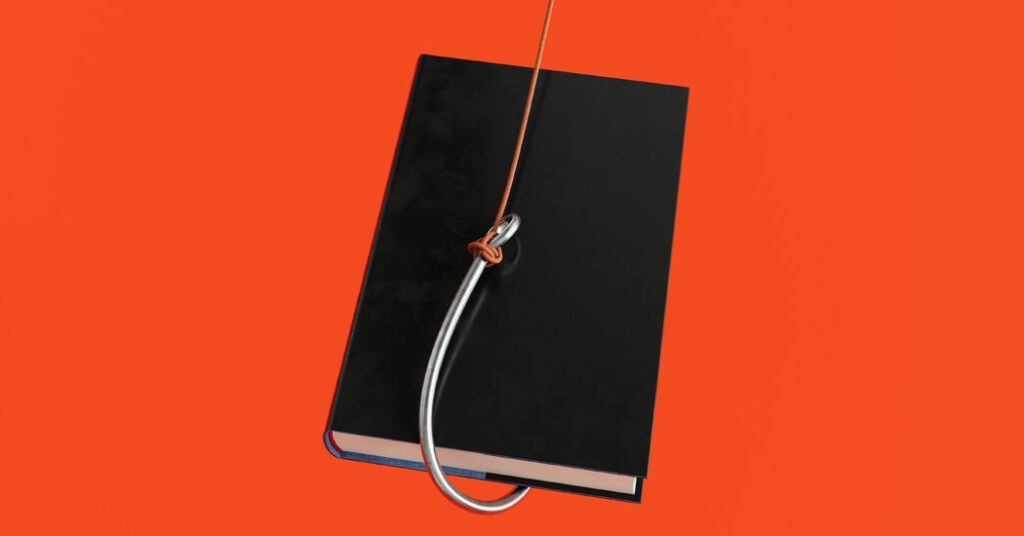
It turns out that the fawning emails I’ve been receiving are mere specks in a virtual mudslide of fraud descending upon the publishing world. Scam artists overseas, using artificial intelligence, are impersonating publishing figures on illegitimate websites and in flattering emails, to hoodwink both fledgling and established authors into paying fees for services never to be rendered.
The literary chorus sounding the alarm includes the novelists George Saunders, Rebecca Makkai and Colson Whitehead; the Authors Guild and Bomb magazine; numerous book agents and publishing houses; and, quite recently, the National Book Foundation.
Last month an author notified the foundation that she had paid a substantial fee for marketing and proofreading to a Jonathan Smith, who was associated with the website nationalbookfoundation.com. But the site is a misdirection; the actual foundation (at nationalbook.org) offers no such services and has no employee named Jonathan Smith.
“I have no idea how many writers have been taken in by this,” said Ruth Dickey, the foundation’s executive director. She recently sent a cease-and-desist letter that began with the salutation: “Dear Jonathan (if that is your actual name).”
Many of these flimflammers specialize in the long game. The initial, A.I.-polished correspondence draws in the mark with gushing praise peppered with details culled from online blurbs and reviews, conjuring the illusion that the scammer has actually read the book at hand.
Then, when you’ve been suckered in by their kind offer of help, they reveal the small matter of a fee. But when you inquire about services you paid for but never received, your new best friend Joel, or Lucas, or Elsie, or Dave, or Sara, or Linda — I have many new best friends — will school you in the art of ghosting.
The publishing industry has seen its share of cons over the centuries. Fabricated memoirs, bogus contests, manuscripts both “discovered” and pilfered. Fall for the book-fair scam and you’ll pay a hefty fee to have your work promoted at a trade show with global influence, only to have a single copy placed on a table with dozens of other volumes.
But this relentless wave of A.I.-generated impersonations presents a much broader level of grift, according to Victoria Strauss, an author who back in 1998 co-founded Writer Beware, a watchdog group sponsored by the Science Fiction and Fantasy Writers Association. She said the current swirl of swindles has created “the worst environment for writing and publishing scams that I’ve ever seen.”
Strauss said that one rip-off, which she traces to the Philippines, targets self-published writers by offering to republish a book and then draining the author’s resources with bogus “re-licensing” fees and “book return insurance.”
Another so-called “pig-butchering” scam, which she believes originates from Pakistan, will have swindlers posing online as self-publishing service providers who zero in on first-time authors; this appears related to the fakeout perpetrated on the woman who thought she was dealing with the National Book Foundation.
The most recent literary sting, the one that has honored me with its attention, apparently comes from Nigeria and employs several approaches. They include the literary marketer who will raise your profile; the private reading community that will produce positive reviews (for $20 each); the book club pining for you to lead an online discussion; and the famous author who wants to bond over writing before recommending an agent or marketer to help you receive the audience you justly deserve.
I’ve received lovely, fraudulent notes from several celebrated authors, including Margaret Atwood, who was looking to connect — a tip-off to a scam if there ever was one. When I informed the actual Margaret Atwood by email that she was being impersonated, her agent, Karolina Sutton, wrote back to say that they were aware of the proliferation of these hustles and were helping to spread the word industrywide.
Atwood responded as well. “Oh this is so terrible and mean,” she wrote, “preying on people’s hunger for success and/or their hope to improve their writing.”
The scammers use A.I. to generate personalized, well-written emails. They often impersonate actual people, from a HarperCollins editor in London to a book-club organizer in Manhattan. And they are very, very patient.
“They invest a lot of words in buttering up the writer and trying to soothe any doubts,” Strauss said. “The theory is that the deeper you get, the harder it is to say no.”
But there is one other element that seems essential to these scams: the victim’s vulnerability. A lonely heart yearns for love and companionship; an author yearns for sales and validation.
“It’s all based on exploiting human frailty,” Strauss said.
Many publishers, literary agencies and writers’ associations have issued warnings to beware. Wibke Grutjen, a senior vice president at Simon & Schuster, wrote in an email that the publishing house has even set up a “dedicated fraud inbox” to monitor reports of deception.
“When we’re made aware of a bad actor mimicking our company name, we issue takedown notices,” Grutjen wrote. “And in instances of a bad actor impersonating an employee, we can submit complaints to the platform at issue.”
But, she added: “It’s very much a game of Whac-a-Mole, as scammers frequently appear under new names or accounts.”
Barry Harbaugh, a literary agent with WLA Books, said that his client Ben Markovits, whose recent novel “The Rest of Our Lives” was shortlisted for the Booker Prize, received a fan letter from someone claiming to be the novelist Ottessa Moshfegh. Out of curiosity he wrote back, but quickly realized it was an impostor when he received an awkwardly worded reply that seemed intent on maintaining the correspondence.
Later that day Markovits received another fan letter written in essentially the same style and format, Harbaugh said. This one was from “Thomas Pynchon.”
I tested the murky waters. The supposed organizer of a large book club recently wrote to thank me — thank me! — for “City Lights: Stories About New York,” my 2007 collection of columns for The New York Times. She cited specific details from several pieces and said she would be honored to feature the book with her group’s 2,300 members.
“Looking forward to hearing from you. Best regards, Chazzy.”
“Please tell me more,” I wrote back.
My new best friend Chazzy responded that prior to my appearance, the club’s members would “fully immerse themselves in your book and reflect on its themes, storytelling, and emotional nuances” — as if it were the next “Ulysses.”
“To facilitate this experience, there is a participation fee of $170,” she noted, for which she’d be happy to send the details on how I could pay right away.
The scams are not always this polished. A cursory check of a name or address will often reveal no there there. Other telltale tips can slip past the A.I. mask; for example, that fraudulent National Book Foundation website offering proofreading services included the encouragement to “Unlock You Literary Succes Today.”
Perhaps the biggest flaw is the sheer relentlessness of the emails. The bombardment betrays the lie.
Then again, scams like this continue to find success because humans continue to be human. All you need are a few insecure writers who dream of financial reward, literary acclaim and Hollywood interest in, say, the inspiring story of a Copperfield-like character from Long Island.
Audio produced by Jack D’Isidoro.
Dan Barry is a longtime reporter and columnist, having written both the “This Land” and “About New York” columns. The author of several books, he writes on myriad topics, including New York City, sports, culture and the nation.
The post Hungry for Affirmation, Vulnerable to Scams: As a Writer, I Know the Feeling appeared first on New York Times.