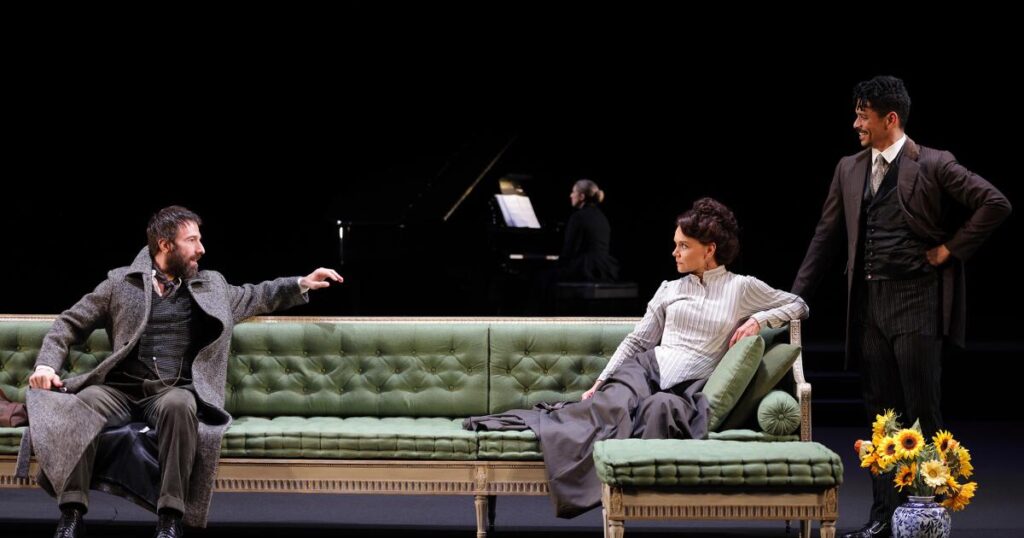
If Henrik Ibsen’s “Hedda Gabler” seems to crop up more often than his other plays, it’s probably because of the enigmatic hold the chilling title character has on actresses and audiences alike.
Katie Holmes, who has come a long way since her days on “Dawson‘s Creek,” is the latest to take on the Hedda challenge. She stars in a new version of the play by Erin Cressida Wilson that compresses the action and sharpens the language to a razor’s edge.
Hedda’s aberrant behavior now has the power to provoke an F-bomb, though the period of Barry Edelstein’s production at the Old Globe hasn’t otherwise been radically updated. The scenic decor and costumes situate us in the late 19th century of Ibsen’s bourgeois Norway.
Ibsen, it turns out, doesn’t need his layers of exposition. European auteurs, such as Thomas Ostermeier and Ivo van Hove have had great success burning through the texts to reveal the visceral clashes of characters whose souls are on the line along with their ideologies.
The setting needn’t be explicitly Norway, but the stultifying strictures of this middle-class world must be in place for Ibsen’s vision to have its detonating effect. I once saw a production of “Hedda Gabler” on Broadway that could have taken place in contemporary Southern California, a choice that led me to wonder why Hedda didn’t just hop on a plane and leave her staid, suffocating surroundings for a more congenial situation elsewhere.
That Hedda doesn’t have unlimited options is an essential part of her tragedy. Trapped in a life inimical to her sensibility, she becomes an arsonist of the home that has been made at exorbitant expense to keep her satisfied.
But satisfaction isn’t in the cards for this general’s daughter, famed for her beauty and imperious style. She has married a conventional husband, George Tesman (Charlie Barnett), not for love but for security.
Time ran out for Hedda, so she gave her hand to a feckless academic, a scholar of medieval handicrafts who spent his honeymoon in Europe copying manuscripts in dusty archives in the hope of securing a professorship for himself.
The more George dotes on her, the more she tries to squirm free from the prison that has been prepared for her. Aunt Julie (Saidah Arrika Ekulona), the sister of George’s dead father, has spared no expense to ensure that the couple’s new home is worthy of the illustrious woman her nephew has somehow managed to marry.
Julie is overjoyed to discover that Hedda and George may soon be having a baby and promises to check in on them daily. Pregnancy for Hedda is as distasteful a matter as these in-law intrusions, but it’s clear that George didn’t spend his entire honeymoon in the library and that the marriage plot has got ahead of her.
Hedda paces around the villa, sketched with modernist spareness by scenic designer Mark Wendland, like a panther in a gold-plated cage. She makes a derisive remark about Julie’s new hat, pretending it was left behind by the maid, Berte (Katie MacNichol). More ominously, she can’t resist fondling her guns, a precious legacy of her father, and is in the habit of aiming one straight at Judge Brack (Alfredo Narciso), who has designs on her.
The entrance of Thea Elvsted (Celeste Arias), a school girl acquaintance, both unsettles and diverts Hedda. Thea has taken on the mission of reforming Ejlert Lovborg (Alexander Hurt), Hedda’s former lover, a brilliant intellectual whose alcoholism has been in check under Thea’s steadying influence.
Hedda can’t stand that Thea, a girl whose hair she used to pull and threaten to burn, has been eliciting from Lovborg his magnum opus. The manuscript they’ve produced is apparently even superior to the recently published book that has put him in contention for the same professorship that George’s entire future is riding on.
What really rankles Hedda, though, is that Lovborg and Thea have created something sublime while she has sought refuge with a scholastic mediocrity. This galling notion sets her on a rampage.
“Hedda Gabler” marks the end of Ibsen’s great stretch of realism and paves the way for his late symbolist period, which includes the masterpieces “The Master Builder” and “When We Dead Awaken.” Hedda, in effect, torches the realistic trappings that Nora from “A Doll’s House” also came to understand as a trap.
Edelstein sees the symbolist pattern already emerging in “Hedda Gabler.” A pianist (Korrie Yamaoka) provides his production with dissonant accompaniment, heightening the jangled atmosphere while seated upstage at the piano that Hedda brought from home and still occasionally plays. Caroline Shaw composed the haunting original music that subtly becomes part of the dramatic weather.
The interior design may be a touch too avant-garde, but perhaps Aunt Julie was futilely trying to impress Hedda.
An extended couch of striking blue-green color allows for tête-à-têtes to be conducted at various degrees of intimacy. Ottomans provide storage not only for Hedda’s guns but also for her secrets. A prominent heating stove will become as much a part of Hedda’s arsenal as her precious pistols.
The compact nature of the production, performed without intermission in just over 90 minutes, awkwardly exposes the melodrama that Ibsen took great pains to undercut. As Hedda’s actions grow more extreme, the audience could be heard tittering.
There’s humor in Ibsen’s ironic observations but the play’s climactic moments are deadly serious. Hedda’s outrageousness is beyond the pale, but in a way that can come off as eerie (as in the case of Deborah Warner’s production led by Fiona Shaw that was filmed for BBC Television in 1993) or even self-abasing (as in the deconstructed case of Van Hove’s 2004 New York Theatre Workshop production starring an Elizabeth Marvel splattered in tomato juice).
Holmes, who has been testing her mettle in adventurous Broadway productions of classics (“All My Sons,”“Our Town”) and who starred in Edelstein’s off-Broadway production of Anna Ziegler’s “The Wanderers,” plays up the petty cruelty of Hedda’s behavior. She’s an aesthete run amok, determined to deface anything that doesn’t live up to her impossible standards. Ibsen’s tragic anti-heroine shares character DNA with Medea and Lady Macbeth. But here she invokes facets of Gustave Flaubert’s Emma Bovary. Hedda’s romantic picture — of Lovborg dying magnificently, with Dionysian vine leaves in his hairs, from a bullet of one of her own guns — smacks of the same literary cliches that has Emma fantasizing about a torchlight wedding at midnight.
Barnett’s George is a more sympathetic version of the character than is perhaps strictly warranted. His shrieking reactions to his wife’s savagery throw into relief his good nature and her perversity. It’s clear that George has married above himself, but his shortcomings come off as risible rather than oppressive, and it’s hard not to feel protective of him as he’s being pummeled to a pulp.
Ekulona’s Julie is assailed as much by Hedda’s slights as by her indifference. The nasty remark about the hat is just the opening salvo. George’s cluckingly affectionate aunt wants to enfold Hedda in a tradition that would consign her to the role of wife and mother. But Julie seems a victim here of Hedda’s artillery rather than a busybody relative anxious to extend the family line.
The social context, meticulously noted by Ibsen, isn’t as lucidly rendered by the production as the play’s sexual warfare. The romantic intrigue involving Hedda, Lovborg and Thea is more passionately combustible than the one involving Hedda, George and Judge Brack. But the gamesmanship, foreshadowing the adulterous antics of Harold Pinter’s plays, escalates perilously.
Hurt’s Lovborg is an ideal theatrical combatant for Holmes’ Hedda. The ferocity of their scenes together, aided by Arias’ devoted yet outmaneuvered Thea, sets the production ablaze with erotic danger.
All the while, Narciso’s Judge Brack stalks Hedda with a predator’s stealth. Wilson, who remains largely faithful to Ibsen’s play, unlike Nia DaCosta’s bracing free-hand 2025 film adaptation, still allows him the last aghast word in the face of Hedda’s final gunshot: “What kind of person does something like that?”
Hedda, like Hamlet, doesn’t relinquish her mystery, which is why we keep returning to her tragedy. The mythic dimension may be missing here, but Holmes darkly captivates within the narrower compass of this energizing revival.
The post Katie Holmes wages sexual warfare in energized new ‘Hedda Gabler’ adaptation appeared first on Los Angeles Times.