STARRY AND RESTLESS: Three Women Who Changed Work, Writing, and the World, by Julia Cooke
World War II had ended, and Martha Gellhorn had changed. Not yet 40, she was already known as a formidable American journalist who had written dispatches from some of the world’s most dangerous places: Madrid during the Spanish Civil War, Omaha Beach on D-Day. In 1945, she witnessed the liberation of Dachau, leaving just days before Germany’s unconditional surrender.
What she saw in Dachau taught her the reality of evil. “A darkness entered my spirit,” Gellhorn told a friend. She moved to Mexico, where she found a house and paid for renovations with her “literary whoring,” as she put it. Her “bilgers” — short, delectable fiction about low-stakes dramas that sold easily to magazines — had her “laughing like a goat.”
Gellhorn said she missed reporting but hated “writing journalism.” She would later describe Dachau as the moment when she stopped being young — though growing older meant knowing not more, but arguably less: “It is as if I walked into Dachau and there fell over a cliff and suffered a lifelong concussion.”
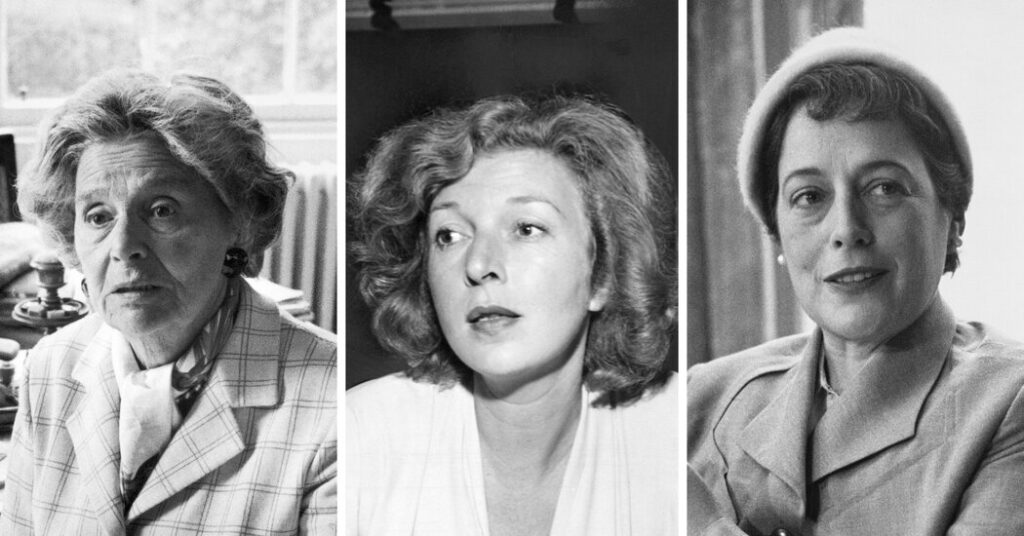
Gellhorn’s crisis is just one of many arresting moments in “Starry and Restless,” Julia Cooke’s vibrant triple biography of Gellhorn, Rebecca West and Emily “Mickey” Hahn, who served as a China correspondent for The New Yorker. West and Hahn became close; each crossed paths with Gellhorn. “Starry and Restless” traces their lives during the consequential period between the 1930s and the 1950s, when they flourished as journalists who habitually rejected the conventions of cold objectivity in favor of a memorable first-person point of view.
West, born in 1892, was the oldest of the bunch. Cooke introduces her in 1936 on her first trip to Yugoslavia. She intended to write a “snap book” about the place, something short and impressionistic. Then she became transfixed. The project ballooned into a “wretched, complicated book that won’t interest anybody,” she told a friend. West submitted the final manuscript around the time that Germany’s bombing of London had forced publishing companies to ration paper. But her editors pushed forward with the 1,100 pages of “Black Lamb and Grey Falcon.” She went on to cover the Nuremberg trials for The New Yorker and The Daily Telegraph.
We meet Gellhorn in 1937, just after she made her way to Spain on her own dime by writing an article for Vogue titled “Beauty Problems of the Middle-Aged Woman.” (She was 28.) Cooke inevitably has to discuss Gellhorn’s affair with Ernest Hemingway, whom she would later marry and divorce. But it’s Gellhorn’s relationship with her work and the world around her that interests Cooke most. “Her articles hinged on the contrast of domesticity and war, sociability and war, safety and war, routine and war,” Cooke writes. Against ideology and annihilation Gellhorn foregrounded the tangibility of human existence: “Martha’s prose was populated with soldiers, wives and babies; decorated with wallpaper and shards of shattered soup tureens in wrecked cabinets.”
Hahn is the writer readers may know least about, and Cooke does a marvelous job of conveying her talent as well as her cunning. Hahn liked to say that she had an “unfashionably happy” childhood in the Midwest as the fifth of six children. By the time she moved to Shanghai, she was already the author of two novels and two nonfiction books. She cultivated a mystique, entering a long-running affair with a married Chinese man and swanning around town with a pet gibbon perched on her shoulder.
All three women wrote fiction in addition to their journalism, which sometimes blurred the lines to the point of confusion. After Gellhorn wrote a short story about two travelers in the American South observing a lynching, a British magazine published it as fact — leading to an invitation to testify before the Senate. Hahn, for her part, wrote two dozen pieces about “Mr. Pan” for The New Yorker. This man was based on her Chinese beau, though whether the portraits were fact or fiction “was left alluringly unclear.”
Fiction offered a freedom to explore a range of circumstances and emotions. Cooke, whose previous book was about the stewardesses of Pan Am, writes with a similar verve and expansiveness, immersing herself in her characters’ perspectives, even as she sticks responsibly to the biographical record. She presents each complicated life with such moving specificity — West’s ruthlessness, Hahn’s opium addition, all three women’s difficult relationships with their children — that it’s curious to see her end the book by plucking out a few prosaic themes: “the caliber of their writing,” “the persistence of their travel,” “their acquaintance with one another.”
Apparently the cultural imperative to wrest salutary lessons, even from the most audacious and defiant women, is strong: “Maybe they offer a new compass by which a person may orient herself within her own choices.” Maybe. Or maybe the idiosyncratic lives of these peregrinating writers invite a simpler, but no less significant, proposal: Read this book and be enthralled. As West said of her own approach to telling a story, “Again and again I broke sequences and relaxed tension to get the lethargic attention of the ordinary reader along the road.”
STARRY AND RESTLESS: Three Women Who Changed Work, Writing, and the World | By Julia Cooke | Farrar, Straus & Giroux | 433 pp. | $32
Jennifer Szalai is the nonfiction book critic for The Times.
The post These Women Journalists Changed Their Field. Their Lives Make Great Copy. appeared first on New York Times.