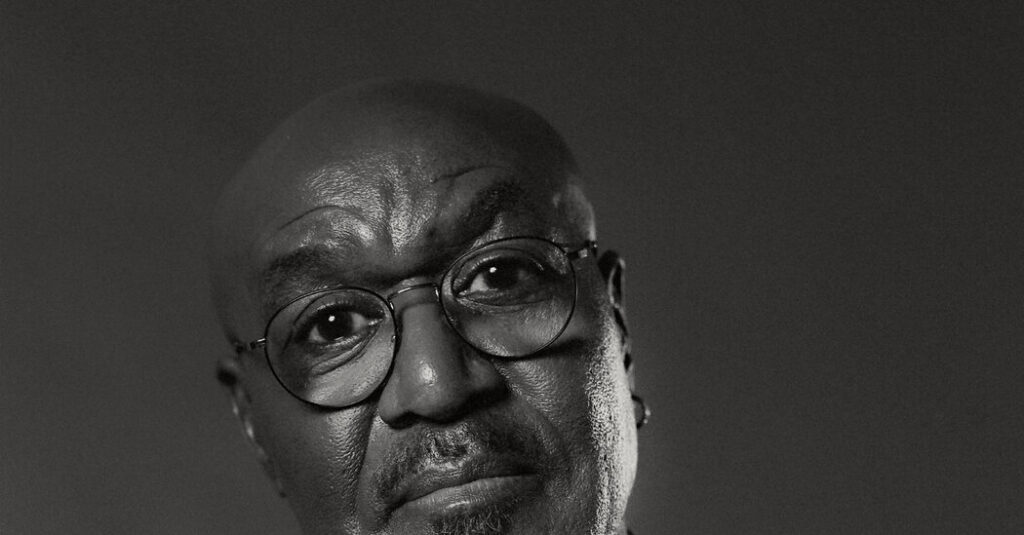
Delroy Lindo is tired of the sound of his own voice. It’s a fabulous one, deep and commanding, fitting for a man prone to thoughtful pauses and allergic to slick sound bites. But he’s heard a lot of it lately, given how often people want to discuss his performance as the liquor-loving blues musician Delta Slim in Ryan Coogler’s acclaimed movie “Sinners,” the role that earned him an Oscar nomination last month for best supporting actor, one of the record-breaking 16 nods the film received.
Its recognition many feel is overdue, given Lindo’s stellar turns in “Da Five Bloods” (2020), “The Cider House Rules” (1999) and “Malcolm X” (1992). Coogler, who has said “Malcolm X” changed his life, attested to the power of Lindo’s portrayal of Delta Slim. “I don’t know if I’ve ever been a part of a character who could be this poignant,” he said. “In those moments of emotional truth, where you see the cracks between when he’s drinking and not, it just knocks everybody flat.”
“The best part of this process has been that people are so genuinely happy for me,” Lindo, 73, said. “It’s not an ego thing. It’s nothing to do with that. It has everything to do with affirmation. And the power of work to impact one’s fellow human beings, which is why one got into it in the first damn place.”
This interview was conducted before the BAFTAs, where an audience member with Tourette’s syndrome involuntarily shouted a racist slur when Lindo and his “Sinners” co-star Michael B. Jordan were presenting. When reached for additional comment Lindo, through a representative, declined and pointed to his statement to Vanity Fair that he wished “someone from BAFTA spoke to us afterward.”
Here are edited excerpts from our conversation.
Much as been written about Delta Slim’s pivotal monologue about a rail station lynching, the exact moment when his pain is channeled into music. Can you talk about how that came about?
By the time I got to that final moment, I was sufficiently steeped in the storytelling. On the one hand, I was steeped in the pain of the moment. But on the other hand, I’m not speaking to the two gentlemen in the car [Michael B. Jordan’s Stack and Miles Caton’s Sammie] as a victim. I’m not a victim. These things happened; I’m pushing back against that violation. It is a manifestation of where, quote unquote, the blues comes from. Inasmuch as any oppressed persons are going to find ways of expressing themselves to help them to navigate the pain.
An early cut of the film didn’t have the full scene. What did you, and from what I understand, some of the other cast members, do?
Well, they just talked about the importance of it being reinserted. In my own personal case, both the chain gang scene, which had been taken out, and very specific moments in the monologue had been taken out. I said to Ryan, in my opinion, man, those things have to be put back in. One, because they speak directly to my origin story. And two, structurally, they’re critically important to the overall narrative. It wasn’t just about an actor having a moment of ego.
Because it wouldn’t have made sense for his character to be self-medicating without having gone through that. That concept of pain creating art.
That’s right. Exactly. I am doing what I believe every other human being on the planet would do. And that is to find a way to live my life without being crushed by my circumstances. The self-medicating you reference is my way of doing that. I was in New York a few months ago and this lady in the restaurant said, “Oh you play the drunk in ‘Sinners.’” And in my head I thought, is that what you saw? A drunk? Forgive me, but it’s about so much more than that.
I understand how having a difficult childhood can inform one’s work. I watched your recent episode of “Finding Your Roots” and wondered if something similar happened with you, in terms of channeling experience into art.
Absolutely. [Long pause.] I’d say fairly consistently that my work has saved my life. Figuratively and literally, no question. Hands down. Because what my work has allowed me to do is channel just what you said, channel my pain, channel my neuroses, channel my eccentricities into specific forms of expression, without which I’m not sure what would have happened. [Laughs.] I’m not sure, man.
In the past you have talked about your first role in your elementary school’s Nativity play. And how the reason you loved acting was not because of the response you got from the audience but because of the affirmation you received from the teacher. You often speak about moments of affirmation in your life. Why are they so significant to you?
Because in those moments, God is presenting himself — or herself, the universal being, whatever term you use — to me and saying keep going. And it’s happened frequently enough to constitute for me signs. These are signs that I must keep going. Keep working. Do you know who Earle Hyman was?
I do.
I was at such a low point when Earle gave me that affirmation. As a young actor — this is going back so many years — but I think it was eight months where I couldn’t get arrested, man. And one thinks like the world is coming to an end. It’s over. And that kind of despair, that kind of hopelessness. You know and I know that as a human being one can never get to a point of hopelessness where you truly give up. But I tell you what, you can come this close.
Earle was a savior in that moment. He said this, and I’ll never forget this. He said to me, ‘Young man, you have nothing to worry about.’ [Lindo paused to wipe tears from his eyes.] Now why does that, every single time, why is it always so moving to me? I’m surmising it’s because it’s something that lives so deeply inside of me and is gargantuanly important for my survival as a creative human being and my going on to flourish. Therefore, it is critically important for me to provide, wherever I can, provide those kinds of affirmations for others.
I was going to ask if you were mindful of doing that for people.
Hell yeah. Hell yeah. Hell yeah. Because it can mean the difference between hopefulness and hopelessness. And in the final analysis, man — and this is a very contemporary notion — we can’t give up. It’s not an option. It’s very complicated because what I’m referring to is looking at the America we are living in currently, all the things that one could just absolutely despair over. But we don’t have that option, those of us who are parents. I have a 24-year-old son, and young people are watching every single move we make; they are listening to every single word we utter.
One of the reasons people were so happy you got nominated for an Oscar is because you’ve had a long career with ups and downs. You did a bunch of movies with Spike Lee and others in the ’90s and early aughts and then you did mostly TV, before your renaissance in the last few years. Did you have a blueprint for your career?
[Laughs.] The blueprint was to keep working. And I’m saying “blueprint” in quotes. I’m hesitant to say this to you because you are a journalist: I cringe at some of the work experiences that I had. Not the material itself, but how the experiences unfolded and what they became. I had to find an upside because that’s what enabled me to keep going.
There was a period where one was being offered certain things and it’s like OK, I’ll try to find a positive way of entering into this work and making it something decent for myself and hopefully the project. But do I really want to do this? Not really.
Ryan was open to receiving your notes on Delta Slim for “Sinners.” But I can imagine over the dozens of movies and TV shows you’ve done, that hasn’t always been the case. Do you feel that your directness in providing feedback has hurt you?
Absolutely. In some instances, it absolutely has hurt me because people don’t want to hear it. And they’re resentful. But I wasn’t always as diplomatic as maybe I should have been, but I also didn’t read the room in some instances. I didn’t sufficiently take into account who I was speaking with. You know what I would tell my 40- or 45-year-old self? I would say never lose sight of the fact that you get more with honey than you do with bitters. Understand that in actuality this industry is very small and everybody talks to everybody else. And also understand you are working in an environment that is not a meritocracy, so conduct yourself accordingly. Understand the playing field that you’re on. And understand that it’s tilted.
From experience as a person of color, you have to be very aware of how you comport yourself.
Absolutely. 7000 percent. I’ve said it to [my son]. You have to be acutely aware of your comportment at all times. And as a person of color, you have to accept — and it’s a cliché but it’s so true — in some instances you’re going to have to be twice as good for half the reward. But that should not be one’s mantra. Have it as an awareness, conduct yourself accordingly, but don’t let it become a guiding principle.
What’s been the best part of this time in your life?
People are so happy for me. It’s been one of the most meaningful and moving things for me. I’ll tell you a story. When I was just starting out, I hadn’t done anything, my résumé was blank. And a casting person said, what do you want for your career in five, 10 years? And I said well, I want to be respected for my work. She kind of rolled her eyes and didn’t say anything. But that’s what I’ve got. Being respected for my work.
Additional cinematography by Jensen Gore.
The post Delroy Lindo on ‘Sinners,’ Speaking Up and the Power of Affirmation appeared first on New York Times.