Last week, after the Supreme Court told President Donald Trump that his tariff policy exceeded the executive branch’s authority, he held the justices in contempt. And then he sidestepped them.
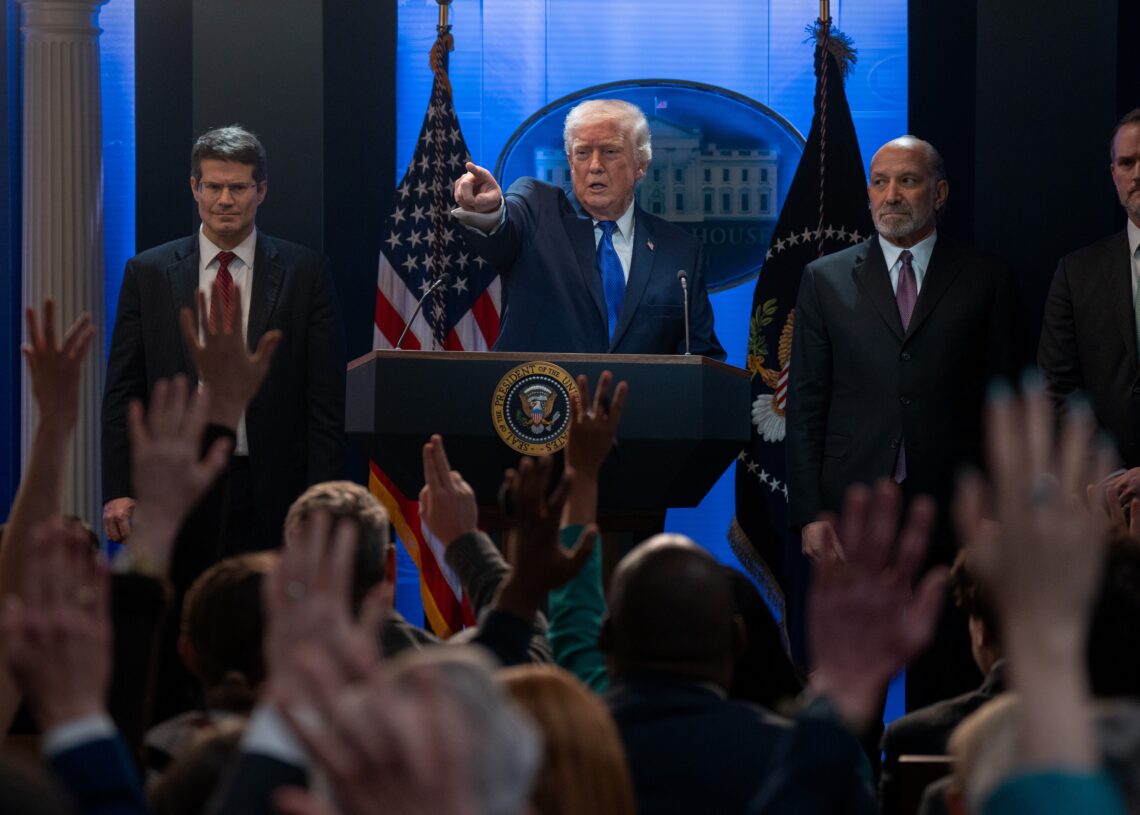
“They write this terrible, defective decision,” Trump said at a White House news conference after the ruling was released. “It’s almost like not written by smart people.” He accused the justices who decided against him of being “very unpatriotic and disloyal to our Constitution.”
Seething, Trump then shrugged his shoulders at the court, declaring he’d just use a different law to do what he wanted: “In fact, I can charge much more than I was charging, so I’m going to just start.” He wasn’t bluffing — within hours of the court’s ruling, he issued a proclamation imposing a 10 percent tariff on the world. One day later, he made it 15.
The Supreme Court deliberated for months before moving to end the president’s unprecedented use of one tariff power, only for him to put a different tariff power to unprecedented use almost immediately. The court operates on a calendar of months and years; the executive, on a timetable of days and hours. The Constitution made the branches equal in power, not in speed. That asymmetry is a natural feature of the system. But in the hands of defiant presidents, it becomes a loophole readily exploited and prevents judicial decisions from being meaningfully implemented.
When this happens, the courts are not ignored outright — executives simply go shopping for different authorities to do what they want. For Trump, this was easy. Writing in dissent, Justice Brett M. Kavanaugh helpfully listed three laws the president could use to continue unilaterally imposing tariffs, one of which became the basis for Trump’s new global surcharge. Any legal challenge will take months to adjudicate, only for a vigorous executive to cite a different statute and restart the process. And in the interim, things often continue as before.
The country knows this pattern well — most notably, following Brown v. Board of Education in 1954. When the Supreme Court unanimously ruled that the “separate but equal” doctrine and racial segregation in public schools were unconstitutional, it demanded desegregation occur “with all deliberate speed.” In response, Southern state governors and legislatures crafted measures to work around the ruling, filed suits to slow compliance with it and devised novel ways to dodge it altogether.
It was not until 1957 — after open defiance in Arkansas — that President Dwight D. Eisenhower federalized the National Guard, deploying soldiers to protect nine Black students integrating a high school in Little Rock. A decade after Brown, though, only 1 percent of Black children in the South attended desegregated schools with White children. And in 1970, in southwest Georgia, my mother was the last valedictorian of her county’s still-segregated Black high school — 16 years after it was declared a violation of the Constitution.
What finally produced real change was a decade of politics, protest and organizing — making inaction more politically costly than transformation. The Civil Rights Act of 1964 and the Voting Rights Act of 1965 were required to establish the federal enforcements necessary to overcome the resistance of elected officials. Political action delivered the change that courts could only voice. And strong legislation made it real: By the early 1970s, approximately 90 percent of Black students in the South attended desegregated schools — as I did in the 1980s.
The same challenge shadows the tariff ruling, which sits in the gap between what the Supreme Court has declared and what the country will do about it. And much work remains. The court’s landmark decision triggered questions about how to refund the roughly $175 billion collected in tariffs. It limited executive overreach, constraining the president’s ability to impose tariffs against whatever country he liked, for whatever length of time and for whatever amount of money.
And it pleaded with Congress to do its job. In a concurring opinion, Justice Neil M. Gorsuch wrote, “It can be tempting to bypass Congress when some pressing problem arises. But the deliberative nature of the legislative process was the whole point of its design.” It is a reminder that the “slowness” of democracy is not a flaw for faster actors to exploit, but when they do, it is Congress’s job to rein them in.
Democracy is protected — or lost — in the distance between the branches’ authorities and in the difference in speeds at which they act. Over the decades, Congress has ceded its tariff power to the executive, statute by statute. Executives don’t always abide by the lines a court draws. When presidents treat this space as an opportunity to dodge checks and balances, it becomes unfair leverage and an unjust advantage. Closing the gap requires legislation, oversight and accountability.
The Supreme Court can declare change, but it cannot deliver it. Only politics can do that. And only a quickened Congress can make it endure.
The post How Trump raced past the Supreme Court appeared first on Washington Post.