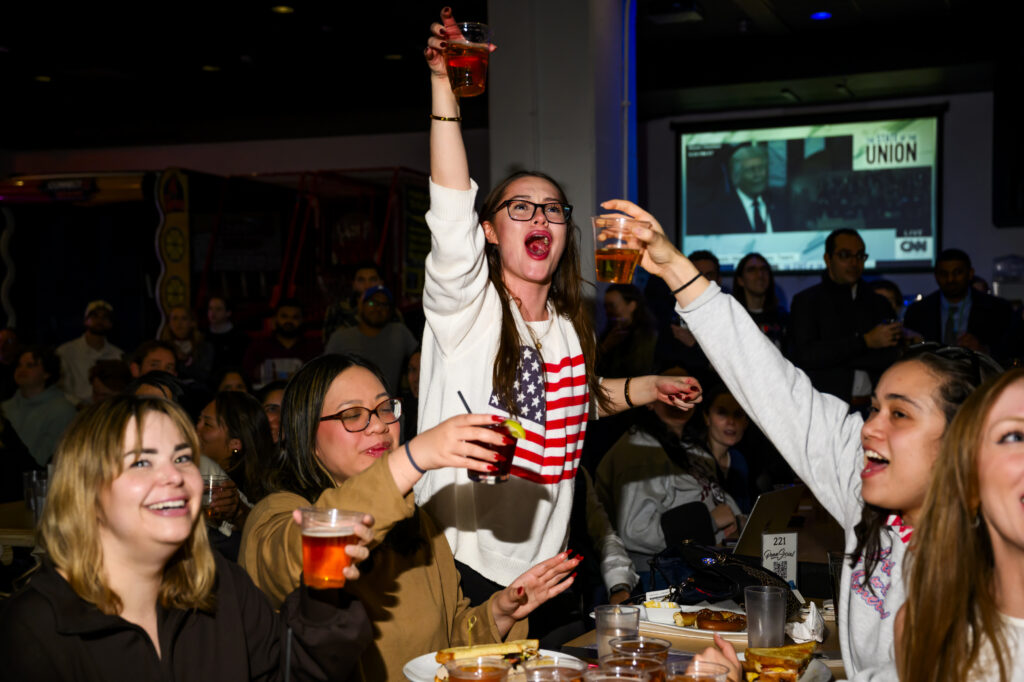
The kegs were ready. Revelers crammed against the glossy white bar. The fliers promised: FREE BEER UNTIL THE FIRST INSULT.
The clock started ticking at 9 p.m., when President Donald Trump was scheduled to begin talking on the big screen.
“We have achieved a transformation like no one has ever seen before,” he said as Grace Rhodes sipped her first Narragansett lager.
Trump’s caustic brand of humor mostly repulsed her. But the 25-year-old self-described policy nerd and liberal still squeezed into Penn Social, a bar less than a mile from Capitol Hill, along with hundreds of other young people eager to revel in what promised to be a ripe political spectacle.
Any jab targeting “an individual, a group of people or a country,” as the event page defined it, would halt the flow of gratis suds. The manager predicted it would happen quickly. Everyone within elbowing distance of Rhodes guessed five minutes or less.
Here was one of many State of the Union watch parties in the nation’s capital, and one of many rooms across the country glued Tuesday night to a leader known for name calling. Plenty of Trump supporters savor his verbal punches. But when surveyed, most Americans on both sides of the aisle say they’re tired of hostile rhetoric. Most believe our political system is too divided. Yet even the weary, numb or bored still line up to watch the kind of Washington vitriol that ratings and algorithms reward. Or they just like beer.
Rhodes expected Trump, a seasoned showman, to bask in applause, which, she figured, would extend everyone’s on-the-house guzzling — maybe for 10 minutes.
“No need to throw out an insult until the first lull,” she said.
Then the clock ticked past 15 minutes, 20 minutes, and the crowd heard lines like “now we are the hottest country anywhere in the world, the hottest” and “our new friend and partner, Venezuela.” Bashing the Supreme Court’s “unfortunate” ruling to scrap most of his international tariffs didn’t count, the bartender ruled.
Pettiness is baked into presidential history. George Washington reportedly skewered Gen. Charles Lee as a “damned poltroon” (or in modern terms, a coward). John Adams blasted Alexander Hamilton as “a bastard brat of a Scotch Pedler.” Andrew Jackson, a fan of duels, notoriously expressed regret that he never shot Henry Clay. Harry S. Truman got devastatingly folksy, once claiming Dwight D. Eisenhower knew as much about politics as “a pig knows about Sunday.”
But this American tradition of bluster was largely contained to private letters and conversations (or reserved for foreign foes). For more than a century, the State of the Union — once dubbed the Annual Message — remained a far statelier affair. Hearing an explicitly personal insult in the speech was about as likely as, well, a pig knowing about Sunday.
Shadia Shahin, 41, waited for Trump to unleash a good one. A MAGA fan who works in real estate, she’d laugh when he knocked Sleepy Joe.
“Because Joe was sleepy,” she said. Sometimes, though, Shahin wrestled with an internal conflict. She wished he’d tone it down occasionally, she said, so that his words wouldn’t distract from his actions. But Trump’s manner of speaking drew her to him in the first place.
“He’s just so authentic,” she said.
In the not-so-distant past, presidents packaged disdain for rivals in the State of the Union more politely. Attacks landed on the policies or behavior of “my predecessor,” “the previous administration” or “a former president.” Even Trump, the architect of “Sleepy Joe” and “Lyin’ Ted” and “Little Marco,” used to stick to that norm.
During his first congressional address in 2017, he delivered a tame message of unity: “We all bleed the same blood. We all salute the same great American flag.” It took him 17 minutes and 10 seconds to get to an insult. And the “savage” group he condemned was ISIS.
Back then, the father of the MAGA movement prodded his audience to envision 2026. “In nine years,” he said, “the United States will celebrate the 250th anniversary of our founding.” What, he asked, will America look like? “The time for trivial fights is behind us,” Trump declared.
In his subsequent three SOTU speeches, Trump steered clear of in-your-face pejoratives in his prepared remarks. He criticized Democratic policies and maneuvering without naming names. Obamacare, for instance, was “disastrous,” he said, but Trump made no mention of Barack Obama. Even after his unsuccessful impeachment, Trump’s most disparaging apparent dig at those seeking his ouster was an appeal to “reject the politics of revenge, resistance and retribution.”
By 2025, though, whatever was keeping the rhetoric of his rallies out of his words in the U.S. Capitol had evaporated.
Nine minutes into his first congressional address as a second-term president, Trump lambasted Joe Biden as “the worst president in American history.” Then he called the World Health Organization “corrupt” and the U.N. Human Rights Council “anti-American.” He tossed out “Pocahontas,” the nickname he has used to mock Elizabeth Warren’s claims of Native American heritage. He dismissed the Southern African nation of Lesotho as a place “nobody has ever heard of.”
Nearly three-quarters of Americans surveyed last year by the Reagan Presidential Foundation and Institute’s Center on Civility and Democracy said they believe “outrageous and uncivilized behavior” among elected officials is tolerated now more than in the past, while 83 percent wanted leaders across the political spectrum to locate some common ground.
Yet our politics keep getting messier.
“Nasty rhetoric gets more clicks and likes,” said Thomas Zeitzoff, a professor in the School of Public Affairs at American University and author of “Nasty Politics: The Logic of Insults, Threats and Incitement.”
Ella Waidalowski also guessed it would take a mere five minutes before Trump fired his first broadside. Ten if she was lucky. That was enough time for one beer, she figured. She had detested the president’s insults, she said, since first hearing them as an eighth-grader. What had he called Hillary Clinton?
“Crooked Hillary!” recalled her roommate, Megan Moody.
The recent American University graduates, both 23 and looking for jobs in liberal politics and policy, said they showed up because paying attention felt like the right thing to do. They wanted to stay informed and engaged, no matter how much they disagreed. Also, the beer.
“If we’re going to have to hear this clown show,” Moody said, “we might as well be around free alcohol.”
Forty-five minutes in, when dozens of patrons were visibly good and drunk, a bartender finally called it. The Narragansett lager was officially no longer free after Trump slammed “Biden and his corrupt partners in Congress.”
But that was just the start of another hour punctuated with invective against ethnic groups (“Somali pirates who ransacked Minnesota”) and more frequently his political opponents.
“You should be ashamed of yourselves for not standing up.”
“These people are crazy. I’m telling you they’re crazy.”
“The only way they can get elected is to cheat.”
“Democrats are destroying our country.”
The post They drank free until Trump’s first insult. The beer flowed longer than expected. appeared first on Washington Post.