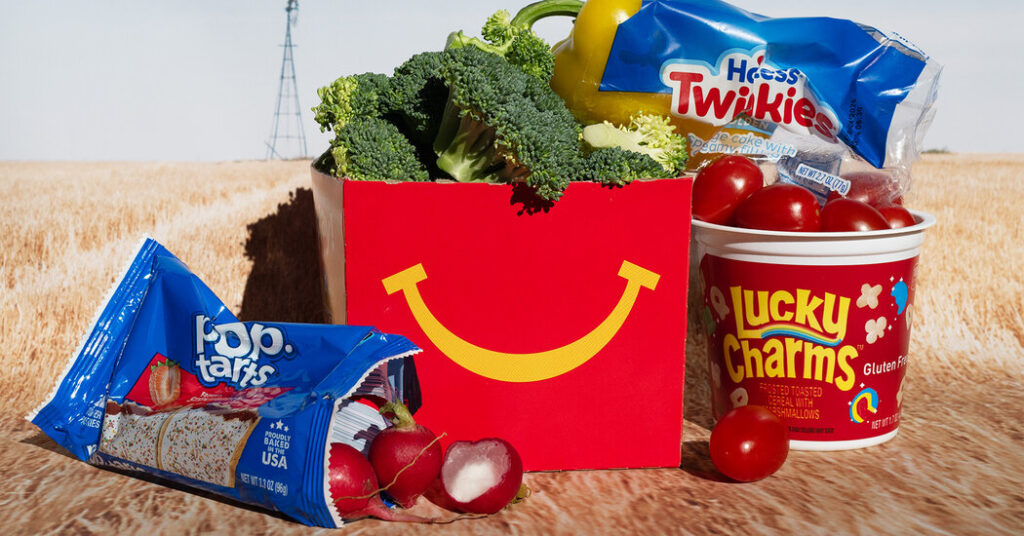
Are you a picky eater? Do you mostly stick to just a few foods you already know and like? Or are you an adventurous eater — someone who is always curious to try a new cuisine, dish or flavor?
In the guest essay “There’s a Reason American Kids Are Such Picky Eaters,” Helen Zoe Veit writes that not so long ago, children in this country weren’t fussy about food:
American kids ate very odd things in the 19th century. Spicy sauces and vinegary pickles. Shellfish and organ meats. Beets, rutabagas, collards. They even loved coffee. In historical documents of all kinds, from medical treatises to diaries to school records, Americans described children as curious omnivores who appreciated bold flavors and interesting textures. A group of children in 1830s Boston spent their pocket money on raw oysters, doused them with vinegar and pepper and “ate them with rapture.” A girl in 1870s New York adored a salad made of tiny crabs that she ate by the spoonful, shell and all. It was normal for a child to cheer when she saw turnips growing in the garden or for another to call cabbage his “delight.”
The more I researched, the clearer it became that American children’s experiences with food in the past were full of pleasure. This was unrelated to socioeconomic status — children at every income level happily ate a diversity of foods. But today, appreciation of sharp and varied flavors can be hard to find among American kids. Parenting message boards are filled with questions about getting reluctant children to eat vegetables, and kids’ menus across the country offer dishes aimed at narrow palates.
Many adults assume that prolonged pickiness is a hard-wired stage and that kids naturally dislike many foods. But mass childhood pickiness is a modern phenomenon created largely by junk food companies that marketed products like sugary cereals as food specifically for children, convincing Americans that kids need different, easily likable foods. This fostered a culture of pickiness that is harming children’s health and depriving them of a range of pleasures and flavors that would have been available to them in the past — all while adding heaps of unnecessary anxiety to dinner tables across the country.
Dr. Veit writes that widespread pickiness didn’t exist until the 20th century:
All this changed as food companies like General Foods and Nestlé poured money into designing products in laboratories to target humans’ biological instincts and make their foods very hard to refuse. By the mid-20th century, thousands of seductively sweet, salty and crunchy factory foods crowded grocery shelves, and many of them were marketed aggressively to children — from Goldfish crackers to SpaghettiOs. “Child-pleasing” emerged as a marketing slogan, and brands promised in advertising campaigns that even the fussiest eaters would find their food irresistibly delicious. One 1960 Kraft advertisement featured an otherwise “picky” girl who “never turns up that button nose at mild, golden Velveeta!”
Junk food companies also started pushing portable, calorie-dense snacks. By the 1960s, Hostess was selling “snack cakes” like Twinkies, Kellogg’s was advertising Pop-Tarts as an “eat anytime” food, and eye-poppingly sweet cereals were showing up at snack time as well as breakfast. Many children were nibbling and drinking milk or Kool-Aid right up until the start of meals and showing much less interest in the food on the table because they were already full. In contrast, 19th-century children didn’t snack much and were more likely to have roaring appetites at mealtime. If you’ve ever gone grocery shopping on an empty stomach and come home with questionable items that just looked so good, you understand how powerfully hunger sharpens interest in food.
The essay continues:
It might be tempting to buy marketers’ claims that once children got personalized food, they finally got to eat what they actually liked. But exploding choice fostered comparison and discontent. Within just a few decades, all sorts of foods that kids used to love — from briny shellfish to bitter marmalade — came to be unthinkable as kids’ foods. Preferences were increasingly understood in relation to aversions, and the beating heart of modern children’s food became displeasure.
Students, read the entire article and then tell us:
-
How would you describe your relationship with food? Do you tend to eat the same foods over and over? Or are you open to trying new dishes and flavors? Tell us about your eating habits — and if you have foods that you refuse to eat or even touch.
-
If you are a picky eater, does it ever cause problems? Does it limit your options at restaurants or friends’ houses or make it harder to maintain a balanced and nutritious diet? Have your parents ever struggled to get you to expand your palate?
-
What is your reaction to the essay? Were you surprised to learn that American children of an earlier era were described as “curious omnivores” who delighted in bold flavors and interesting textures?
-
Dr. Veit argues that childhood pickiness is a modern phenomenon created largely by junk food companies that marketed products like sugary cereals as food specifically for children. How convincing is her argument?
-
Dr. Veit also writes, “Children are still capable of learning to love the foods enjoyed by their elders; we just need to regain the confidence to lovingly help them do so.” Do you agree? Does her essay make you want to try to be more adventurous in your eating habits?
-
What tips would you give to parents of a finicky eater or to a friend or peer who is reluctant to try new dishes?
Students 13 and older in the United States and Britain, and 16 and older elsewhere, are invited to comment. All comments are moderated by the Learning Network staff, but please keep in mind that once your comment is accepted, it will be made public and may appear in print.
Find more Student Opinion questions here. Teachers, check out this guide to learn how you can incorporate these prompts into your classroom.
Jeremy Engle is an editor of The Learning Network who worked in teaching for more than 20 years before joining The Times.
The post Are You a Picky Eater? appeared first on New York Times.