When Sahar Tahvili, a professor at a Swedish university, sat for an interview with Voice of America’s Persian service on Jan. 9, she discussed the security concerns for Iranian viewers using Starlink satellites to circumvent the government’s internet blackouts.
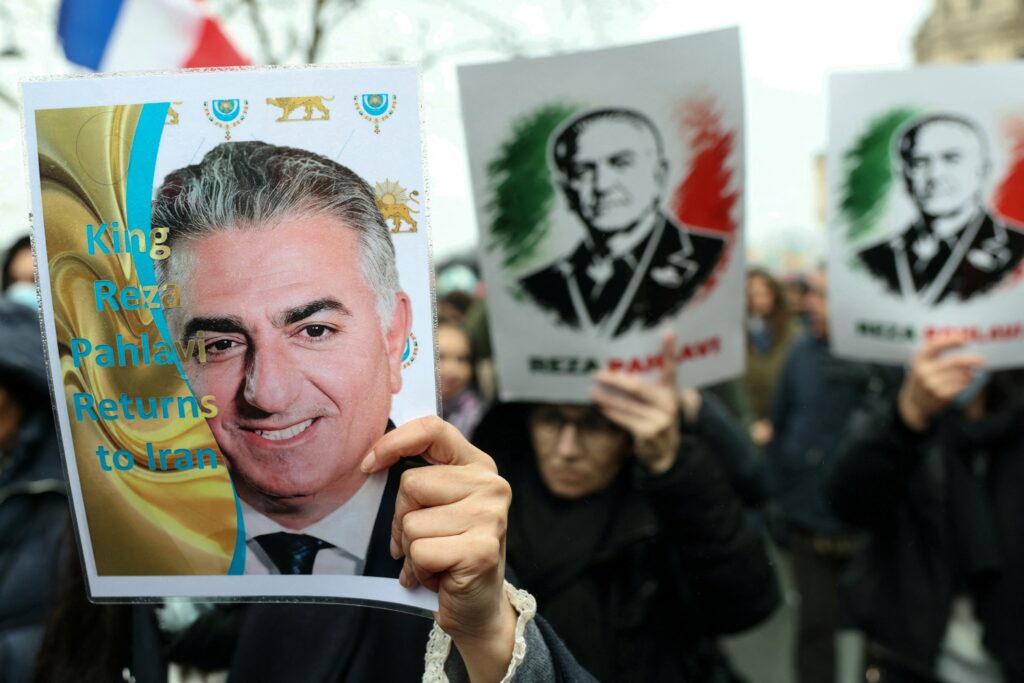
But it was a greeting at the start of the interview that crossed a line with the company’s top brass. She thanked the network for having her before invoking the name of Reza Pahlavi, the son of Iran’s deposed shah: “Let me first pass my greetings to our compatriots in Iran, a nation that, by standing on the right side of history and by responding in the millions to Crown Prince Reza Pahlavi’s call, is shaping historic days for the freedom of our country.”
Later that day, Tahvili received a phone call from the VOA producer who arranged her interview, complaining that she had violated Voice of America’s new policy barring mentions of Pahlavi’s name — which she said she didn’t know about.
“He called me in a very angry way and said, ‘Why did you mention his name?’” Tahvili, adjunct associate professor of AI industrial systems at Sweden’s Mälardalen University, said in an interview. “No one is allowed to mention Pahlavi’s name.” Because she had mentioned him, Tahvili said she was told her interview, which aired live, would not be reposted to social media and she would no longer be welcome on the network.
Critics including Tahvili allege that since the mass protests broke out in the final days of last year, the U.S. government has systematically censored the best-known Iranian opposition figure by banning his name from its broadcasts. They also claim that, in the process, U.S. Agency for Global Media Deputy CEO Kari Lake and the new head of the Persian service, Ali Javanmardi, have exerted control over a government broadcaster that’s long been editorially independent of the U.S. government.
In a January interview with Reuters, President Donald Trump questioned whether Pahlavi has enough support to take over in Iran, but said “that would be fine with me” if he wins over the majority of Iranians. “He seems very nice, but I don’t know how he’d play within his own country,” Trump said.
In the same interview, he remained noncommittal about efforts to pressure regime change in Iran either, saying, “Whether or not it falls or not, it’s going to be an interesting period of time.”
The push to excise Pahlavi’s name was first reported by the Hill.
Lake and Javanmardi, a former VOA contractor recently brought in to run the Persian service, have defended their new rules, saying that they are simply clamping down on an effort by VOA employees eager to see one opposition group prevail over another at a time when Iran’s regime under Ayatollah Ali Khamenei is on shaky ground. They say it applies to all opposition leaders, not just Pahlavi.
“We are not in the business of selecting Iran’s political leadership,” Lake said in a statement. “That decision belongs solely to Iran’s 93 million citizens, who have a right to self-determination. Right now, the story should be about them, not the numerous opposition groups outside Iran. Elevating external opposition figures over voices inside the country risks externalizing the conflict in ways that would only benefit the cruel regime and undermine protesters on the ground.”
In a separate statement, Lake called Javanmardi “a respected and fearless journalist” with deep experience reporting on Iran and the region. “His commitment is to journalistic responsibility, truth, and ensuring coverage that aligns with American policy interests and centers the voices of the Iranian people in support of their right to freedom and self-determination.”
The spokesperson did not make Javanmardi available for an interview.
Javanmardi has voiced opinions, however, about Pahlavi on-air, saying in a recent VOA appearance, “The United States government is not going to replace a dictator inside Iran with another totalitarian one who has threatened all his opponents even before coming to power with death and elimination.” In recent months he has also described other media as engaging in “propaganda engineering” and “artificial magnification” of issues in Iran.
Javanmardi has also called out Iranians for not participating in the recent protests. “We should all participate in identifying the mercenaries who did not join the people and are involved in suppressing the people,” he said in one broadcast. “Let’s participate so that they do not have immunity, both inside and outside Iran.”
Under Lake, Voice of America has undergone massive staff cuts. The broadcaster, first set up in 1942 to counter Nazi propaganda abroad, suspended most of its programming after Trump issued an executive order in March. Then, Lake cut hundreds of contractors and placed hundreds of full-time staffers on paid administration leave. A federal judge blocked Lake from firing the employees and instructed her to broadcast in a few languages mandated by law, including Farsi.
In January, Congress rejected requests from Lake and the White House to zero out the agency’s budget, approving a $653 million budget. Lake said she was “disappointed” at the move.
VOA’s Persian service, once among its largest divisions, has maintained a skeleton crew since this summer, when Lake briefly ordered staff back and called for some broadcasts amid escalating military tensions between Iran and Israel. Many of those recalled staffers were put back on administrative leave when the conflict simmered.
But when popular uprising broke out in late December, Lake once again ramped up its staffing, bringing back a few dozen employees and contractors.
She also tapped Javanmardi, who years earlier worked as a VOA correspondent based in Erbil, Iraq, to lead the charge. He quickly became a divisive figure among staffers and viewers because of his close control over broadcasts. So far, more than 58,000 people signed a Change.org petition to have him removed, saying, “Ali Javanmardi’s biased approach silences the Iranian struggle and betrays the trust of those who depend on honest journalism.”
In an email, a USAGM spokesman defended the new policy regarding opposition figures. “Mr. Reza Pahlavi himself, as well as the leaders of other political groups, have been invited to speak on the Voice of America,” he said.
Despite the invitation, Pahlavi has not appeared on the network. Pahlavi did not respond to a request for comment.
Several VOA staffers working on the broadcasts, who spoke on the condition of anonymity out of fear of retaliation, said that Javanmardi appeared to target Pahlavi. The staffers said he personally approves all guests before they appear on air and has instructed staff not to book anyone who sympathizes or promotes Pahlavi.
“He completely censors his name, his activity and everything,” one staffer said, noting that Javanmardi has refused to play audio of protesters in Iran shouting Pahlavi’s name. “All the people chanting in Iran — nothing. He censors everything.”
Holly Dagres, a senior fellow at the Washington Institute who writes a Substack newsletter called “The Iranist,” said that many Iranians have indeed chanted Pahlavi’s name during the protests. “While this may seem surprising to outside observers, nostalgia for the pre-1979 era has grown in recent years,” she said. “Many Iranians — particularly Gen Zers who weren’t alive during that period — perceive life before the revolution as a better time.”
She added that omitting this detail “erases a key element of the uprising — including the motivations of some of the protesters who have risked, and in some cases lost, their lives in the name of freedom.”
Another staffer said that no pro-Pahlavi content can appear on the network. “If anything ever has been published or broadcast, it’s because we missed it,” the staffer said.
Another employee said that the approach has hampered reporting, such as when Sen. Lindsey Graham (R-South Carolina) met with Pahlavi and Javanmardi instructed the staff not to cover it.
However, one VOA staffer defended the policy, saying that without it, the service and the United States could be labeled having interfered in Iran’s internal affairs.
And Arash Azizi, a lecturer at Yale University who writes about Iran for different publications, also said he is “at least partially favorable” to VOA’s approach because Pahlavi leads “one political faction” of the opposition.
“No country in the world should recognize Mr. Pahlavi as the leader of the Iranian opposition because he has absolutely no legitimacy for that position,” Azizi said. “I think it’s good for VOA to have effectively pulled the brake and say, look, you’re nobody’s leader. You can’t just appoint yourself the leader and then expect us to treat you as one.”
Navid Mohebbi, a former political prisoner in Iran now working for the National Union for Democracy in Iran (NUFDI), which supports Pahlavi, said in a statement that VOA is effectively the “only major Persian-language diaspora outlet” that has avoided covering Pahlavi’s calls for demonstrations in Iran and protesters shouting pro-Pahlavi slogans.
“This level of censorship is striking, particularly when even Iranian regime media and outlets hostile to the United States acknowledged the existence of these slogans,” he said.
For Tahvili, who grew up watching VOA in Iran, the experience of being banned from the network was painful.
“For us, for my generation, we grew up with the Voice of America,” she said. “It was the only channel, the only Persian-language news source that we had at that time. Freedom of speech. Professional journalism. It really hurts to see how it changed from that to this.”
Yeganeh Torbati contributed to this report.
The post Voice of America is covering Iran’s protests, but not its best-known dissident appeared first on Washington Post.