President Donald Trump’s first effort to replace the tariffs struck down by the Supreme Court is based on a misreading of a 1974 law that allows for temporary trade restrictions due to “large and serious United States balance-of-payments deficits.” That is not the same as the balance of trade, which is why courts would ideally enjoin the president’s proclamation.
The U.S. has a large and negative balance of trade, and the proclamation equates that with the balance of payments. But the balance of payments includes all financial transactions, not just trade in goods. Congress recognized the difference between them: Elsewhere, the same law uses “balance of trade” to mean something different from “balance of payments.”
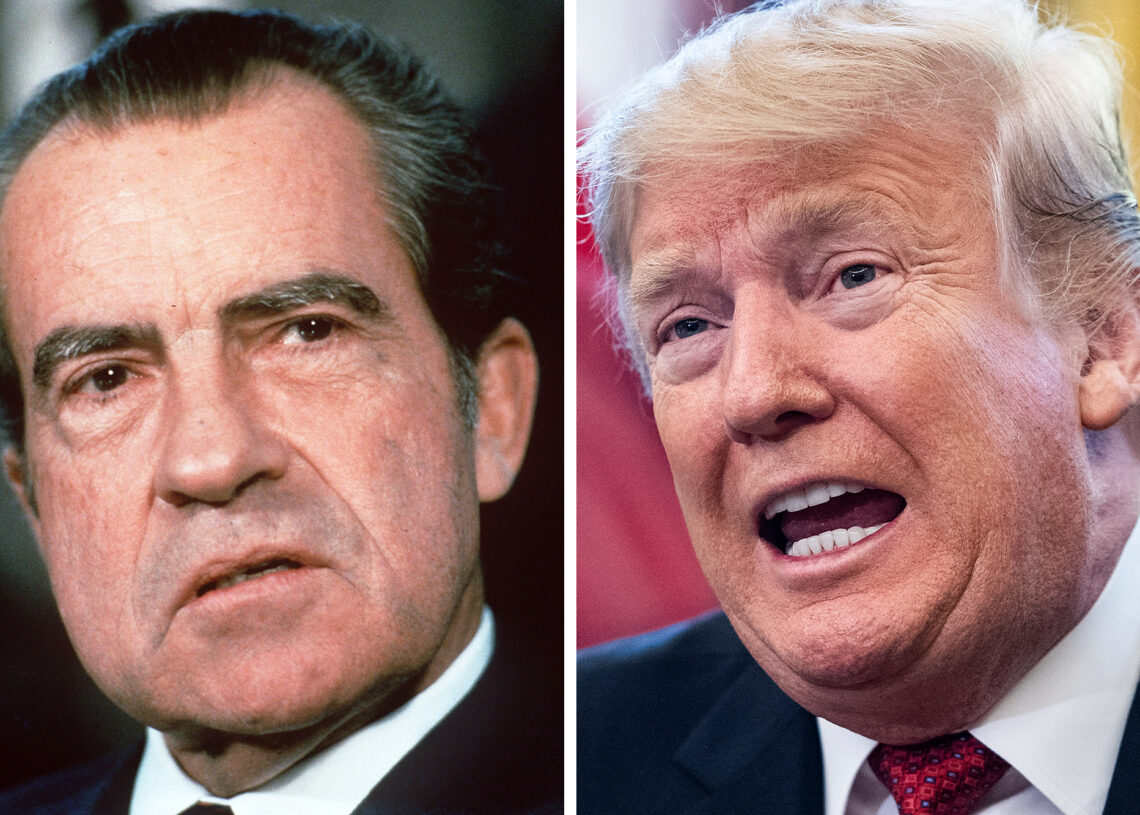
Trump’s proclamation appears to be modeled on President Richard M. Nixon’s 1971 order to impose a 10 percent blanket tariff to respond to a balance of payments problem. But the economy has changed quite a bit over the past 55 years.
Back then, the global economic system had fixed exchange rates for many currencies, and the dollar was redeemable for gold. In that world, it could make sense to restrict trade to avoid an imbalance of payments due to dwindling gold reserves. That’s why international trading rules had an exception to allow for such restrictions.
The U.S. was also at a transition point in its trade balance, shifting from years of surpluses to the beginning of deficits in the early 1970s. The U.S. imported more than it exported for most of the 1800s as well, but it was the first time in decades that the trade balance was going negative, presenting a new challenge for policymakers.
Neither can be said of the world today. The dollar and the currencies of most U.S. trading partners float freely, allowing instant adjustments that respond to market fundamentals. Even after a year of Trump’s tariffs, the U.S. trade deficit is completely normal.
Nixon also implemented the tariff in a totally different way than Trump has. He did it by surprise, for the purpose of shocking countries with which the U.S. was seeking to negotiate currency accords. He removed it immediately once a new currency accord was struck in December 1971.
There is nothing less surprising than Trump announcing a tariff today, and this president has made clear that he intends to keep a universal tariff on all imports even if the U.S. secures trade deals, no matter how beneficial.
Nixon saw the currency accord as an alternative to protectionism, and he never intended for it to raise lasting revenue. It was Congress that wanted protectionist tariffs in the 1970s, and Nixon sought to thwart legislators by negotiating currency deals instead.
The law Trump is using, Section 122 of the Trade Act of 1974, didn’t exist when Nixon gave his order, and it has never been used to impose tariffs, so there is no legal precedent to evaluate. That said, there are obvious problems. The statute says that import restrictions must be “broad and uniform,” but Trump’s proclamation comes with 76 pages of exceptions. The Tax Foundation estimates it would cover just 34 percent of imports.
Courts are supposed to interpret the words in the laws that Congress passes. The justices have made clear they are no longer expected to defer to the executive branch’s interpretations of them. “Balance of payments” doesn’t mean “balance of trade,” and there’s nothing serious about these accounting statistics for the U.S. economy.
The post Trump tries to rewrite the history of trade appeared first on Washington Post.