In recent years, scientists have given Tyrannosaurus rex a makeover. Some have suggested that the dinosaur’s toothy maw was covered by fleshy lips. Others have reconstructed the beast with a fluffy coat of feathers.
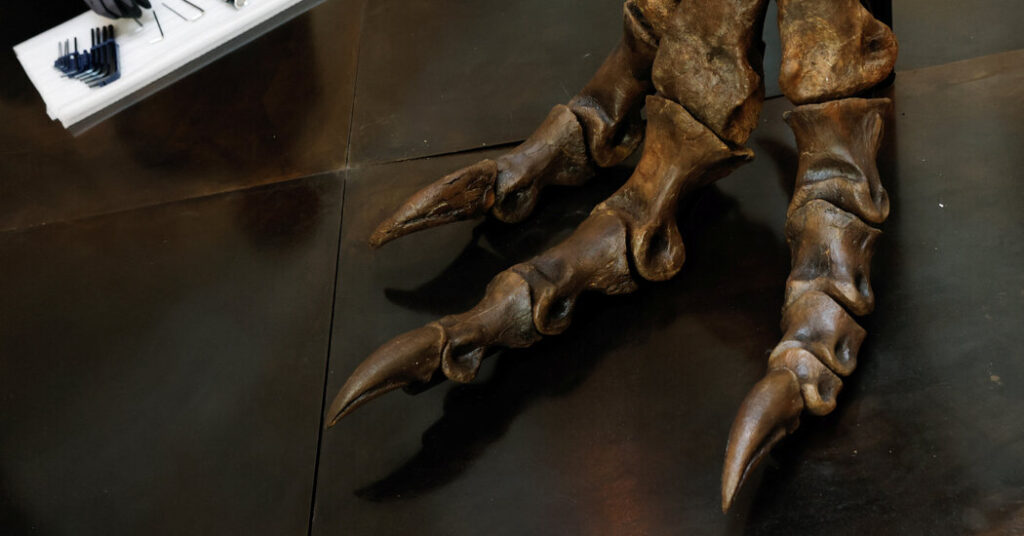
Even the dinosaur’s earthshaking footsteps are being re-examined. An analysis of fossilized tracks and Tyrannosaurus rex’s lower leg anatomy are prompting a reconstruction of the dinosaur’s gait. The findings, published on Wednesday in the journal Royal Society Open Science, reveal that the top of the dinosaur food chain walked on tippy toes, not unlike modern birds.
“This study shows that even the iconic T. rex was quite birdlike in the way that it walked,” said Steve Brusatte, a paleontologist at the University of Edinburgh who was not involved in the study. “It would have been something like an eight-ton chicken clucking about in the barnyard.”
Adrian Boeye, an undergraduate student at the College of the Atlantic in Maine who studies biomechanics, led the project. He was interested in how Tyrannosaurus rex, an animal capable of weighing more than 10 tons, was able to move through its environment and chase down prey.
According to Mr. Boeye, previous efforts to reconstruct T. rex movements often simplified the dinosaur’s feet. “The feet were treated as these rigid blocks,” he said, that would simply stomp on the ground heel-first.
That style of locomotion differs from T. rex’s living relatives. Terrestrial birds, which are also dinosaurs, hit the ground with the front of their feet first. And instead of trudging along, birds use short, quick strides (think of the blur-like steps of the Road Runner in Looney Tunes) to sprint, helping reduce contact with the ground and allowing them to smoothly transition from walking to running. Larger birds utilize these short strides to reach speeds far faster — a sprinting ostrich can hit 43 miles per hour — than other bipedal runners, like humans.
To determine if a far larger animal like Tyrannosaurus rex moved like modern birds, Mr. Boeye and his colleagues examined the dimensions of fossilized footprints left by tyrannosaurs, including a track nearly three feet long from New Mexico. They also examined the lower leg anatomy of several skeletons, including a lanky juvenile T. rex and the full-grown behemoth named Sue. The team had to account for the animal’s muscular tail, and calibrated their models by examining the movement patterns of modern birds.
This data helped estimate the dinosaur’s speed, stride frequency and foot-strike patterns, measuring which part of the foot strikes the ground first.
The work revealed that T. rex likely struck the ground toe-first like modern birds and utilized short and faster strides to reach top speeds. “Rather than taking these bigger and bigger steps, like in Jurassic Park, it would move quickly by rapidly swinging its legs,” Mr. Boeye said. “It would resemble being chased by an oversized bird.”
While the team’s speed estimates are consistent with previous findings, the biomechanical models confirm that T. rexes of different sizes moved at noticeably different speeds. Youngsters were likely to cover over 37 feet per second, while larger adults like Sue topped out at a more leisurely 20 feet per second, around the speed of a Komodo dragon today. The pronounced difference in pace suggests that T. rexes hunted different prey as they aged.
According to Thomas Carr, a paleontologist at Carthage College in Wisconsin who was not involved with the paper, the results provide interesting insights into T. rex’s lifestyle that cannot be deduced from fossilized bones alone. The new findings also emphasize how closely tyrannosaurs are related to living birds. “The tiptoes-first gait can be added to the long list of bird traits that have their origins significantly earlier than the origins of flight, along with feathers and wishbones,” he said.
Mr. Boeye and his colleagues would not be surprised if older theropod dinosaurs were tiptoeing around long before Tyrannosaurus rex came onto the scene.
“Seeing how these dinosaurs move,” he said, “is part of the same evolutionary story as how birds began running around on the ground.”
The post T. Rex Ran on Its Tiptoes ‘Like an 8-Ton Chicken’ appeared first on New York Times.