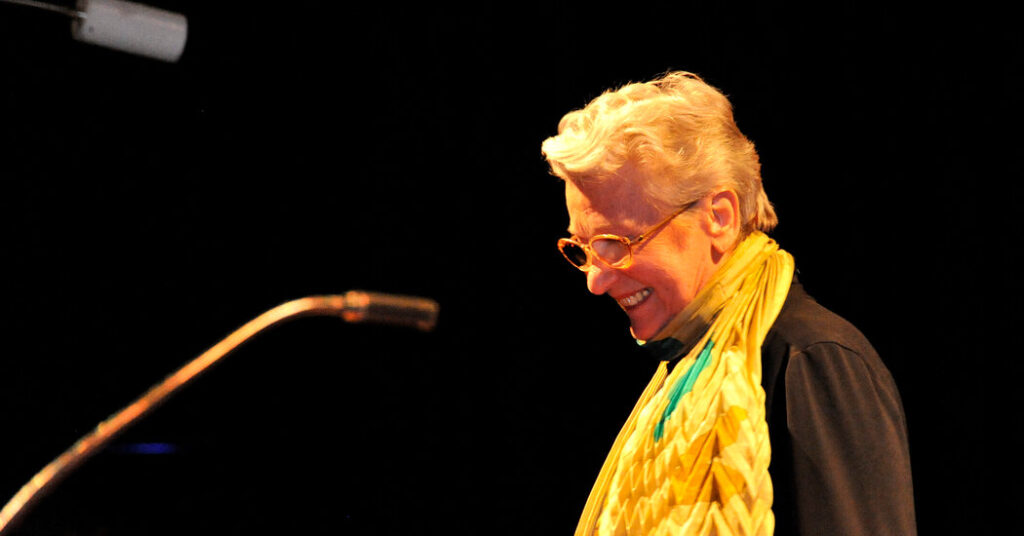
Éliane Radigue, a French composer whose Tibetan Buddhist spiritual practice and experiments with synthesizers came together in vast, slow-moving works that could feel altogether outside time, died on Monday in Paris. She was 94.
Her death, in a hospital, was confirmed by the composer and clarinetist Carol Robinson, a friend and collaborator. She said the cause was complications after a fall.
“Time, silence and space are the main factors constituting my music,” Ms. Radigue told The New York Times for a profile in 2022. “Shivering space, like a soft breath, induces the vibrations of the silence slightly, becoming sound.”
From the start of her career in the 1960s, Ms. Radigue’s stature among her colleagues and listeners grew steadily but slowly, much like the pace of her compositions. Her shifting textures seemed to ebb and flow glacially, without the sense of forward motion or drama that has characterized much of Western music.
In a 1973 review of “Psi 847,” one of her first pieces composed with her beloved ARP 2500 synthesizer, the critic John Rockwell wrote in The Times that the work, which ran more than 80 minutes, “consisted almost entirely of thin, soft, sustained sounds” with “nothing loud, nothing dramatically contrasted.”
“One kept waiting for something to happen,” Mr. Rockwell added. “Then one became aware that on a far smaller level, the sounds were constantly permutating in texture, that a steady stream of sonic activity was in fact taking place right at the edge of one’s perceptions.”
Ms. Radigue’s career could be said to comprise three overlapping phases. Her pioneering electronic work with the ARP 2500 began in the 1970s and continued for about 30 years. In the mid-70s, she embraced Buddhist study and practice and took a three-year break from composing before returning with pieces that included the sprawling “Trilogie de la Mort,” influenced by the Tibetan Book of the Dead. Finally, in the early 2000s, she pivoted from electronic music to collaborations that featured traditional acoustic instruments.
In this post-electronic period, Ms. Radigue produced acclaimed works, like the three-hour “Naldjorlak” (2005-9) and the “Occam” series, an open-ended, multipart composition that she once called an “unfinishable project.” The series, broadly inspired by bodies of water, eventually included 88 parts — solos, ensembles and orchestral pieces — and occupied the last 15 years of her musical life.
Éliane Louise Thérèse Radigue was born on Jan. 24, 1932, in Paris, to Germaine (Lubain) Radigue and Clément Radigue, who was a shopkeeper.
As a girl living through World War II and the German occupation of France, Ms. Radigue studied piano and sang. She became so enraptured with the piano, and with her teacher, that her mother grew jealous and stopped the lessons.
When she was 18, her parents sent her on a trip to Nice, where, at a friend’s house, she met Armand Fernandez, a student who would later become a prominent artist known as Arman. They married in 1953 and had three children.
Ms. Radigue played the piano and studied harp. Though not yet composing, she met, through Arman, the painter Yves Klein and other artists of the Nouveau Realisme movement, who began to influence the direction of her creative life.
She found herself enchanted by “nonmusical” sounds she encountered. In the family’s apartment, near the Nice airport, she began to hear in the takeoffs and landings of jet planes a kind of atmospheric music. She would sometimes hum to herself, with the planes’ engines as accompaniment.
Around the same time, she heard a radio broadcast of “Étude aux Chemins de Fer,” a noise collage, based on recordings of trains, by the pioneering French composer Pierre Schaeffer. It was among the earliest examples of musique concrète, which uses recorded sounds as base material.
The experience was a conversion of sorts. “Of course it’s music,” Ms. Radigue later recalled thinking. “Like flights are music. Like water in a pipe is music. Everything can become music.”
She took a position at Schaeffer’s Studio d’Essai in Paris, which had become a kind of experimental music institute after the war. Working with him and another musique concrète composer, Pierre Henry, Ms. Radigue learned the painstaking art of editing tape.
She first traveled to the United States in 1964 for an extended stay with Arman. They divorced in 1967, and he died in 2005. She is survived by her daughters, Marion Moreau and Anne Fernandez; six grandchildren; and 12 great-grandchildren. Her son, Yves, died in a car accident in the late 1980s.
Ms. Radigue returned to America in the early 1970s, becoming part of a crowd that included important experimental music figures like John Cage, James Tenney, Laurie Spiegel, La Monte Young, Terry Riley and Steve Reich.
Moving away from Schaeffer and Henry’s style, she began to delve into recorded feedback, producing tape- and feedback-based “sound propositions” for specific sites and spaces, which involved careful acoustical planning.
She also began to explore the potential of the synthesizers being developed at the time. After trying a few, she found her musical partner in the ARP 2500.
Her attraction to the instrument, with its rich, multilayered sonic palette controlled by hundreds of knobs and switches, was both immediate and long-lasting.
“The day I came across the ARP,” Ms. Radigue later said, “it was obvious. I didn’t have to look anymore.”
She transported the synthesizer to Paris and installed it in her apartment. She even gave it a name: Jules.
After encountering disciples of the Buddhist teacher Kunga Rinpoche in 1975 — they had attended a performance of her work — she began to study with the lama Tsuglak Mawe Wangchuk. When she returned from her three-year composing hiatus, she created pieces that reflected her devotion, like “Trilogie de la Mort” and two works inspired by the ancient Tibetan poet Milarepa: “Songs of Milarepa” and “Jetsun Mila.”
“Jetsun Mila,” the critic Ben Ratliff wrote in The Times in 2015, “doesn’t really have rhythm, it has oscillations. It doesn’t really have notes, it has frequencies with certain colors and depths. It is inclusive and suggestive and abstract.”
In her 60s, Ms. Radigue finally began to earn broader recognition in France. With the turn of the 21st century, as she aged and the physical demands of composing with Jules grew to be a strain, she accepted her first acoustic commission, from the French bassist Kasper T. Toeplitz. She then took on another, from the cellist Charles Curtis, with whom she would work for the rest of her career.
After decades of composing in relative solitude, collaboration was a revelation. However happy she had been making music in the past, she found, by working with other performers, the sonic qualities that she had been pursuing with Jules — and then some.
“For the first time, I heard the music I’d dreamed of making,” she said of the lengthy “Naldjorlak,” after the Tibetan term for yoga, a work created with Mr. Curtis and two clarinetists, her friend Ms. Robinson and Bruno Martinez.
“Occam Ocean,” named for the concept of Ockham’s razor and begun in 2011 with a small group of musicians, expanded over time to include a network of dozens. In March 2025, Ms. Radigue decided that the project she had called unfinishable would, in fact, end. The last “Occam” piece, “Occam Hexa 8,” a collaboration with Ms. Robinson, premiered in Los Angeles in September.
Those who worked closely with Ms. Radigue have said that the experience was often more spiritual than merely professional.
“Somehow the musicians must give themselves over to the music,” Ms. Robinson said, “and enter into a different state of openness and heightened listening, so that the music in some ways seems to play itself.”
Ash Wu contributed reporting.
The post Éliane Radigue, Composer of Time, Silence and Space, Dies at 94 appeared first on New York Times.