Robert Pozen is a senior lecturer at MIT Sloan School of Management and former vice chairman of Fidelity Investments and president of Fidelity Management & Research Company.
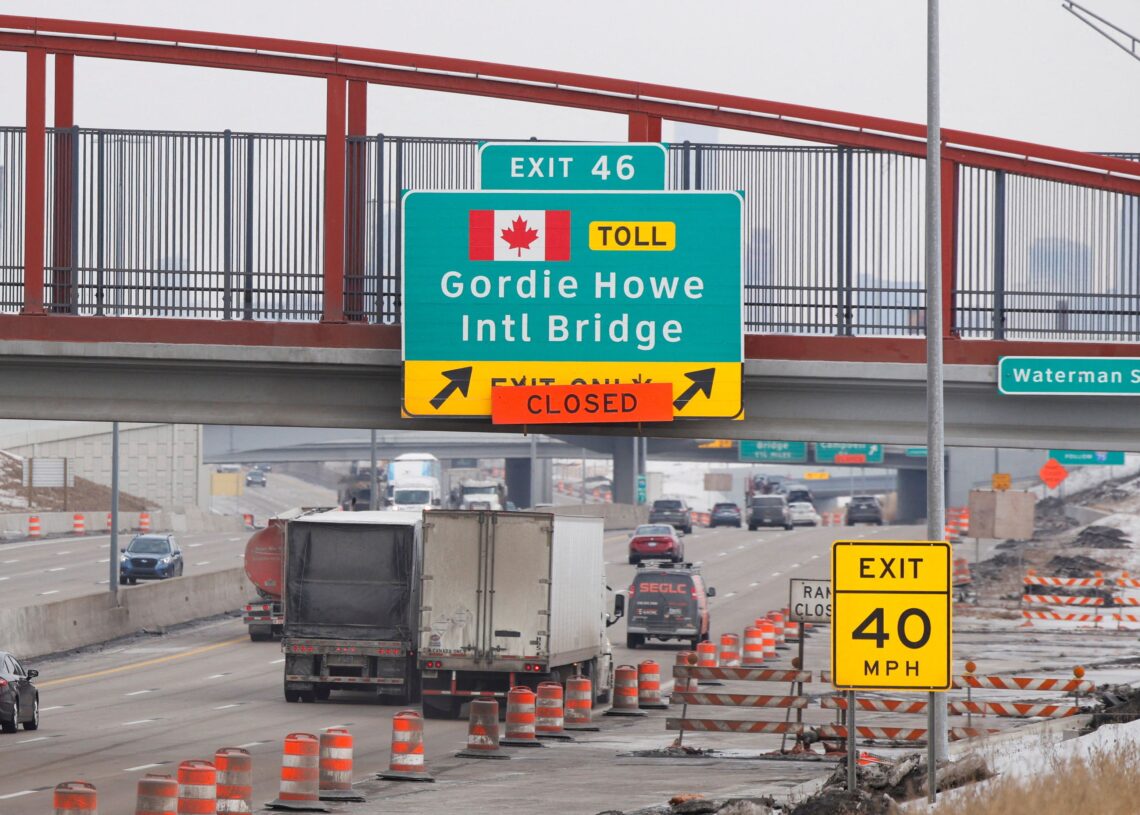
President Donald Trump’s threat to block the opening of the Gordie Howe International Bridge, a new six-lane span linking Detroit and Windsor, Ontario, defies economic logic — and smells suspiciously like a political quid pro quo that will harm the competitiveness of the United States.
During his first term, Trump supported the $4.7 billion project, financed almost entirely by Canada, calling it a “vital economic link.” Yet, referring to this same project, he recently declared on Truth Social, “What does the United States of America get — Absolutely NOTHING!”
That is false.
The new bridge is not simply a Canadian project. It stems from a 2012 agreement between Michigan and Canada, supported by U.S. politicians from both the Republican and Democratic parties. Canada financed the upfront construction costs and will recoup them through tolls. Once those costs are recovered, Michigan will share in future revenue from the bridge.
In short, the United States gains a modern trade artery built largely with Canadian financing, while Michigan retains joint ownership and future earnings.
Moreover, contrary to Trump’s claim that there was “virtually no U.S. content” in the new bridge, the 2012 agreement requires that its structural steel and iron be sourced from the United States and Canada. Several American companies helped build the span. Nucor Skyline, with executive offices in South Carolina, supplied various types of piles. Fluor Corp., headquartered in Texas, is a core member of the Bridging North America consortium responsible for designing, building, operating and maintaining the project. Parsons Corp., based in Virginia, was awarded a key engineering advisory contract.
If the new bridge is blocked, the only winner will be the structure that has the existing monopoly on crossing the Michigan-Ontario border by motor vehicle. The aging Ambassador Bridge, opened in 1929, is now owned by the Moroun family, located mainly in a wealthy Detroit suburb. The bridge carries more than 40,000 commuters, tourists and truck drivers moving $323 million worth of goods across the Windsor-Detroit border each day. This constitutes more than a quarter of total U.S.-Canada trade by value. For decades, the old bridge has been one of the most critical commercial crossings in North America.
The new bridge is essential to modernizing the Michigan-Canada trade corridor. It will create a second freeway-to-freeway link, thereby relieving bottlenecks and congestion on the old bridge. More than 40 percent of Michigan’s GDP derives from foreign trade, with Canada by far the largest market. The manufacturing sector is particularly reliant on an efficient border for just-in-time supply chains. For example, the economies of Michigan and Ontario together produce more than 20 percent of North America’s vehicles, sharing parts and assembly lines across the border.
The new bridge is projected to cut crossing times by roughly 20 minutes per trip and generate an estimated $2.3 billion in transportation savings over 30 years. And the need for redundancy is not theoretical. In 2022, when truck-driver protests over coronavirus vaccine mandates shut down the Ambassador Bridge, U.S. auto plants halted production, with trade losses estimated at nearly $300 million in just a few days. A single chokepoint for one of America’s most important trade corridors is not sound economic policy.
So, what explains Trump’s sudden reversal of position on the Gordie Howe International Bridge? The president seems to be holding the bridge hostage to prevent the adoption of what he perceives as a broad free-trade agreement between Canada and China. However, Ottawa was pushed toward negotiations with China by Trump’s repeated taunts of Canada as the 51st state. In any event, Prime Minister Mark Carney insists that this is a narrow agreement to resolve existing trade issues with China.
More suspiciously, Commerce Secretary Howard Lutnick met early this month with Matthew Moroun, whose family has aggressively lobbied against the building of a new bridge. Less than a month before that meeting, Moroun donated $1 million to MAGA Inc., a super PAC devoted to Trump. Immediately after that meeting, Lutnick reportedly called Trump, who a few hours later announced his strong opposition to opening the new bridge.
For years, both political parties in the U.S. supported infrastructure projects that boost trade and create jobs. The Detroit Regional Chamber has described the bridge as “the most consequential infrastructure project in the state and region of this generation.” More pointedly, Rep. Haley Stevens (D-Michigan) complained that Trump is “threatening to block one of the Midwest’s most important infrastructure projects, putting thousands of Michigan jobs and billions of dollars in economic growth at risk.”
That threat does not put America first; it undermines American competitiveness. Turning down a fully built, Canadian-funded bridge to and from Detroit is economic malpractice.
The post Why is Trump blocking this bridge to Canada? Something stinks. appeared first on Washington Post.