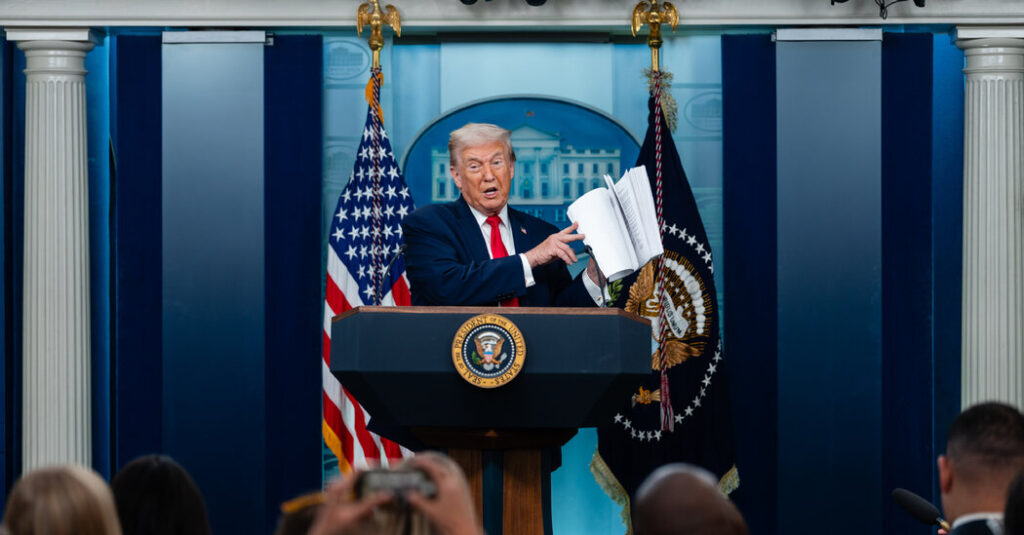
President Trump had been back in office for only six weeks last year when he told a joint session of Congress that Democrats had left the country in a mess and that he was cleaning it up.
Now, as Mr. Trump prepares to deliver his State of the Union address on Tuesday evening, the effects of his policies and actions are starting to come into focus. He has had a polarizing, whirlwind year, enacting fundamental changes to U.S. politics and society.
At the same time, the country is also seeing changes tied to longer-term, national trends.
Here is a by-the-numbers look at where the country was last year versus now.
Approval numbers are down.
Forty-one percent of Americans approve of Mr. Trump’s performance, according to a daily average of polling data compiled by The New York Times. That is a significant decline from a year ago, when he recorded a 49 percent approval rating at the start of his presidency.
Polling has shown voters becoming disappointed with Mr. Trump over two subjects once thought to be winning issues for him: the economy and immigration.
Inflation has eased.
Overall inflation eased to 2.4 percent at the start of the year, down from 3 percent when Mr. Trump took office. Inflation reached a four-decade high of 9.1 percent in the summer of 2022.
The overall inflation number is particularly important to Mr. Trump, who has tried to dismiss voters’ concerns over affordability. But core inflation, which filters out volatile food and energy prices, remains high.
Deportations are up.
The Trump administration has deported about 540,000 immigrants so far in the past year, according to a New York Times analysis of government data — well shy of its goal of one million. But the deportation of 230,000 people who were arrested in the country, rather than at the U.S.-Mexico border, largely exceeds the 50,000 interior deportations recorded during the last year of the Biden administration.
Illegal crossings are down.
Border Patrol recorded just over 6,000 illegal crossings at the U.S.-Mexico border in January, according to Customs and Border Protection data. That is a substantial drop from the roughly 29,000 illegal crossings during the same time last year.
Crossings began to decline during the tail end of the Biden administration. But after a flurry of executive actions and collaboration with the Mexican authorities, illegal crossings remain at record lows.
The labor force is holding steady.
Mr. Trump has said “we have the most people working in history,” which is true. But most presidents not in office during periods of economic downturns or recessions could make the same claim because of population growth.
More people are employed now — about 159 million people in January — than at any other point in U.S. history. But the population of the United States is also the biggest in history.
Labor force participation — those who were employed or actively looking for a job — has held steady under Mr. Trump, changing little from 62.6 percent in January 2025 to 62.5 percent last month.
Homicides are down.
The murder rate has been falling steadily since 2020, and the numbers for last year — which are still being calculated — are on track to be the lowest in 125 years. The Council on Criminal Justice, a nonpartisan think tank, estimated that the national homicide rate was likely to fall to 4.0 per 100,000 residents for 2025.
The rate for 2024 was 5.0 per 100,000 residents, according to official F.B.I. data.
Executive orders are way up.
Mr. Trump has issued at least 243 executive orders during his second term as of Feb. 20, as he muscles past Congress and erodes independent checks on the White House. President Joseph R. Biden Jr. signed 162 executive orders during his time in office, according to the Pew Research Center. In December, Mr. Trump eclipsed his total of 220 executive orders during his first term.
Zolan Kanno-Youngs is a White House correspondent for The Times, covering President Trump and his administration.
The post Trump’s State of the Union, By the Numbers appeared first on New York Times.