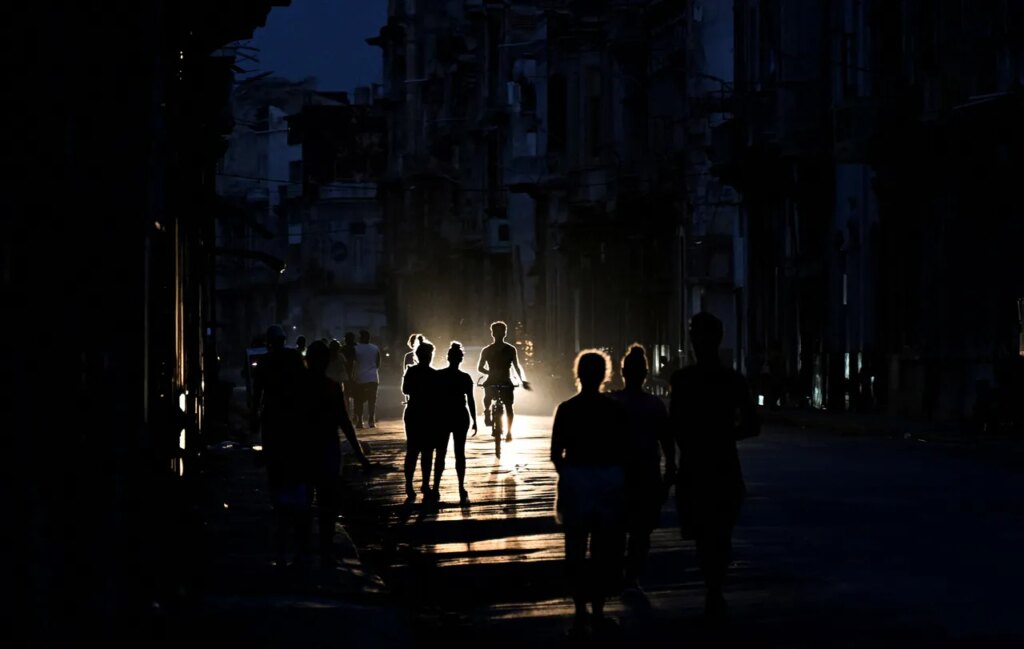
It’s 5:30 in the morning in Arroyo Naranjo, a municipality located to the south of Old Havana. Javier (who is 27) and his father, Elías (64), cannot remember the last time they walked hand in hand. Now they are taking short steps, side by side, because in the early-morning darkness they can barely see their hands in front of them. They can only hear the whispers of neighbors, chatting in their homes, as they walk in this suburb on the outskirts of Cuba’s capital city.
They haven’t showered in over a day and their house hasn’t had electricity for more than 16 hours. The power outage coincided with the day when the aqueduct pumps water into this area, so the neighborhood’s water tanks are also empty. They are hungry and thirsty. The little they had left in the refrigerator—some chicken and the last two sausages from a pack of five—had to be shared between four people. If they didn’t eat them, they would soon rot. To cook their meal, they built a makeshift charcoal stove on the roof, using stones and wood boards; gas tanks haven’t been refilled in this municipality for a month. They are tired. They have hardly been able to sleep because of the heat and the stench coming from the overflowing trash containers on the corner, which are now blocking traffic. And because there is no electricity, the only way they can make sure that they get up on time in the morning is to keep their eyes always half open so they can be their own alarm clocks.
Javier and Elías are the first to arrive at the bus stop that morning. Before long, five other people join them: four men and one woman. At 6:30 am, 30 minutes after the bus they’d been waiting for had been scheduled to arrive, they all decide to return home. The transport that was supposed to take them to military exercises that they were required to attend as members of the reserves of the Revolutionary Armed Forces never showed up. (Their participation in the reserves takes place on weekends: Javier works in tourism, and Elías is retired.)
This scene took place in January, two Sundays after the US government removed Nicolás Maduro from power in Venezuela. Javier and Elías shared the story of their failed attempt to attend the mandatory exercises during a video call that took place after power came back on in their neighborhood.
The US operation in Caracas and President Donald Trump’s aggressive statements (“Cuba looks like it’s ready to fall,” he told reporters aboard Air Force One, “I don’t know if they’re going to hold out”) have forced the regime to be on high alert with a series of measures in preparation for a “state of war,” a strategy of general mobilization of the population that has been implemented since the 1980s to deal with external threats.
Javier, Elías, and the other civilians who were expected to participate in the military exercises would later be informed that the buses scheduled to transport reservists from Arroyo Naranjo and other municipalities were unable to operate because of a lack of fuel. “Stay in touch and be alert,” they were told. Elías said to me: “What happened to us sums up Cuba today. It’s a country that doesn’t have enough fuel for trucks to collect garbage from neighborhoods, and even though we are about to be invaded, we don’t have the resources to defend ourselves.”
A Country Without Oil
The lack of fuel in Cuba has the country on the brink of total collapse. There are 16 thermoelectric power plants in Cuba, but six are out of service, and two of those are the largest generators of electricity in the country. Since early 2025, this situation has caused the population to spend days without power. Blackouts commonly last from 12 to 20 hours every day throughout the country.
Cuba, home to 9.7 million people, has seen its economy contract by more than 15 percent since 2020. After my conversation with Javier and Elías, blackouts left nearly 64 percent of the country without power during the late afternoon and evening, the time of day when energy demand is highest.
In addition to the other challenges Cuba was already facing, Maduro’s imprisonment by the United States has created another. Since Hugo Chávez was president of Venezuela, the country had been Cuba’s main supplier of oil. Maduro continued to send Venezuelan oil to Cuba until his capture. It’s no exaggeration to say that the island survived, in terms of energy, at least, thanks to Chavismo. In the past two years, Venezuela has supplied more than 50 percent of Cuba’s oil needs. In late 2025, Venezuelan oil exports to the island were estimated at around 30,000 barrels per day.
Now, Trump has declared that those shipments will stop. Cut off from its main source of crude oil, Cuba finds itself exposed, a circumstance that the US president wants to take advantage of as he decrees the death of Castroism. He has also decided to impose tariffs on other countries that provide Cuba with oil, seeking to further isolate it in order to force negotiations.
The last ship carrying crude oil from Venezuela arrived in December 2025 with 598,000 barrels. That oil, plus the 84,900 barrels sent by Petróleos Mexicanos (Pemex) a week after Maduro’s capture, is all the regime has to survive the coming weeks. The regime was counting on support from Mexico, but after pressure from Trump, President Claudia Sheinbaum has, for the time being, promised food and medicine but not crude oil.
According to the consulting firm Kpler, Cuban oil reserves are in critical condition. Imported crude oil is essential for the electrical system, transportation and, therefore, the economy. The Cuban leadership appears to have no other alternative than to choose between negotiating with Trump to lift the blockade or leading the country into an economic paralysis.
Food or the Internet
One of the issues that will be at the forefront, if the Cuban regime finally sits down with Trump to negotiate a way out of its current situation, will be internet access, a key concern of those opposed to the government.
The Trump administration anticipated this in a June 2025 fact sheet, announcing increased restrictions on the island and an amplification of “efforts to support the Cuban people through the expansion of internet services, free press, free enterprise, free association, and lawful travel.”
In 2015, when internet services began to expand in Cuba, many Cubans had access to the web for the first time in their lives, and the impact was profound. The regime lost the monopoly on information that had existed for years. As the country’s only legal political party, the Communist Party had been able to construct the country’s narrative as it saw fit through its media outlets. The emergence of social media, where activists, artists, and opponents of the regime were able to share their work and their messages, along with the rise of independent media, empowered a dissident civil society that had long struggled to be heard.
Six years later, in 2021, the opposition to the regime was strong enough to attempt to change the country’s status quo with calls for an end of repression and human rights abuses. Citizens took to the streets in almost every city. They demanded freedom, an end to the dictatorship, and a new beginning for the nation. The regime responded with violence: one death, more than a thousand political prisoners, and forced exile for others. Finally, it tightened surveillance and access to the internet, which had been central to the opposition movement.
Since then, Castroism has brought an increased focus to control of the internet as it tightens the screws of repression to prevent another uprising.
The only telecommunications company in the country, ETECSA, has raised its rates in an attempt to reduce internet usage. Today, Cubans can renew their phone data only once a month at a price of 360 Cuban pesos (about $1.25), which buys six gigabytes. If someone wants more data, they must pay 3,360 Cuban pesos (about $7.55) for three additional gigabytes, an amount higher than the monthly pension of retirees (2,075 Cuban pesos or about $4.65). That figure also represents more than half the average monthly salary of state workers (6,506 Cuban pesos or about $14.60).
According to the digital news portal Cubadebate, average monthly internet consumption was 10 gigabytes before the rate increases. People are spending much less time on the internet, because they can’t afford what they used to consume, which would now cost more than many people earn at their jobs.
My mother, who lives in Havana, provides one example of the impact of the increase in the price of internet service. (I live in exile in Barcelona.) A few days ago, she wrote to me on WhatsApp: “It’s not that I don’t want to write to you, son, it’s just that the money isn’t enough to pay for food and the internet. It’s one or the other.”
Raising prices to reduce internet usage is only one part of the Cuban regime’s strategy to silence messages of discontent among its citizens. The other part is repression, which manifests itself through digital surveillance of opinions and content, as well as blocking most independent media outlets.
All of this was studied by the organization Prisoners Defenders, which documented in detail the systematic digital surveillance by the regime of its citizens.
It’s “a panoptic social control ecosystem,” whose main objective is “the neutralization of dissent, the inhibition of public debate, and the dismantling of independent social, civic, and political networks,” according to a report that details, among many other issues, how “88 percent of those surveyed stated that authorities had cited their digital activity or messages as grounds for summonses, arrests, and interrogations.”
As a result of his online activity, Aroni Yanko spent a year and a half in prison. He had posted a meme on his WhatsApp status showing Raúl Castro, President Miguel Díaz-Canel, and Prime Minister Manuel Marrero naked and tattooed. Mayelín Rodríguez Prado was sentenced to 15 years in prison after a Facebook post about protests that took place in the streets of Nuevitas, a town in the Camagüey province. Víctor Manuel Hidalgo Cabrales spent a year and four months in prison after writing a post on Facebook: “Hey, Las Tunas [a city in Cuba], what’s up? They turn it [electricity] on for four [hours] and then turn it off for five or six. Are we going to put up with this?”
And so, Javier and Elías, on that night in Havana, many hours after Trump posted the historic image of Nicolás Maduro in a gray tracksuit, with his hands cuffed and his eyes covered on the warship that took him to the United States, used the little battery life left on Javier’s phone (they had been without electricity for more than 10 hours at that point) to ask me if the news of Maduro’s capture and Trump’s subsequent warning that now, without Venezuela, Cuba would be next was true. “Yes, it’s true,” I replied. I sent them a photo of Maduro and a video of Trump talking about Cuba. When we next chatted, I realized he had deleted both files. I didn’t ask why.
This story originally appeared in Wired en Español. It was translated by John Newton.
The post Life in Cuba Under Trump’s Pressure Campaign: No Electricity, No Oil, and Impossible Choices appeared first on Wired.