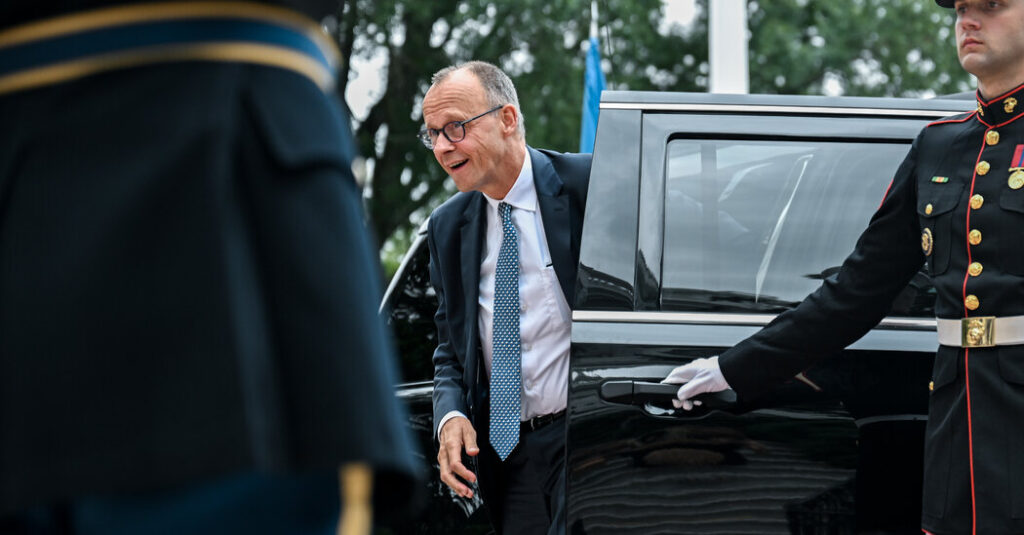
Chancellor Friedrich Merz of Germany has spent the opening months of this year sketching out a new vision for Europe in a world increasingly shaped by the bullying behavior of superpowers.
His idea is roughly this: Europe should cut its dependence on China and the United States to avoid being pushed around on the global stage — but it should not cut them off entirely.
This week, Mr. Merz will road-test that idea on a trip to Beijing and Hangzhou, China. It will be his first visit to the country since he became chancellor last year, challenging his ability to address tensions between Berlin and Beijing — on trade, Taiwan, Ukraine and a host of other issues — without further inflaming them.
German officials suggest Mr. Merz will seek to minimize conflict with China’s top leader, Xi Jinping. But they also say he will push Mr. Xi on sore spots in the countries’ relationship, including Chinese economic policies that hurt German manufacturers and Beijing’s backing for President Vladimir V. Putin of Russia four years after the full-scale invasion of Ukraine.
Mr. Merz is expected to stress that Germany and Europe are strengthening their military defense capability and economic competitiveness — effectively, a vision for how Europe can build its own power to rival China and America.
And while Mr. Merz will emphasize the need for improved ties with China, he has made clear that he still sees the United States as Germany’s more natural ally.
At a conference of his center-right Christian Democrats last weekend, the chancellor said China was “claiming the right to define a new multilateral order according to its own rules. Freedom of expression, freedom of religion and freedom of the press are not part of this understanding.”
Given that, Mr. Merz added, “wouldn’t it be right that we Europeans, together with the Americans, have something better to offer in response to our shared understanding of freedom, indeed our shared image of humanity?”
The chancellor’s trip will be the fifth to China by the leader of a U.S. ally since December. Chinese officials appear eager to cast the visit as yet another important country turning toward Beijing for stability amid the uncertainty unleashed by President Trump. His administration has disrupted global trade with a flurry of tariffs, while pulling back on America’s longstanding security guarantees for Europe.
In seeking closer ties with Germany, the world’s third-largest economy and the industrial heart of Europe, Mr. Xi is attempting to further splinter the United States from its historical allies. Mr. Xi has already reset ties with Canada and Britain during their leaders’ visits to Beijing this year.
China’s top diplomat, Wang Yi, recently signaled at the Munich Security Conference that Beijing wanted to draw Berlin closer, and called on the two countries to upgrade bilateral ties to a “new level.” Mr. Wang also said China supported Berlin’s “strategic autonomy,” which Beijing understands to mean the weakening of American influence over Germany.
“The aim of China’s leadership is quite simple,” said Noah Barkin, an expert on European-Chinese relations at Rhodium Group, a research firm. “It wants to present itself as a guarantor of stability in a world rocked by U.S. unilateralism and aggression. The sequence of European visits are meant to underline this message and reinforce a narrative of trans-Atlantic division.”
But there is still plenty of division between Germany and China, particularly on economic issues. After decades of courtship by German industry and chancellors, including Angela Merkel, the country’s former leader and Mr. Merz’s longtime intraparty rival, China was Germany’s top trading partner last year.
Mr. Merz still sees China as a crucial export market and an incubator of innovation for German companies with significant operations there. He will visit two of those companies’ operations — Mercedes-Benz and Siemens, as well as China’s Unitree Robotics — on his trip, along with a delegation of 30 German business leaders.
But he appears more candid than Ms. Merkel was a decade ago about the need to protect German industry from Chinese competition, and he is already eyeing alternative sources of consumer demand for German products. Notably, Mr. Merz visited India before he visited China as chancellor.
In Beijing, Mr. Merz is expected to raise concerns with Chinese officials over their subsidies for domestic manufacturing and the artificially low value of its currency, the renminbi. Both are being used to help China flood European markets with low-cost products that Mr. Barkin estimates are contributing to the loss of nearly 10,000 German industrial jobs a month.
Officials from both sides have expressed hope that the discussions could yield modest agreements, perhaps in opening some trade in agriculture. But many analysts say Mr. Merz’s primary goal should be striking a new tone with Mr. Xi.
“There is very little to be secured from the Chinese side right now,” said Thorsten Benner, co-founder and director of the Global Public Policy Institute, a Berlin-based think tank. “The most important thing is that he sends a clear message about defending Germany’s economic interests.”
Beijing has urged Mr. Merz to further open Germany’s and Europe’s market to Chinese exports. That includes for Chinese electric vehicles, which pose a direct threat to Germany’s legacy auto industry.
Mr. Xi has some leverage in the discussions. Germany’s 40 leading blue-chip companies rely on China for more than 10 percent of their revenues, according to research from Deutsche Bank. Many German manufacturers would grind to a halt without vital Chinese industrial inputs like rare earth minerals. Mr. Xi has already demonstrated he is willing to throttle supplies when Chinese interests are threatened.
Chinese officials are likely to push Mr. Merz to support Beijing’s claim to the self-governed island of Taiwan. Germany does not recognize Taiwan as a sovereign country, but it maintains diplomatic relations with the territory. China rebuked Germany’s foreign minister, Johann Wadephul, last year after he criticized Beijing for its “increasingly aggressive behavior” in the Taiwan Strait.
Mr. Merz, in turn, is likely to push Mr. Xi to pressure Mr. Putin to end the war in Ukraine, though in careful language. Mr. Merz sometimes says there are three men who could force the war to an immediate end: Mr. Putin, Mr. Xi and Mr. Trump.
The chancellor will see two of the three in the span of a week. A few days after returning to Berlin from China, he is scheduled to fly to Washington to visit Mr. Trump.
Pei-Lin Wu contributed reporting from Kaohsiung, Taiwan.
Jim Tankersley is the Berlin bureau chief for The Times, leading coverage of Germany, Austria and Switzerland.
The post Germany’s Leader Heads to China and Walks a Tightrope Between Xi and Trump appeared first on New York Times.