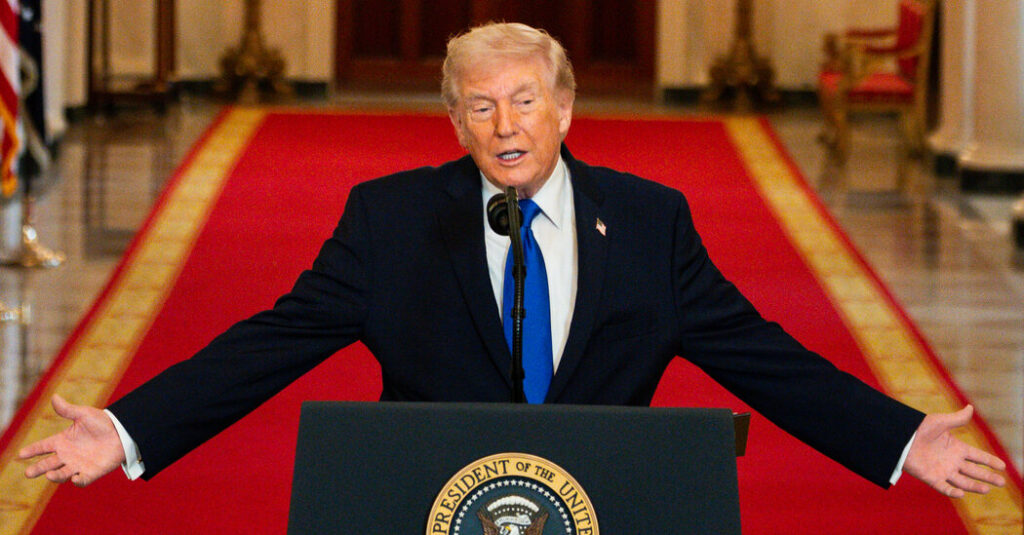
Since the Supreme Court last week struck down his use of an emergency law to impose tariffs, President Trump has drawn on another novel and unproven legal provision in a bid to replace them.
But that tactic could soon see its own challenges. Legal experts are now debating whether the Trump administration may have overstepped again when it tapped a 50-year-old law to impose a 10 percent tariff on nearly every import from around the world. Some of Mr. Trump’s longtime critics on trade are considering another round of lawsuits against his new tariffs.
Their complaints center on Section 122 of the Trade Act of 1974, a little-known set of powers that allows the president to impose duties for up to 150 days in response to “large and serious United States balance-of-payments deficits” or other situations that present “fundamental international payments problems.”
On Tuesday, the administration used the law to impose a 10 percent tariff on imports. While Mr. Trump said on Saturday that he would raise the rate to 15 percent, a White House spokesman said that the higher increase was still being worked on and that he did not have a timeline for when it might take effect.
The Trump administration claims that it can use Section 122 because the law applies to issues with the “balance of payments,” which is a record of all of the goods, services, money, stocks and other assets that flow in and out of a country each year.
The administration says the balance of payments is related to the U.S. trade deficit, the amount by which imports exceed exports. The administration has been trying — somewhat unsuccessfully — to reduce the U.S. trade deficit by imposing tariffs.
But some analysts question the administration’s logic. Section 122 was passed by Congress in 1974, in the years after the United States abandoned the use of gold as a peg for its currency. Critics say the law was directed at the kind of economic issues that would arise under a fixed exchange rate, which no longer exists.
The administration itself has argued that this provision was not meant for the kind of tariffs Mr. Trump wants to impose. During legal arguments last year, the Department of Justice tried to persuade a court that the president should be allowed to use an international emergency law to impose tariffs, because Section 122 wasn’t appropriate for the situation.
In a brief submitted to the Court of Appeals for the Federal Circuit last year, the administration’s lawyers wrote that Section 122 did not “have any obvious application here, where the concerns the President identified in declaring an emergency arise from trade deficits, which are conceptually distinct from balance-of-payments deficits.”
No president has invoked Section 122 before, so it’s unclear how a court would rule on its use.
Scott Lincicome, a trade expert at the libertarian-leaning Cato Institute, said Mr. Trump “was a little out over his skis when he said that was a legally tested provision.” The threshold in the law is a “large and serious balance-of-payments issue,” but the statute is silent in defining what that is, he said.
“I think somebody will sue,” Mr. Lincicome said, noting that the stakes for some companies could reach into the “tens of thousands if not millions of dollars.”
By Tuesday, many economists and legal groups were still deciphering the scope and impact of the justices’ opinion and Mr. Trump’s response. Some said they were only starting to consider, or at least had not yet ruled out, a return to court to fight any concerns of presidential overreach.
Oliver Dunford, the senior lawyer at the Pacific Legal Foundation, which helped a collection of businesses including the clothing company Princess Awesome sue over the president’s emergency tariffs, said his group might mount another lawsuit.
“We’re certainly thinking about it,” Mr. Dunford said. “The problem the president has identified under Section 122 doesn’t exist.”
Andrew Morris, senior litigation counsel for the New Civil Liberties Alliance, another group that previously sued the administration, said his organization was still “analyzing” the new tariffs but could not say either way how his organization might proceed.
The group that helped to bring the original case that reached the Supreme Court, the Liberty Justice Center, also signaled it was taking a closer look. Sara Albrecht, the group’s chair, said in a statement that the group was “closely monitoring any new statutes being invoked.”
“We are not ruling anything out,” she added.
Others have defended the administration’s use of Section 122 to impose tariffs. Marc L. Busch, a professor at Georgetown University, and Daniel Trefler, a professor at the University of Toronto, wrote in a blog post last year that the “whole point” of Section 122 was to “hand the executive a tool to address the very condition the executive now calls the trade deficit.”
“Suggesting otherwise is akin to handing the president a fire hose and insisting it can only be used for kitchen fires, not living room fires,” they wrote.
Some analysts argue that the economic facts may not matter much either way in how a court rules on the law. Courts have typically deferred to a president to determine whether a particular economic condition exists.
In the case over the emergency law, for example, the Supreme Court did not weigh in on Mr. Trump’s argument that trade deficits constituted an economic emergency. Instead, justices focused on whether the law itself allowed for tariffs.
“The case law suggests that courts are probably going to be pretty deferential to the president on the finding here,” said Peter Harrell, a former Biden administration official and a visiting scholar at Georgetown’s Institute of International Economic Law.
For many prominent economists, however, the problems they see in the Trump administration’s economic arguments matter.
Economists have long disagreed with Mr. Trump’s single-minded focus on the trade deficit, saying that it’s a complex metric that is driven not mainly by trade practices, but by bigger forces like economic growth, savings rates and government spending.
Gita Gopinath, a Harvard economist and former first deputy managing director of the International Monetary Fund, said the administration had also made inaccurate claims as it laid out its legal justifications for using Section 122.
In a Feb. 20 proclamation, the president said that the United States faced “fundamental international payments problems, such as large and serious balance-of-payments deficits, an imminent and significant depreciation of its currency in foreign exchange markets, or an international balance-of-payments disequilibrium.”
Ms. Gopinath said that a country has a balance-of-payments problem “when it is at risk of losing access to financial markets.”
“If borrowing costs rise sharply because foreign investors lose faith in the country’s ability to repay, then that can trigger a payments problem,” she said. “The U.S. does not have that problem.”
Before 1971, the currencies of many other countries were pegged to the value of the dollar, and each U.S. dollar was redeemable for a certain amount of gold. The United States had begun importing more than it was exporting, increasing the supply of dollars around the world.
That risked a so-called balance-of-payments crisis, where foreign countries had the right to demand more gold than the United States possessed, threatening the world’s confidence in the U.S. government and in the dollar.
In 1971, shortly before the trade law containing Section 122 was passed, President Nixon ended that system. The United States decoupled the value of the dollar from gold, and the dollar and other currencies were allowed to adjust against each other freely.
Gary Hufbauer, a nonresident senior fellow at the Peterson Institute for International Economics, a Washington think tank, said that by the time Section 122 was passed in 1974, Congress was giving the president tools to deal with an exchange rate system “that no longer existed.”
“In a system of floating exchange rates, there’s no such thing as a balance-of-payments deficit,” said Mr. Hufbauer, who served as a consultant to the Treasury in the 1970s around the time that Mr. Nixon was closing the gold window.
“So President Trump comes along and discovers this statute, and they interpret balance of payments to mean a merchandise trade deficit or a current account deficit,” he said. “At the time the law was passed it did not mean either of those things, but what the heck.”
Ana Swanson covers trade and international economics for The Times and is based in Washington. She has been a journalist for more than a decade.
The post Fresh Off a Supreme Court Loss, Trump Could Face New Challenges on Tariffs appeared first on New York Times.