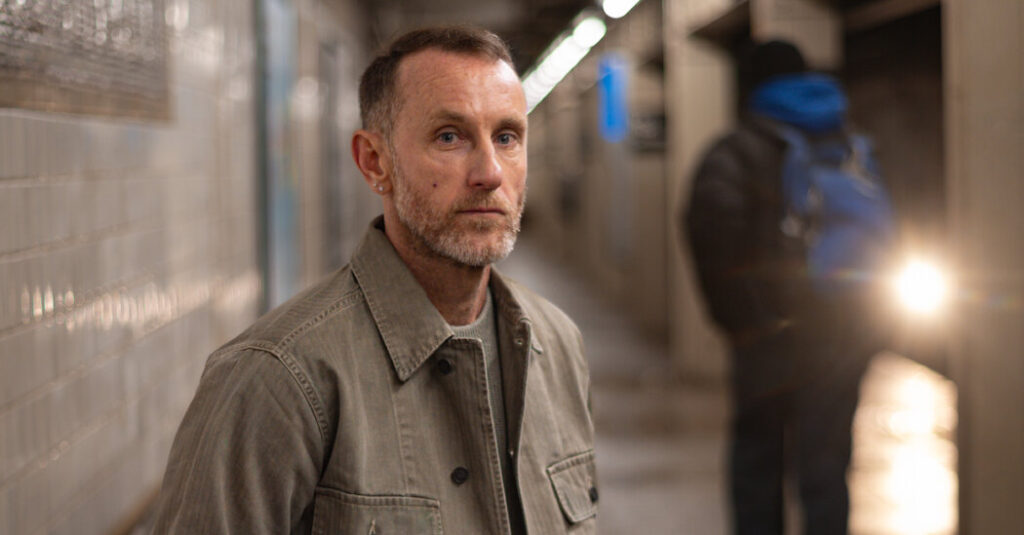
Joseph Lynskey survived being pushed into the path of an oncoming subway train last winter, spending nine minutes lying in a pool of his own blood beneath the hulking train car, inches from the electrified third rail.
His effort to find the courage to get back on the subway has been its own challenge — and a necessity.
“I had felt like a piece of my life in New York had been taken from me,” he said from his studio apartment in Brooklyn recently.
Being pushed in front of a train is among the greatest fears of city dwellers. When that nightmare became Mr. Lynskey’s reality, some assumed he would forsake the city, or at least its underground transportation system.
But the subway is a main character in Mr. Lynskey’s life, as it is for so many New Yorkers.
His fear of being killed by a train created its own hell, isolating him from friends who lived farther away than his feet could take him, the tennis courts that had kept him active and the music venues and museums that had fed his soul.
To help pressure the Metropolitan Transportation Authority and the city to do more to make the subway safe, Mr. Lynskey, 46, filed a lawsuit on Tuesday claiming negligence and disregard for the safety of its riders. In the suit, he argues that the M.T.A., which operates the system, and the city, which is responsible for policing it, ignored its own data about the risk to riders of being pushed — especially by people with mental illness — as well as the recommendations of M.T.A. engineers for how to bolster safety. The suit seeks unspecified monetary damages.
“Only by holding defendants accountable for their negligence, gross negligence, and reckless conduct will the defendants be forced to take responsibility,” the suit says.
“The safety of every rider should be the main concern, and the M.T.A. and the city have ignored it for years,” said Bruce Nagel, one of the lawyers representing Mr. Lynskey.
Representatives for the city and the M.T.A. did not immediately respond to requests for comment.
Mr. Lynskey thought he was the only person in the 18th Street subway station in Manhattan after lunch on Dec. 31, 2024. He said he had waited there less than a minute when, just as a Brooklyn-bound train barreled into the station, he felt a giant shove from behind.
He came to and found himself on the tracks, the train having stopped — on top of him — in the station. For nearly 10 minutes, he lay as still as possible next to the electrified third rail that he knew could kill him. Two firefighters then climbed under the train and dragged him to safety.
On a gurney on the subway platform, bleeding from his head as rescue workers cut off his clothes, Mr. Lynskey begged for someone to make sure Leo, his 16-year-old dachshund who was waiting for him at home in Brooklyn, was cared for.
He had suffered four broken ribs, a fractured skull, a ruptured spleen and a concussion, to say nothing of the psychological trauma.
Kamel Hawkins, then 23, was arrested later that day and charged with second-degree attempted murder. He pleaded not guilty, but his trial has been delayed while he receives psychiatric care, according to court records.
After a week at Bellevue Hospital, Mr. Lynskey began a longer process of recovery. It was physical. It was emotional. It was powered by his determination to reclaim the New York City life of diverse culture and community that he treasured.
He spent much of the winter isolated in his apartment. When he needed to travel farther than he could walk in the cold, he ordered an Uber. “I am not someone who typically takes cars or cabs,” he said. “I am a New Yorker, and in New York everyone takes the train because it’s the fastest and most reliable way to get around the city.”
As his ribs healed and the weather warmed, he began to get out more by riding Citi Bikes. In March, he ventured back to the city’s tennis courts. He visited museums in Brooklyn and Manhattan. But he still felt reined in.
Last summer he began exposure therapy, with a goal of finally getting back on the subway.
First, he rode a bike to the Manhattan Bridge, where the train runs above ground. There, he acclimated himself to the last sound he had heard before he was pushed — the guh-gung guh-gung of the train approaching.
Next, he spent time on the steps of subway stations, and then on platforms with his back pressed against the wall. He worked closely with a therapist, talking through the sleeplessness he suffered each night as he relived the feeling of being pushed, and the way his heart pounded when he walked by an entrance to a station.
He motivated himself with reminders of what awaited him in more distant parts of the city — art, sports, music. He saw Nine Inch Nails perform at Barclays Center. He watched Venus Williams play doubles at the U.S. Open. He went to see Diane Arbus’s photography show, “Constellation,” at the Park Avenue Armory. “I Citi Biked all the way to the Upper East Side,” he said, “and all the way back to Brooklyn.”
But by November, the cold was encroaching again. Then Leo — who had helped Mr. Lynskey survive the emotional aftermath of the subway attack — died after a brief decline.
Another sign. It was time.
With his two best friends, Mr. Lynskey descended the steps of the Fulton Street station in Brooklyn. As the G train roared into the station, the men clasped hands and dashed onto the train. “I started crying but I was happy for myself,” Mr. Lynskey recalled. They rode six stops to Greenpoint and went out to lunch. Then Mr. Lynskey made the return trip alone.
Days later, he celebrated his reclaimed mobility by attending a Patti Smith performance of her 1975 album “Horses” at the Beacon Theater on the Upper West Side, a distance from his Brooklyn home most efficiently traversed by train.
At the end of the year, Mr. Lynskey faced another emotional marker: the anniversary of the day he escaped an almost certain death. There was no question of how he would spend it.
He waited on the stairs of a Brooklyn subway station until the train pulled in. He hopped on. He exited in Chelsea, stopped by a bakery and then headed to the Engine 3, Ladder 12 and Battalion 7 firehouse, the home base of the Fire Department crew that had rescued him. One of the two firefighters who had climbed under the train to pull him out was on duty.
“I had to thank him for getting me to another New Year’s Eve,” Mr. Lynskey said. “I have sort of a new birthday.”
Since then, he has been riding the subway more frequently, though he always waits on the stairs until the train has pulled in.
Recently, he was on a No. 6 train on the east side of Manhattan. He got off at 23rd Street and took note of a few waist-high barriers placed sporadically along the edge of the platform. “A little tiny fence that it’s hard to imagine could protect anyone,” he called them.
Then, on the other side of the platform, he noticed taller, high-tech entry gates meant to prevent fare evasion. The M.T.A. intends to install them at about a third of the city’s subway stations over the next five years, at a cost of $1.1 billion.
“Fare evasion is important, and the M.T.A. has to be funded so they can do things like protect their citizens,” Mr. Lynskey said.
“But when you look at those entry gates, with all the bells and whistles, and then look in the other direction and see these tiny, randomly placed fences,” he added, “it feels like a tale of two priorities.”
He is focused on being a voice for prioritizing safety. “What happened to me was not an anomaly,” Mr. Lynskey said. “It was preventable, and it should not happen to anyone else.”
Katherine Rosman covers newsmakers, power players and individuals making an imprint on New York City.
The post After Being Shoved in Front of a Train, He Has Returned to the Subway appeared first on New York Times.