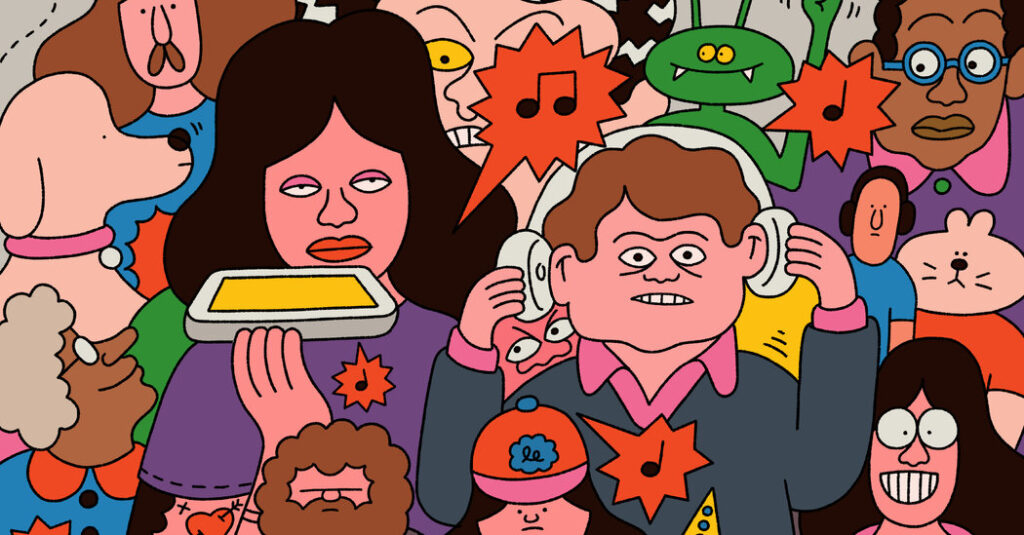
A few months ago, I sat in a half-empty Q train on my way downtown. The car was scattered with a handful of people, most of whom looked down at their phones with a pair of headphones around or inside their ears. I wore them, too: noise-canceling ones, with big cups. I was half-interestedly scouring YouTube for a mixtape I first listened to at 13.
Then I found myself absorbed by an unskippable ad. It showed a young man much like myself wandering toward an approaching train, glancing furtively over his shoulder. The station was pale and gray, and passers-by bumped into him with an air of menace. Then he put on his headphones, and they emanated a vibrant glow that transformed the station. The world became hospitable. Aretha Franklin’s voice filled our ears — well, my ears.
By now, playing music and videos aloud in public is widely considered to be a cardinal social sin in the era of ubiquitous headphones. Still, there is a certain segment of the population who seem to take pleasure in inflicting their portable speakers on the world. Every day, whether on the subway in the city or at a park in the suburbs, one of these people will materialize with a grenade-size device carabinered to their hip, playing a mash-up of the most annoying Top 40 hits from the past 20 years, or watching a TikTok video backgrounded by the same song sped up, before quickly scrolling to another video narrated by a blaring robo-voice.
When I ride the Q train, I have daily encounters with an array of noisemakers. There are the Upper East Siders alternately watching news clips from Fox and CNN; buskers hanging upside-down on poles over speakers near Times Square; students playing video lectures on their way to N.Y.U.; WeChat videos in Mandarin near Canal Street; and FaceTimes in impassioned Russian once the train has breached the city’s surface en route to Brighton Beach.
The complaints against loud sounds are as old as the devices that blast them, the complaints against the people who set them off as old as time. For many years, I joked with friends that the tendency to watch something with the volume cranked up was something more than a selfish convenience — that it must be the product of some nefarious consortium of music marketers or anarchists, or a psychological experiment run by the government to control crowds. Our current lack of situational awareness seems to have risen to a new register, along with the suppressed ire against it.
The headphones I conceded to wearing in public were a pair that looked as if they would better serve a launch commander at NASA. They relied on technology called “destructive interference,” which uses what retailers call “anti-noise.” Soon after buying them, I missed a stop on the Q because I hadn’t heard an announcement that the station was temporarily closed. I goofily began thinking that this manufactured soundlessness was the substrate of some science-fictional “anti-world,” where every external provocation was zeroed-out by its perfect opposite. And it was a different world, populated only by me.
I usually used the headphones in transient public places: on the sidewalk, on airplanes, on the subway or in the grocery store. These are the crannies of life, what we consider the unavoidable connections we must endure to get to the places and people that populate our real lives. In the past, the racket in these spaces was more communal. Instead of the angry disquisitions of a political pundit or a TikTok video about a movie’s underrated “spicy” scenes, we might have overheard conversations about community goings-on, a new favorite movie, someone’s complaints about their life. These conversations still happen, if less often, but when faced with a medley of individual racket, we’ve found it easier to ignore the communal too.
So much of our lives are spent in these shared places, and the rest of our time we are increasingly stowed away. While suspicion of the world is warranted, we should first try for curiosity. I might not be clamoring for, or even able to understand, the information I can glean from the WeChat calls and N.Y.U. student lectures on my Q train rides. But even ambiently, these sounds pull me from my inwardness to glimpse, however briefly, the broader range of experiences existing all around me, willingly or not.
To be clear, I’m not in favor of racket for its own sake. I don’t think blasting Flo Rida on a 7 a.m. subway ride is anything less than obnoxious. What I find troublesome is a broader culture that encourages us to turn away from the world. This feeling crested while I was watching the advertisement for the newer headphones: It wanted to tell me that the noises made by others are forces of chaos and that the only way to stay sane and safe is to wear isolating gadgets. But if reality is all around us, then the refusal to hear it seems instead, to me, a new form of ignorance. So eventually I decided it was time to retire my headphones from public life and reacquaint myself with the noisemakers. While I don’t admire their shamelessness, I do respect their determination to be heard. And while I usually won’t say anything to them myself, I am reinstalled outside the echo of my own little world with the begrudging reminder of the one that is real.
Conor Truax is a writer from Canada who is based in New York.
The post What You Miss When You’re Always Wearing Headphones appeared first on New York Times.