On Jan. 7, 2025, high Santa Ana winds lashed Los Angeles. The wildfire danger was extreme. By evening, as the Pacific Palisades burned across town, Kelly Akashi took her cat, Turnip, and a few keepsakes and left her house in Altadena, in the San Gabriel Valley. Between 4 and 5 a.m. the next morning, a wall of flame consumed her whole block.
Akashi, 42, grew up ineast Los Angeles. She studied at Otis College of Art and Design, teaches at ArtCenter in Pasadena and is prominent in the craft and contemporary art scenes. Like thousands of others, she sustained devastating losses in the Eaton Fire: a Spanish Colonial bungalow she bought in 2021, with a studio full of artwork and materials. Now, the only structure standing on her lot is a brick chimney.
She has channelled that loss into her art. For the 2026 Whitney Biennial in New York, which opens March 8, Akashi will debut a major new sculpture, “Monument (Altadena),” a 13-foot chimney and a walkway, both made of clear glass bricks.
This January, as the work was being installed on a fifth-floor terrace of the Whitney, we met for an interview. We had been speaking regularly about her recovery process for a year.
Akashi was pensive and candid, as usual. Focused. And tired. Having a big project had helped her keep going. “I’m obviously not as destabilized as exactly a year ago,” she said, but “it’s all hitting me now.”
The glass chimney is a close replica of the one in Altadena, built in 1926. But it’s another order of experience. Akashi would never simply move her chimney from Altadena to New York, she said. She is wary of framing the work too starkly in terms of the fire. It’s not disaster porn. The work is personal, of course, but it speaks to broader questions of home, belonging and rest. She thinks of the sculpture as “giving a kind of materiality to restlessness.” It’s not a tombstone, it’s a vitrified ghost.
Outside, tessellated sheets of ice flowed down the Hudson. As a precaution, the Whitney’s installation crew wrapped the sections of the chimney in moving blankets and hoisted them onto the terrace with a gantry to acclimate to the cold. The chimney’s 821 glass bricks and metal armature weigh about 6,550 pounds. Another 538 bricks comprise the pathway sunk flush with the terrace’s pavement. The sculpture was built in segments in fabrication studio in the Hudson Valley, then stabilized with steel plates and rods for shipping to Manhattan. With brickwork, this is simply not done. The head mason, Christian Inga, who started learning his trade at age 7, said he’d never moved anything he’d built.
Glass bricks are tricky. At the factory, the hot glass is ladled into molds rather than cut like clay, which causes slight variations. Akashi’s builders hand-sorted the bricks by thickness to keep the rows level. They painted each brick with a special additive to help the mortar adhere. There are also structural concerns. The sculpture has to sustain 100-mph winds, with no house to support it. The base portions are anchored to a steel leveling plate that took the better part of a day to adjust, fastened to a concrete slab.
The project resonated with Inga’s team, he told me. “My guys, they’re not from here. They’re Ecuadorean,” he said, from Girón, a town renowned for its workers. His father, also a mason, immigrated from Ecuador in the 1970s. “They really can’t go back home. So I told them, look, make this with the intention of a homage to your home.”
The Debris Field
I visited Akashi in February 2025, about six weeks after the wildfires. There had been some hand-wringing about whether the Frieze Art Fair and its satellite events should still happen. In public and in private, including on a video call with local gallerists, Akashi argued adamantly that keeping the show going was the best way to support artists and art workers. The fair moved forward as planned.
Akashi had a solo show at Lisson Gallery opening that week. Her studio was gone, but three bronzes had survived the fire, with a new patina. Other pieces had been safe at the foundry. She had time to remake the glass and stone elements she’d lost. Marcela Guerrero and Drew Sawyer, the Whitney Biennial’s in-house curators, had planned a studio visit but saw her show instead. She was one of the first artists they invited to participate. They told me that her chimney work resonates with the biennial’s themes of climate crisis.
Akashi and I drove through Altadena to her property. The fires had been capricious. The flames jumped from house to house, sometimes skipping a structure, leaving lawns intact. The trees still had green leaves. The few chimneys jutting from the gray rubble would need to be inspected by a structural engineer, and potentially demolished.
“See the light there?” Akashi pointed to a patch of paler ashes near her hearth, in the greater ash heap that had been her living room. “That’s my whole library.”
She had been collecting materials from the site, including buckets full of book ash. “I want to turn some of it into a diamond and wear it,” she said. Or she might mix it with an acrylic binder, to make a sort of paint. She also rescued blackened branches, and charred lace doilies from her grandmother, for possible use in artworks. Her Whitney presentation includes animated CT scans of doilies on a jumbo outdoor screen.
There’s a low-hanging irony: Akashi, who often uses flame to shape metal and glass, whose sculptures include casts of her body and hand-shaped candles, lost her house and studio in a fire.
Akashi works in many materials, including, in order of heat resistance, wax, paper, stone, bronze and glass. She hadn’t bothered to open her baked flat file, which contained everything from handmade paper to rubbings from the Japanese internment camp in Arizona where her father spent World War II. Much of her stone had cracked in the heat, but a couple of pieces might be usable. Bronze starts to melt at 1,800 degrees Fahrenheit and liquefies at about 2,000 degrees. The fire didn’t get that hot, she thinks, because she has pulled lots of bronzes from the wreckage, relatively unscathed. The borosilicate glass Akashi uses, the stuff of Pyrex, softens at 1,500 and liquefies by 3,000 degrees Fahrenheit. The glass sculptures she lost had been smashed.
Her electric kiln, scorched and discolored, had held its shape. A glass chain, part of a work in progress, had survived inside. But when she tried to transport the piece, it broke. “The fire didn’t anneal the glass properly,” Akashi said. Annealing, she explained, is like stress relief for glass. Ideally, a kiln strengthens glass using a gentleheat, 1,050 degrees Fahrenheit, then cools down slowly, letting the glass molecules realign.
Akashi had considered rushing back to save more belongings from the flames. But, besides the danger, she didn’t want to develop a fear of fire. Her work depends on her comfort with it.
Some Relief
Akashi is relatively lucky. She has family in the area (her aunt’s house in Altadena survived with smoke damage) and was able to lease a house in Angelino Heights for her and Turnip within three weeks of the disaster. Now she’s paying both rent and a mortgage.
A hodgepodge of relief has arrived — small grants from FEMA and the Red Cross, a Craft Emergency Relief Fund grant and another from the LA Arts Community Fire Relief Fund. She has applied for low-interest recovery loans. In the long term, she has joined a mass tort lawsuit against Southern California Edison, whose equipment, the company has acknowledged, most likely caused the blaze (in recent lawsuits Edison asserts that other businesses and agencies share responsibility).
The art world chipped in too. A collector she knew handed down a mountain of denim from the Los Angeles-based label 69. “He’s moved on to, like, only Balenciaga,” she said. Before she could furnish her rental, two mounds of indigo clothing served as both a wardrobe and chairs.
Akashi had insurance policies for her house, property, business and artwork; she also had earthquake insurance. Some claims have gone smoothly, but she hired a lawyer to help resolve others. “I am severely underinsured to rebuild at today’s rates,” Akashi said. And much of what she lost is irreplaceable.
She told me that survivors of the fire had two lives: one before the disaster and one after. “We’re kind of still living in both lives,” she said. “And it’s very difficult to move back and forth between them.”
She recalled a particularly disjointed Thursday in February of last year. She spent the morning interviewing potential grad students at ArtCenter, then rushed to Altadena to meet volunteers from Samaritan’s Purse and the Billy Graham Church who helped her salvage personal items. They cut into a fallen wall and recovered more sculptures. They prayed with her and a neighbor, and gave her a Bible. At one point they asked if she had community support. “I said, actually, I do. I’m an artist.” They said, ‘your community is incredible.’ ” Then Akashi drove across town to her rental, showered and went to a dinner celebrating her show at Lisson.
Demolition Day
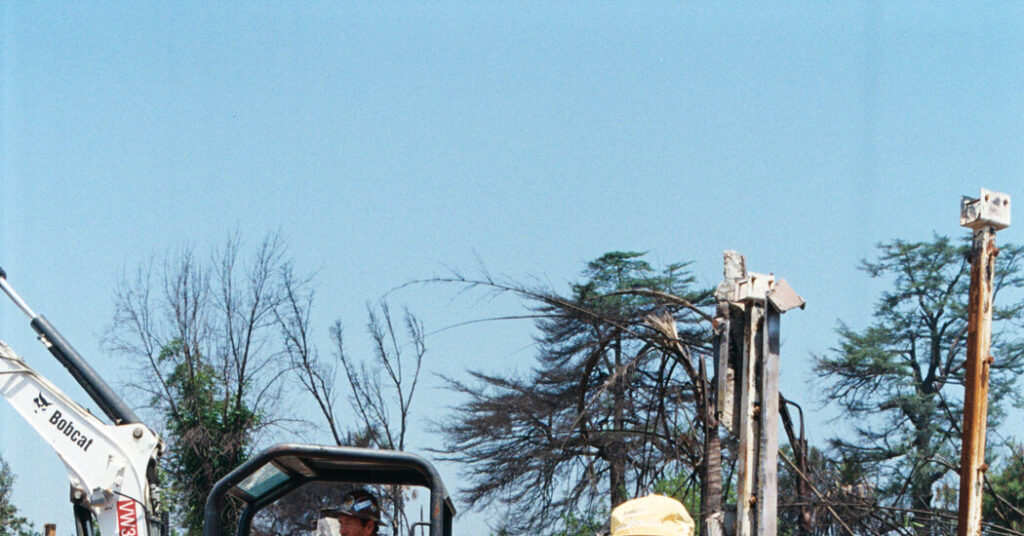
By summer, Altadena showed signs of recovery. Akashi watched workers in white hazmat suits roll the rubble of her neighbors’ houses into tarps and carry them away. Crews sprayed a green hydroseed mixture on cleared lots to secure the soil. Excavators pulled at the wreckage. “It’s actually kind of gentle the way they handle everything,” she said. “It’s not as violent as I thought it would be.”
Akashi wasn’t sure if she would rebuild. Regardless, the debris had to go. She scheduled a private removal company for June 9. That spring she had been diagnosed with breast cancer. Akashi didn’t tell many people; she didn’t want friends urging her to slow down. She scheduled her surgery to give herself enough healing time before the cleanup.
She called it the most physically and emotionally difficult month of her life. Then it was over, and the future began to emerge. “I started laying out floor plans,” she said.
“I don’t like the way this has come about, but, sure, it’s always been a fantasy to build a property from scratch.”
One idea is to use poured concrete and embed the broken stones from her studio into the walls. She is inspired by the Brion tomb, a Brutalist masterpiece by the Italian architect Carlo Scarpa finished in 1978. “I’m an artist. You can’t have things fast, cheap and easy. So I’m willing to sacrifice fast.” Any house she builds won’t be done until 2028, and her rent money will run out by the end of this year.
After months of deliberation, Akashi selected an architect. Oonagh Ryan was in Altadena “when the ground was still smoking,” she told me. “I love this idea of the architect and homeowner working together to celebrate the past and figure out ways to bring those things into the house and bring it forward.”
They may be able to incorporate all or part of the surviving chimney into the new house. Whatever happens, Akashi intends to keep it. Ryan showed me a snapshot she had taken on Akashi’s property, with the battered chimney in the foreground, a cracked brick boundary wall and the tarpapered side of a new house behind that, and the khaki San Gabriel Mountains in the distance.
Akashi said that when her neighbor knocked down that wall to rebuild, she walked around her chimney as if it were a sculpture. “It’s hard to describe the experience,” she said, “and I want that experience again.” The chimney in Altadena is a touchstone of her old life. Its glassy double in New York is a monument to the need to move on, and the need to remember.
The post A Chimney in Search of a Home Lands 3,000 Miles Away appeared first on New York Times.