Throughout much of her life, Lee Krasner was typecast as Mrs. Jackson Pollock. But this may change, once and for all, in October, when the Metropolitan Museum of Art will present the two artists together in dialogue, painting for painting, with the exhibition “Krasner-Pollock: Past Continuous,” including 120 works from 80 international and national lenders.
“This is a story of equals,” said David Breslin, curator for Modern and Contemporary Art, and an organizer of the exhibition with Brinda Kumar, an associate curator. “They were like two planets circling each other.”
We wanted to create an exhibition, he said, that would “show how the two worked together, lived together, but how they also were two different individuals who told two very different stories about what art making is.”
For the first time, this will be a sweeping opportunity to contemplate the fallout from Krasner’s and Pollock’s cross-pollination and mutual respect, as Krasner had only just begun to embark on the fullness of her evolution when Pollock flipped his green Oldsmobile in the East Hampton hamlet of Springs in 1956, killing himself and a passenger. (Krasner died in 1984.) Two modest exhibitions pairing the artists in the 1980s were limited to their 15 years together, which failed to do justice to Krasner’s work. The Metropolitan Museum expands the lens to take in their development before they met in 1942 and the potency of Krasner’s reinventions and audacious color in the years after Pollock’s death.
Pollock, and his classic “Drip” paintings, have long occupied a starring role in the origin story of American art’s emergence postwar. Krasner exhibitions and Krasner enthusiasm have escalated more recently.
When the Metropolitan curators recruited contemporary artists to write for the exhibition catalog, “They wanted to talk about Lee Krasner,” Breslin said, but the curators also “wanted to bring Pollock back into the picture.”
The artist Amy Sillman, one of these contributors, said in an interview, “They’re a couple; they’re seeing each other’s work every day.”
“They’re egging each other on,” Sillman continued. “They’re taking things from each other’s inventions.”
Referring to Pollock’s influential practice of flinging and splashing paint, she said: “I throw paint around; anyone who paints throws paint around. So it’s interesting to look at the OG, original gangster.”
But what she really wanted to talk about was the 1950s collages she saw in a 2019 Krasner retrospective at the Barbican in London. “My jaw dropped,” Sillman said. “She was a really great painter.”
Just as the Metropolitan leads with Krasner’s name in the title, a gallery of Krasner collages from 1953-55 will introduce the exhibition. Krasner described to this writer in 1981 how those collages emerged. At a dead end after struggling with some recalcitrant drawings, she ripped them in half and threw them on the floor. “Having finished this bout of destruction, I slammed the door and walked away,” she said. Days later, she saw the possibilities. She tore more, she pasted those scraps to paper — and later Masonite — and interlaced them with tangled, cursive, or thrusting marks.
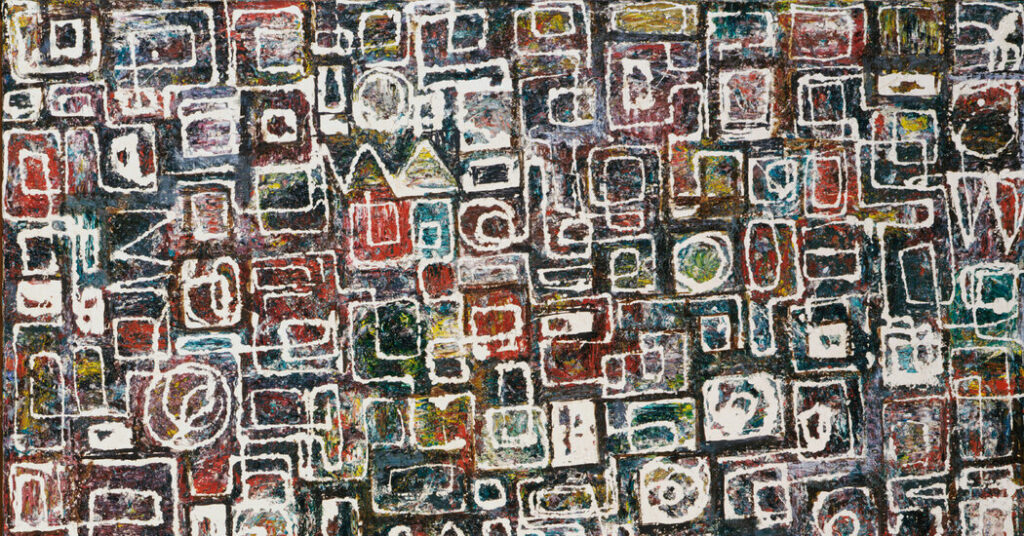
The exhibition will flash back to their separate early influences — for the Wyoming-born Pollock: Native American art, Regionalism, Mexican murals, Jungian psychology, and Surrealism; for Krasner, a Jewish girl from Brooklyn: Hebrew calligraphy, cubism, Mondrian and especially Matisse. They met in 1942 as participants in an exhibition. Their impact on one another was immediate. In the years of Pollock’s breakthrough to the magisterial “Drip” paintings, Krasner was making small, tightly composed “Little Image,” paintings. Pollock was rediscovering the figure, as she burst into collage.
The final gallery will be dominated by collages from Krasner’s 1976 series “Eleven Ways to Use the Words to See,” including the “Past Continuous” of the exhibition’s title, with one Pollock painting to signify that past.
The post For Lee Krasner and Jackson Pollock, Equal Footing at the Met appeared first on New York Times.