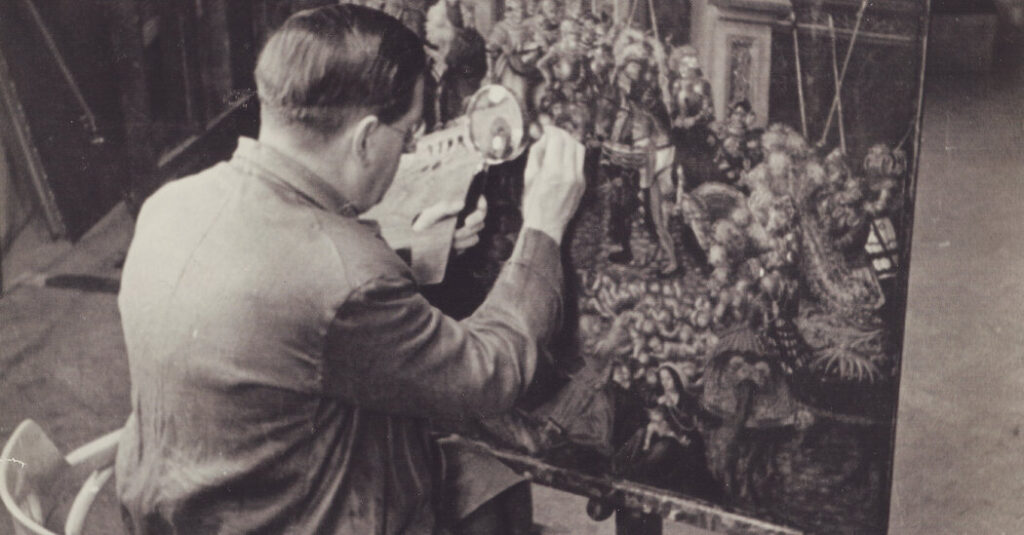
Bookbinders and restorers in the 1930s and ’40s used their craft to help the Nazi regime create a database that was used to persecute and kill Jews and others who were deemed racially impure, a British researcher has found.
Key to building this database were church, civil and synagogue records, which were often hundreds of years old and damaged beyond legibility when the Nazis came to power in 1933.
By tasking professionals with cleaning up these documents, which held information about millions of people, the Nazis gained access to generations’ worth of material — which they used to target specific population groups, the new research shows.
The findings are the result of more than two decades of work by Morwenna Blewett, an expert in conservation history.
She was working as a conservation fellow at the Worcester Art Museum in Massachusetts in 2004 when a question came to her: What had happened to the art restorers who did not flee Nazi Germany during World War II?
She pondered the question while sorting through an old filing cabinet in the museum’s basement — where, as she recalled in a book published this month, “Art Restoration Under the Nazi Regime: Revelation and Concealment,” the “warm, dark air smelt faintly of cigarettes, coffee and engine oil.”
Soon, she had expanded on her query: “How did the Nazi regime intend to use conservation and restoration to achieve its aims?”
The answer, she discovered, was that paper restorers and bookbinders in Nazi Germany had helped the regime track down people’s Jewish ancestry by conserving and cleaning up old records from churches, as well as from synagogues and civil registers.
Dr. Blewett said that, by publishing her book, she hoped to shed light on this part of the Holocaust, which she called “one of the longest and most insidious of all National Socialism’s projects to exploit the field of conservation and restoration.”
Her focus on bookbinders and restorers reinforces the idea that the Nazis were helped “from the ground up” by many disparate facets of German society.
“It just gives us the cogs of how the regime relied on myriad professions and myriad methods in their move toward genocide,” Dr. Blewett said in a phone interview. “A move toward genocide is always piecemeal and it has to be supported by even the most obscure and niche professions.”
One of Dr. Blewett’s key findings was that the restorers often used techniques that were not focused on preserving the integrity of an object, which left the records damaged. Their primary aim, she found, was not posterity, but to recover information, which goes against a fundamental principle of the profession, Dr. Blewett said.
“The preservation of certain types of cultural material — documents listing births, baptisms, marriages and deaths — came to be viewed by the authorities as essential to the process of scrutinizing the ‘racial’ background of past generations,” Dr. Blewett wrote in her book.
Restorers — who, like all other citizens under the Nazi regime, had to register and prove their racial purity if they wanted to keep working and function as members of society — were aware that the cleaned-up records were being used to prove people’s backgrounds, Dr. Blewett said.
“It was publicly known,” she said about the restoration effort, adding that people often went to churches themselves to try to prove that they were not Jewish and to obtain what Dr. Blewett described as an “Aryan pass.”
The methods experts used to clean up the documents varied in complexity depending on how damaged they were, Dr. Blewett said. Once the materials had been made legible, the Nazis collected the materials from churches and photographed them. In some instances, the information was then sent to Nazi agencies.
“Those restorers knew what they were doing,” Dr. Blewett said. “They knew it was about accumulating information to kill people.”
Dr. Blewett’s research has contributed to the historical record by “widening that lens on complicity” and showing how the Nazis weaponized documentation, said Christine Schmidt, the acting co-director of the Wiener Holocaust Library in London.
Historians have long worked to understand the psychology and motivations of the ordinary people who helped facilitate the Holocaust, in which the Nazis killed around six million Jews, in addition to hundreds of thousands of Sinti and Roma, as well as millions of others.
Explanations often fall into two categories, according to the United States Holocaust Memorial Museum in Washington. The first focuses on people’s ideology and antisemitism. The second is grounded in social psychology: the pressure to conform, fear of the Nazis and opportunism to profit from the situation.
The Holocaust was not only perpetuated by ideologues, said Dr. Schmidt, who is a Holocaust historian, “but also carried out through bureaucratic means.”
During the 12 years that the Nazis were in power, people in professions across German society hoped to advance their careers by assisting them, she said. While the motivation of the restorers and bookbinders cannot be entirely known, it is likely that it was often similar, she added.
The conservation effort, which spanned 1933 through 1944, was one of the longest projects carried out by the Nazi regime, Dr. Blewett said.
Often, when people think of the Nazis, she said, they envision well-known individuals like Adolf Hitler or Joseph Goebbels, the Nazi propaganda chief. They think of judges, police officers and other officials in uniform.
What they do not think about, she said, is “what somebody in a studio could do with a church register.”
Claire Moses is a Times reporter in London, focused on coverage of breaking and trending news.
The post How Bookbinders Used Old Records to Help the Nazis Find Their Victims appeared first on New York Times.