Opening arguments were set to begin on Tuesday in a trial that will test the Trump administration’s vow to prosecute antifa, a radical left-wing movement, as an organized, violent terrorist group.
Nine defendants have pleaded not guilty to membership in what prosecutors described as a heavily armed antifa “cell” that they say shot and wounded a police officer during an attack on an Immigration and Customs Enforcement detention center in Alvarado, Texas, last summer.
Lawyers and family members of many of the accused say they were merely staging a demonstration and were not expecting violence.
Critics have pointed to the case as an example of the administration’s attempts to silence and punish dissent. Weeks before the charges were filed, President Trump signed an executive order instructing federal law enforcement to undertake “investigatory and prosecutorial action” against those who financially support antifa and declaring it a domestic terrorist organization.
That designation does not exist under U.S. law, which allows for the executive branch to label groups a “foreign terrorist organization” but does not include a domestic equivalent.
Still, the charges do not require any proof that the defendants were members of a designated terrorist organization. They include providing material support to terrorists and attempted murder of two corrections officers who were outside the facility along with the police officer who was shot.
Several defendants have pleaded guilty, and as many as four are expected to testify for the prosecution.
The trial opens at a moment when the Trump administration has cracked down on left-wing protesters across the country — most markedly in Minnesota where hundreds of people have taken part in demonstrations against the White House’s aggressive immigration enforcement. But while numerous protesters have been arrested on charges including obstruction and assaulting officers, many of those cases have been dropped or downgraded to misdemeanors.
The episode in Alvarado unfolded at about 10:30 p.m. on Independence Day last year, when a group of about a dozen people arrived at the facility, the Prairieland Detention Center. Some of them vandalized the property, spray-painting insulting graffiti on a guard shed and car and damaging a surveillance camera, according to the prosecution.
Others began to set off fireworks where, according to their own accounts, they hoped the detainees would be able to see them. Officers inside the facility called the local police.
All the while, court filings say, one masked figure armed with an AR-15-style rifle stood watch from about 200 meters away. Prosecutors have identified him as Benjamin Song, a former Marine reservist who trained left-wing groups in firearms and close combat.
One of the participants who is expected to testify for the prosecution said Mr. Song’s role was to alert the group of any law enforcement response. Another said he believed Mr. Song intended to use the rifle to intimidate the police long enough to allow the rest of the group to flee.
When Lt. Thomas Gross of the Alvarado Police Department arrived at the scene and got out of his car, Mr. Song yelled, “Get to the rifles!” and opened fire, according to prosecutors, hitting Lieutenant Gross above the collarbone. The rest of the group scattered.
Nine were arrested that evening, including one woman who said she had given people rides to the demonstration and parked nearby but never got out of her car.
Prosecutors say 11 guns were recovered, some of them from cars or disassembled in backpacks. Four of them had been purchased by Mr. Song. They also found a flag that read “Resist Fascism, Fight Oligarchy” and fliers that said, “Fight ICE terror with class war” and “Free all political prisoners.”
The rifle Mr. Song used, court papers say, was equipped with a binary trigger that increased the rate of fire. He evaded capture for 11 days. At least five people who were not at the demonstration are facing charges of aiding Mr. Song with disguises, transportation and gear.
Much of the case will depend on whether the government can show that participants in the ICE demonstration expected, or should have expected, violence.
In its indictment, the government defines antifa as “a militant enterprise made up of networks of individuals and small groups, primarily ascribing to a revolutionary anarchist or autonomous Marxist ideology, which explicitly calls for the overthrow of the United States government, law enforcement authorities and the system of law.”
The government has pointed to the defendants’ choice of “black bloc” clothing that purposefully obscures the wearer’s identity, use of nicknames and an encrypted messaging app with automatic deletion as evidence they were trying to hide their participation in a terrorist plot.
Prosecutors have also noted the presence of multiple firearms, “insurrectionary materials called ‘zines,’” and the fact that members of the group had scouted the facility in advance.
But the indictment included some details that suggest little expectation of violence. For example, in group chats, some of the participants said that concerns over how the police might respond were “way over the top” and insisted that “noise demonstrations” like the one being planned were low risk.
The arrestees included a middle school teacher, a college student, a mechanical engineer and a UPS worker. Two of them were transgender women, one of whose spouses has said the women owned guns to protect themselves.
One defendant, who was not present at the demonstration, is accused of trying to hide a box of “anti-government propaganda” three days later.
During its investigation of the case, the F.B.I. looked into the ties the defendants had to other possible leftist activists. At one point, investigators combed through the list of people who had contributed to their GoFundMe pages for legal defense, according to a person familiar with the matter. Investigators questioned witnesses in the case about their knowledge of other violent attacks believed to have been committed by left-wing suspects, including the assassination in September of the conservative political pundit Charlie Kirk.
“It’s government overreach,” Gabrielle Koza, the mother-in-law of one of the defendants, said in court on Monday. She said the charges were excessive and the trial was being rushed. The judge has set strict time limits, giving each of the nine defendants eight minutes for opening arguments.
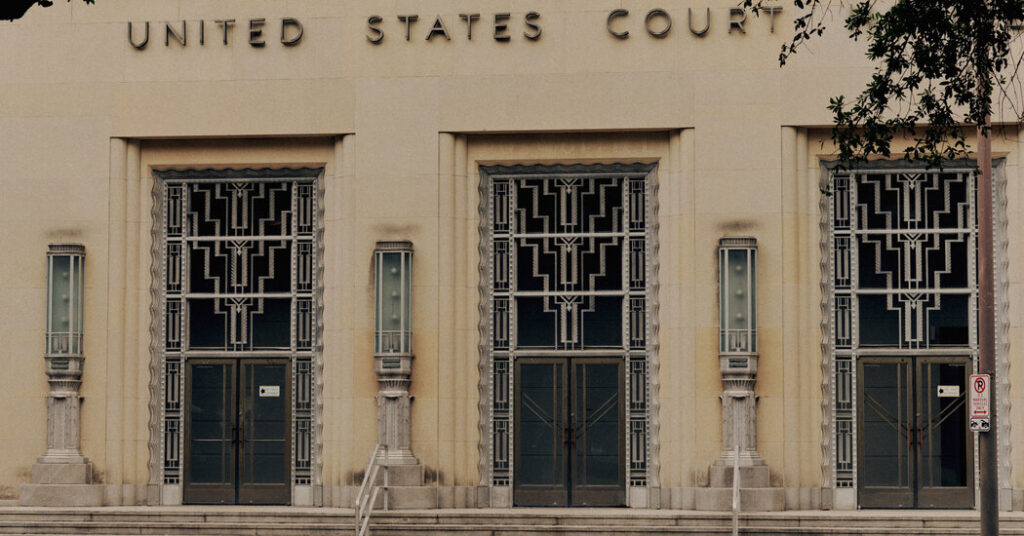
The case, in Federal District Court in Fort Worth, Texas, got off to a rocky start last week when Judge Mark Pittman, a Trump appointee, called a mistrial over a T-shirt worn by one of the defense lawyers. The shirt depicted Martin Luther King Jr., Shirley Chisholm and scenes from the civil rights movement, according to local news accounts.
The lawyer, MarQuetta Clayton, had been addressing potential jurors about the constitutional right to protest and the recent death of the Rev. Jesse Jackson, when Judge Pittman stopped her. He then noticed the shirt and halted the proceedings, according to the reports.
Judge Pittman announced that he would question a new jury pool himself — an unusual move that stripped the defense and prosecution of their usual ability to ask follow-up questions. On Monday, he began the jury selection process by saying, “Political views and sympathies have no place whatsoever in jury deliberations.”
He added, “Are you disgusted in how divided we are? I am.”
Early in the case, defense lawyers sought to prevent the jury from hearing any evidence about antifa or their clients’ potential connections to it, arguing that the term itself was “highly prejudicial” and was being used by the government to “smear” the defendants. Judge Pittman rejected the request.
Krista Torralva contributed reporting.
Shaila Dewan covers criminal justice — policing, courts and prisons — across the country. She has been a journalist for 25 years.
The post 9 Accused of Antifa Ties After a Violent ICE Protest Face Trial in Texas appeared first on New York Times.