President Donald Trump’s new tariffs are not legally justified, according to several prominent economists and trade experts, who say there is no sign of the profound international financial problems that such measures were intended to remedy.
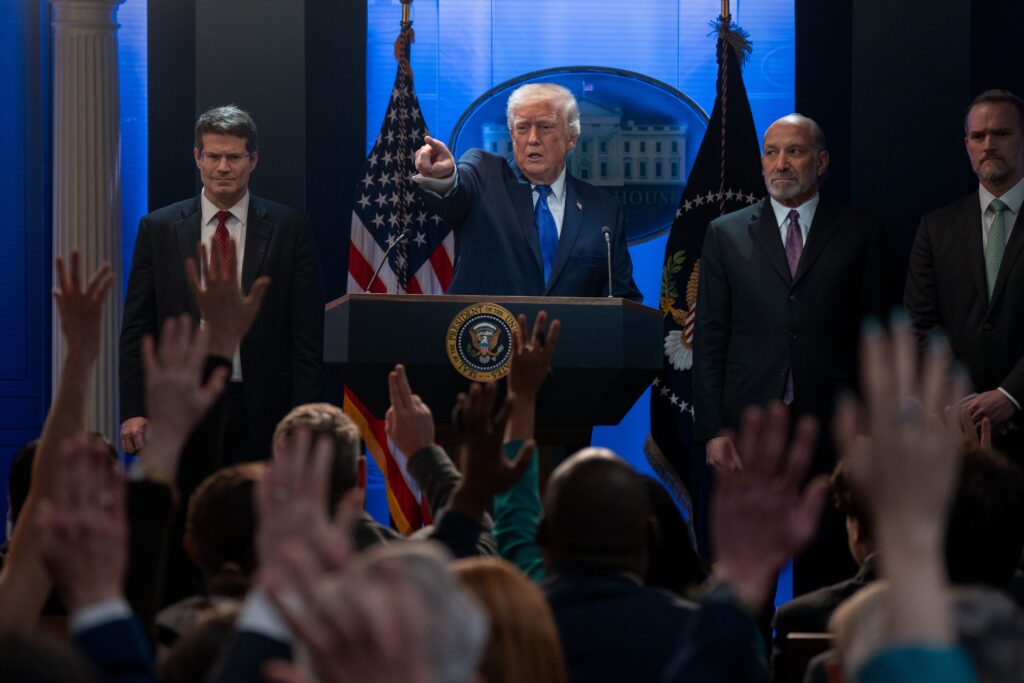
Hours after the Supreme Court invalidated the emergency tariffs that he imposed last year, Trump on Friday invoked a 1974 law to announce a new 10 percent global import tax, shortly raising it to 15 percent. The president cited a provision known as Section 122 that authorizes temporary restrictions on imports to deal with “fundamental international payments problems.”
In an official proclamation, the president said the nation’s “balance of payments,” a comprehensive account of Americans’ financial transactions with foreigners, was suffering “a large and serious deficit.” And he listed a number of metrics reflecting a deteriorating U.S. financial posture.
The law does not define “balance-of-payments deficit,” and economists disagree about what should be included in the term. But several critics, including the International Monetary Fund’s former chief economist and a prominent conservative legal commentator, disputed the president’s claim. Trump wrongly conflated an alleged payments deficit with the merchandise trade deficit that he targeted last year with his first set of comprehensive tariffs under the International Emergency Economic Powers Act (IEEPA), they said.
“The US does not have a ‘payments’ problem. It can finance its trade deficits,” Gita Gopinath, the former IMF official, now teaching at Harvard University, wrote on X.
Added Andrew McCarthy, a former federal prosecutor, writing in the conservative National Review: “These new tariffs are even more clearly illegal than Trump’s IEEPA tariffs.”
Opposition to the new import taxes erupted even before they took effect at 12:01 a.m. on Tuesday. The outcry suggested that the president, still smarting from his 6-3 Supreme Court defeat, could face renewed legal jeopardy over the centerpiece of his economic agenda.
“I do anticipate a lawsuit,” said Scott Lincicome, vice president of general economics for the Cato Institute and a former trade lawyer.
U.S. importers would have the right to sue once they paid the tariffs. Liberty Justice Center, the nonprofit public-interest law firm that represented several small businesses in one of the tariff cases decided by the Supreme Court, said Monday that it is “closely monitoring” the president’s latest actions.
“We will ensure that whatever authority the executive branch relies on, it follows the rules Congress actually wrote and the constitutional guardrails that protect our system of separated powers,” said Sara Albrecht, the center’s chairman.
The debate over the Section 122 levies shows that questions of law and economics will continue to dog Trump’s bid to remake the global trading system. This time, there is no question that Congress has delegated to the president the power to levy tariffs — only under what circumstances. At issue are complex definitional questions of international economics and the legislative intent behind the wording of an untested provision in U.S. trade law.
Time may also be a factor. The Section 122 tariffs expire after 150 days unless Congress votes to extend them, which is unlikely.
Judges might be reluctant to “second guess” the president’s judgment on whether a balance-of-payments problem exists, said John Veroneau, a lawyer who served as deputy U.S. trade representative under President George W. Bush.
Still, the administration’s newfound reliance upon Section 122 reverses the legal arguments it made last year. Defending the president’s emergency tariffs, Justice Department attorneys told an appeals court that Section 122 did not apply to Trump’s trade deficit concerns, which were “conceptually distinct from balance-of-payments deficits.”
The White House declined to elaborate on the president’s Feb. 20 proclamation and fact sheet, which blamed a loss of domestic manufacturing for an excessive number of dollars leaving the country. Problems with the nation’s balance of payments can “endanger the ability of the United States to finance its spending, erode investor confidence in the economy, and distress the financial markets,” the proclamation said.
Congress passed the Trade Act of 1974 when the United States was dealing with a distinctly different set of economic issues. In 1971, President Richard M. Nixon abruptly ended the convertibility of dollars into gold, marking the end of the Bretton Woods system of fixed exchange rates.
At the time, foreign central banks were rushing to trade their unwanted dollars for gold, threatening to deplete U.S. financial reserves.
There’s no sign of that sort of crisis today. The dollar has dropped about 10 percent over the past year, but it remains above its level for most of the decade leading to 2015. There’s certainly no sign of the “imminent and significant depreciation” that Section 122 requires.
But even some Democrats say the administration is reacting to worrisome financial ailments.
Economist Brad Setser, who served in the Treasury Department under President Barack Obama, said the global economy is characterized by dangerous imbalances.
For years, the U.S. has run a deficit in its current account, the broadest measure of the nation’s trade balance, while China has run a mirror-image surplus. To keep running a large trade deficit, the U.S. must attract financing from abroad. So far, it’s been able to do that, which is why many analysts do not share the administration’s urgency.
But the nation’s net international investment position — which balances the value of foreign stocks and bonds owned by Americans against what foreigners own in this country — is also deteriorating. That figure reached negative $26.7 trillion last year, down sharply in recent years.
Some of that decline reflects foreigners’ large purchases of U.S. stocks, which have outperformed other markets, and thus is not a problem, Setser said. But the deterioration in the investment account also stems from the growth in the U.S. external debt, which carries a rising interest burden.
“At this level of the current account [deficit], U.S. external debt will tend to rise. The external position will tend to weaken, which is one definition of a balance-of-payments problem,” he said. “The debt position does worry me.”
The post Trump’s newest tariffs could face legal challenge, though time is short appeared first on Washington Post.