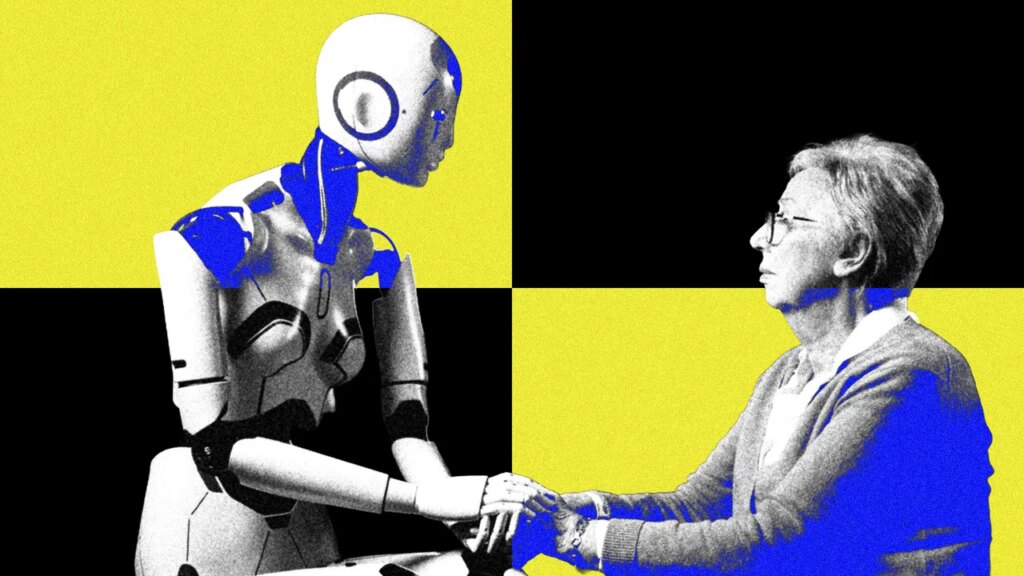
The Blake Lemoine incident is remembered today as a high‑water mark of AI hype. It thrust the whole idea of conscious AI into public awareness for a news cycle or two, but it also launched a conversation, among both computer scientists and consciousness researchers, that has only intensified in the years since. While the tech community continues to publicly belittle the whole idea (and poor Lemoine), in private it has begun to take the possibility much more seriously. A conscious AI might lack a clear commercial rationale (how do you monetize the thing?) and create sticky moral dilemmas (how should we treat a machine capable of suffering?). Yet some AI engineers have come to think that the holy grail of artificial general intelligence—a machine that is not only supersmart but also endowed with a human level of understanding, creativity, and common sense—might require something like consciousness to attain. In the tech community, what had been an informal taboo surrounding conscious AI—as a prospect that the public would find creepy—suddenly began to crumble.
Buy This Book At:
If you buy something using links in our stories, we may earn a commission. This helps support our journalism. Learn more.
The turning point came in the summer of 2023, when a group of 19 leading computer scientists and philosophers posted an 88‑page report titled “Consciousness in Artificial Intelligence,” informally known as the Butlin report. Within days, it seemed, everyone in the AI and consciousness science community had read it. The draft report’s abstract offered this arresting sentence: “Our analysis suggests that no current AI systems are conscious, but also suggests that there are no obvious barriers to building conscious AI systems.”
The authors acknowledged that part of the inspiration behind convening the group and writing the report was “the case of Blake Lemoine.” “If AIs can give the impression of consciousness,” a coauthor told Science magazine, “that makes it an urgent priority for scientists and philosophers to weigh in.”
But what caught everyone’s attention was that single statement in the abstract of the preprint: “no obvious barriers to building conscious AI systems.” When I read those words for the first time, I felt like some important threshold had been crossed, and it was not just a technological one. No, this had to do with our very identity as a species.
What would it mean for humanity to discover one day in the not‑so‑distant future that a fully conscious machine had come into the world? I’m guessing it would be a Copernican moment, abruptly dislodging our sense of centrality and specialness. We humans have spent a few thousand years defining ourselves in opposition to the “lesser” animals. This has entailed denying animals such supposedly uniquely human traits as feelings (one of Descartes’s most flagrant errors), language, reason, and consciousness. In the last few years, most of these distinctions have disintegrated as scientists have demonstrated that plenty of species are intelligent and conscious, have feelings, and use language and tools, in the process challenging centuries of human exceptionalism. This shift, still underway, has raised thorny questions about our identity, as well as about our moral obligations to other species.
With AI, the threat to our exalted self‑conception comes from another quarter entirely. Now we humans will have to define ourselves in relation to AIs rather than other animals. As computer algorithms surpass us in sheer brainpower—handily beating us at games like chess and Go and various forms of “higher” thought like mathematics—we can at least take solace in the fact that we (and many other animal species) still have to ourselves the blessings and burdens of consciousness, the ability to feel and have subjective experiences. In this sense, AI may serve as a common adversary, drawing humans and other animals closer together: us against it, the living versus the machines. This new solidarity would make for a heartwarming story and might be good news for the animals invited to join Team Conscious. But what happens if AI begins to challenge the human—or animal, I should say—monopoly on consciousness? Who will we be then?
I find this a deeply unsettling prospect, though I’m not entirely sure why. I’m getting comfortable with the idea of sharing consciousness with other animals (and possibly even with plants, in my case) and I’d be happy to admit them into an expanding circle of moral consideration. But machines?
It could be that my discomfort with the idea stems from my background and education. I have been slow‑cooked in the warm broth of the humanities, especially literature and history and the arts, and these have always held up human consciousness as something exceptional that is worth defending. Just about everything we value about civilization is the product of human consciousness: the arts and the sciences, high culture and low, architecture, philosophy, religion, government, law, and ethics and morality, not to mention the very idea of value itself. I suppose it is possible that conscious computers could add something new and as yet unimagined to the stock of these glories. We can hope so. To date, poetry written by AIs isn’t much better than doggerel; the absence of consciousness might explain why it lacks even a spark of originality or fresh insight. But how will we feel if (when?) conscious AIs start producing really good poetry?
Why should we assume that conscious machines would be any more virtuous than conscious humans?
As a humanist, I struggle with the possibility that the animal monopoly on consciousness might fall. But I have now met other types of humans (some of whom call themselves transhumanists) who are more sanguine about this future. Some AI researchers endorse the effort to build conscious machines because, as entities with feelings of their own, conscious machines are more likely to develop empathy than computers that are merely intelligent. Building a conscious AI is a moral imperative, as both a neuroscientist and an AI researcher sought to convince me. Why? Because the alternative is the blazingly smart but unfeeling AI that will be ruthless in pursuit of its objectives, because it will lack all of the moral constraints that have arisen from our consciousness and shared vulnerabilities. Only a conscious AI is apt to develop empathy and therefore spare us. I am not exaggerating; this is the argument.
One has to wonder if these people have ever read Frankenstein! Dr. Frankenstein gives his creation the gift of not only life but also consciousness, and therein lies the rub. Mary Shelley’s novel chronicles “the creation of a sensitive and rational animal,” and it is the combination of those two qualities that determines the monster’s fate. It is not the monster’s rationality but his emotional injury that spurs him to seek revenge and turn homicidal.
“Everywhere I see bliss, from which I alone am irrevocably excluded,” the monster complains to Dr. Frankenstein after being driven out of human society. “I was benevolent and good; misery made me a fiend.” The monster’s ability to reason surely helped him realize his demonic scheme, but it was his consciousness—his feelings—that supplied the motive. Why should we assume that conscious machines would be any more virtuous than conscious humans?
Remarkably enough, the Butlin report on artificial consciousness represents something of a consensus view in the field; most of the computer scientists I interviewed endorsed its conclusions. Yet the more time I spent reading it (and interviewing one of its coauthors), the more I began to question its conclusion that artificial consciousness is right around the corner. To their credit, the authors are scrupulous about setting forth their assumptions and methods, both of which make me wonder if they haven’t erected their bold conclusion atop a dubious foundation.
Right on page one, these computer scientists and philosophers set forth their guiding assumption: “We adopt computational functionalism, the thesis that performing computations of the right kind is necessary and sufficient for consciousness, as a working hypothesis.” Computational functionalism takes as its starting point the idea that consciousness is essentially a kind of software running on the hardware of what could be a brain or a computer—the theory is completely agnostic. But is computational functionalism true? The authors aren’t quite prepared to nail themselves to that claim, only to say that it is “mainstream—although disputed.” Even so, they will proceed on the assumption that it is true for “pragmatic reasons.”
The candor is admirable, but the approach demands a tremendous leap of faith that I’m not sure we should make.
For the purposes of the report, the “material substrate” of the system—that is, whether it is a brain or a computer—“does not matter for consciousness … It can exist in multiple substrates, not just in biological brains.” Any substrate that can run the necessary algorithm will do. “We tentatively assume that computers as we know them are in principle capable of implementing algorithms sufficient for consciousness,” the authors state, “but we do not claim that this is certain.” The acknowledgment of uncertainty doesn’t go nearly far enough. Unquestioned in the report is the metaphor that brains are computers—the hardware on which the software of consciousness is run. Here, we meet a metaphor parading as fact. Indeed, the whole paper and its conclusions hinge on the validity of this metaphor.
Metaphors can be powerful tools for thinking, but only as long as we don’t forget they are metaphors—imperfect or partial analogies likening one thing to another. The differences between the two things are as important as the similarities, but these differences seem to have gotten lost in the enthusiasm surrounding AI. As cyberneticists Arturo Rosenblueth and Norbert Wiener noted years ago, “The price of metaphor is eternal vigilance.” Beyond the authors of this report, the whole field of AI appears to have let down its guard on this one.
Consider the sharp distinction between hardware and software. The beauty of separating hardware from software in computers is that a great many different programs can run on the same machine; the software and the knowledge it encodes survive the “death” of the hardware. The separation also speaks to our folk intuition that dualism is true—that, following Descartes, we can draw a bright line between mental stuff and physical stuff. But the distinction between hardware and software simply doesn’t exist in brains; there, software is hardware and vice versa. A memory is a physical pattern of connection among neurons in the brain, neither hardware nor software but both.
Indeed, everything that happens to you—everything you experience or learn or remember—changes the physical structure of your brain, permanently rewiring its connections. (In this sense, there is no dualism in the brain; mental stuff can never be completely disentangled from physical stuff.) The idea that the same consciousness algorithm can be run on a variety of different substrates makes no sense when the substrate in question—a brain—is continually being physically reconfigured by whatever information (or “algorithm of consciousness”) is run on it. Your brain is materially different from mine precisely because it has been shaped, literally, by different life experiences—that is, by consciousness itself. Brains are simply not interchangeable, neither with computers nor with other brains.
Just about anyplace you push on it, the computer‑as‑brain metaphor breaks down. Computer scientists treat neurons in a brain as though they are transistors on a chip, switched on or off by pulses of electricity. That analogy has some truth to it, but it is complicated by the fact that electricity is not the only factor influencing the firing of neurons. Brains are also awash in chemicals, including neuromodulators and hormones that powerfully influence the behavior of neurons, not just whether or not they fire but how strongly. This is why psychoactive drugs can profoundly alter consciousness (and have no discernible effect on computers). The activity of neurons is also influenced by oscillations that traverse the brain in wavelike patterns; the different frequencies of these oscillations correlate with different mental operations, such as consciousness and its absence, focused attention and dreaming (as well as other stages of sleep).
To liken neurons to transistors is to grossly underestimate their complexity. Compared with transistors on a chip, neurons in the brain are massively interconnected, each one communicating directly with as many as 10,000 others in a network so intricate that we are still decades away from being able to draw even the crudest map of its connections. In computer science, much has been made about the advent of “deep artificial neural networks”—a type of machine‑learning architecture, supposedly modeled on the brain’s, that layers a mind‑boggling number of processors in such a way that the network can process and learn from vast troves of data. Impressive, for sure, yet a recent study demonstrated that a single cortical neuron can do everything an entire deep artificial neural network can.
Yes, there are plenty of ways in which computers do resemble brains, and computer science has made great strides by simulating various aspects and operations of the brain. But the idea that brains and computers are in any way interchangeable—the premise of computational functionalism—is surely a stretch. And yet this is the premise upon which stands not only the Butlin report but also most of the field. It’s not hard to see why. If brains are computers, then sufficiently powerful computers should be able to do whatever brains do, including becoming conscious. The premise all but guarantees the conclusion. Put another way, it is the authors themselves who have removed the biggest “barrier” to building a conscious AI—the barrier that says brains differ from computers in crucial ways.
To liken neurons to transistors is to grossly underestimate their complexity.
There is a second aspect of the report that makes me wonder how seriously to take its conclusion, and that is the standard it proposes for deciding if an AI is actually conscious or not. This is a serious challenge. Citing the Lemoine incident (fairly or not), the authors point out that AIs can easily dupe humans into believing they are conscious when they are not. (It’s probably more accurate to say that we dupe ourselves into this belief, thanks to our weakness for anthropomorphism and magic.) “Reportability” (philosophical jargon for just asking the AI itself) won’t work when the AI has been trained on pretty much everything that’s been said and written about consciousness. One approach to this dilemma would be to remove all references to consciousness (and presumably feeling and emotion as well) from the dataset on which the AI has been trained and then see if it can still speak convincingly about being conscious.
Instead, the authors propose that we look for “indicators” of AI consciousness that match the predictions of the various theories of consciousness in play. So, for example, if the design of an AI included a workspace that brought together various streams of information, but only after those streams had competed to enter it, that would look a lot like global workspace theory and so might qualify as conscious. The report reviewed a half‑dozen theories of consciousness, identifying the “indicators” that an AI would have to exhibit to satisfy each of them and, by doing so, be deemed potentially conscious.
The problem here (well, one of them) is this: None of the theories of consciousness that it proposes we measure AIs against are even remotely close to being proved to anyone’s satisfaction. So what kind of standard of proof is that? What’s more, many of these theories can be simulated in the design of an AI, which should come as no surprise, because they’re all based on the idea that consciousness is a matter of computation. Round and round we go.
By the time I finished digesting the Butlin report, the Copernican moment I’d worried about seemed more distant than the report’s bold conclusion had led me to believe. After reviewing the half‑dozen or so theories of consciousness covered by the report, it seemed clear that all of them stacked the deck by taking for granted that consciousness could be reduced to some kind of algorithm.
I was also struck by what was missing from the theories under consideration. None of them had anything to say about embodiment—the idea that consciousness might depend on having both a body and a brain—or, for that matter anything remotely biological. Nor did the theories have anything to say about the conscious subject. Who or what, exactly, is the recipient of the information that is broadcast in the global workspace? Or the information that is integrated in integrated information theory (IIT)? And what about the role of feelings in rendering experience conscious?
This last point was not lost on the authors, who noted the absence of “affect” from most current theories and recommended that the field pay more attention to the issue of whether conscious machines would have “real” feelings, because if it turns out they do, we will have a moral and ethical crisis on our hands. “Any entity which is capable of conscious suffering deserves moral consideration,” the report states. (But isn’t suffering always conscious?) “This means that if we fail to recognize the consciousness of conscious AI systems,” the report continued, “we may risk causing or allowing morally significant harms.” What would we owe machines that can suffer? And do we really want to bring any more suffering into the world?
Apart from this sort of highly speculative discussion of feeling (as a troublesome by‑product of making machines conscious), in the AI community, the conversation about consciousness is as relentlessly abstract—as bloodless, bodiless, and utterly oblivious to biology—as one would expect. When I posed the suffering‑computer conundrum to a researcher seeking to build a conscious AI, he waved away the problem, explaining it could be offset with a simple fix to the algorithm: “There’s no reason we couldn’t just turn up the dial on joy.”
Adapted from A World Appears: A Journey into Consciousness by Michael Pollan. Copyright ©2026 by Michael Pollan. Published by arrangement with Penguin Press, an imprint of Penguin Publishing Group, a division of Penguin Random House LLC.
The post AI Will Never Be Conscious appeared first on Wired.