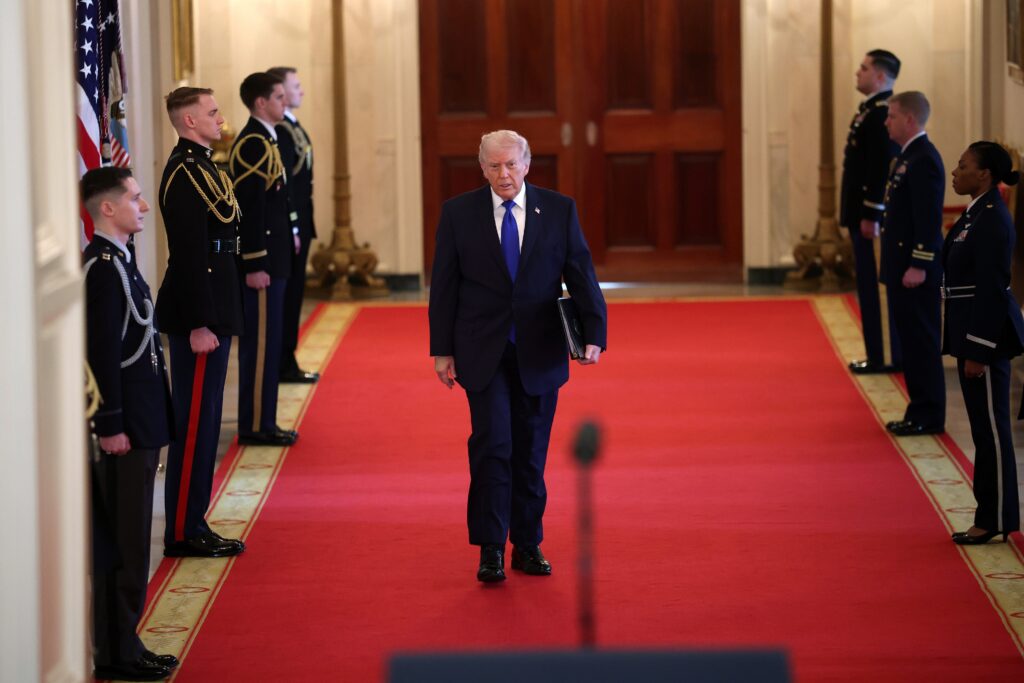
President Donald Trump will deliver his State of the Union address to Congress on Tuesday night at one of the most fragile moments of his second term, as he confronts new Supreme Court limits on his agenda, voter anger over inflation and growing crackswithin his MAGA coalition ahead of the midterms.
But during a time of hardened political divides, shrinking attention spans and declining television viewership, it’s unlikely that even one of Washington’s most enduring political traditions can reset the course of his embattled administration, according to interviews with Republican political consultants, historians and communications experts.
The State of the Union remains one of the rare moments when Trump is guaranteed airtime across networks to speak directly to a nationwide audience, and the constitutionally mandated address to the legislative branch remains a powerful symbol of the separation of powers. But in the age of algorithm-driven social media feeds and bite-size video clips, the audience for the speech is increasingly fragmented and entrenched in their political positions.
The carefully crafted speeches are more likely than ever to be drowned out by memes and partisan fireworks, as Americans increasingly experience the speech in clips online tailored for one party’s narrative rather than through a more than hour-long network broadcast.
“This moment used to have a huge buildup to it,” said Ron Bonjean, a Republican strategist who previously served as a spokesman for congressional leaders. “The expectations were sky-high for presidents to knock it out of the park. Now, it feels like when the speech is given on that Tuesday, by the next day you are talking about something else.”
Vice President JD Vance told Fox News that Trump will focus his speech on the economy, touting a “Trump boom” that will bring manufacturing jobs back to the United States and reduce energy costs for American households. The president will deliver that message to an increasingly skeptical public, as his disapproval rating hit 60 percent for the first time since the aftermath of the Jan. 6, 2021, attack on the U.S. Capitol, according to recent a Washington Post-ABC News-Ipsos poll.
The political forces buffeting his agenda are expected to be on full display under the Capitol dome. He is likely to come face-to-face with some of the Supreme Court justices he called“fools and lapdogs” following their Friday decision to strike down many of the broad tariffs central to his economic agenda. Some Democrats are planning to walk out of the address or forgo the event altogether, in part in protest of his approach to immigration enforcement amid a partial government shutdown causedby a standoff over funding for the Department of Homeland Security. And he’ll confront members of his own party who are increasingly critical of his agenda, especially his foreign policy movesas he considers launching an extended military assault on Iran as soon as this week.
Trump is omnipresent on television, but the State of the Union could still provide the largest single night audience that he will attract before the midterms in November. Trump administration officials and advisers continue to project confidence that people will start to feel the effects of their economic policies in the next few months, which they expect to improve the midterms map, according to a person close to the White House, who spoke on the condition anonymity to discuss private conversations. In multiple meetings to discuss the midterms, officials have described the election as “a game of inches, not a wave” and said the results will come down to the strength of each individual candidate and their fundraising operation, in addition to the economic reality.
Recent Washington Post polling has found that Trump’s worst issue is inflation, with 32 percent approval for how he has dealt with consumer prices. That could spell political trouble in November for Republicans, who made President Joe Biden’s handling of inflation central to their 2024 campaign pitch.
The Republican Party is struggling because the party lacks “a strong contrast message” to Democrats this cycle, given that they control the White House and Congress, said John McLaughlin, a longtime Trump pollster.
In part, some of the messaging challenge stems from how Americans consume news, McLaughlin said. During a presidential campaign, Trump travels the country to appeal directly to millions of people. Right now, he is spending most of his time managing parts of the government, so he is more dependent on media to amplify his talking points.
But fewer than half of Americans consume news via right-of-center outlets, McLaughlin’s polling has found. The State of the Union, he said, is an opportunity to reach a far larger and more diverse audience with a sharper message to voters.
“It’s not like when you had the Trump ’24 campaign,” he said, “so they have to get back into a campaign mode and campaign structure.”
An estimated 36.6 million people watched Trump’s address to a joint session of Congress last year, according to Nielsen. The event provided Trump one of his largest audiences besides inauguration, but his speech was largely overshadowed by partisan theatrics. The most notable was the removal of Rep. Al Green (D-Texas), who was escorted out of the chamber after he stood up, shook his cane in the air and shouted at Trump had “no mandate” to cut Medicaid.
Republicans sought to drown Green out by chanting, “USA!” Meanwhile, other Democrats held up signs that said “Save Medicaid” and one that just read “False.” This year, more than a dozen Democratic lawmakers are planning to hold a rally on the National Mall to provide counterprogramming to Trump’s speech. House Democrats in the chamber, meanwhile, will host the family of deceased Jeffrey Epstein accuser Virginia Giuffre, drawing attention to their continued investigation into the financier’s sex crimes.
Despite broadly declining interest in the speech, Trump, a former reality TV producer, has displayed a proficiencyat creating viral moments during his annual addresses.
During his 2020 State of the Union, first lady Melania Trump awardedconservative news commentator Rush Limbaugh, who had recently announced he was battling advanced lung cancer, the Presidential Medal of Freedom. The speech also featured a service member’s surprise reunion with his wife and children following a deployment in Afghanistan and a surprise scholarship for a Philadelphia fourth-grader.
This year, Trump has invited the U.S. men’s hockey team to attend the speech on the heels of their overtimegold medal victory at the Winter Olympics. The gold-medal-winning U.S. women’s hockey team declined the invitation.
Before the social media era, presidents often drew larger audiences for their first addresses or at times of crisis or scandal. More than 62 million viewers tuned into hear President George W. Bush’s justificationfor the imminent invasion of Iraq in 2003, and 53 million watched President Bill Clinton deliverhis address in 1998, a week after revelations that he and former White House intern Monica Lewinsky had a sexual relationship and that he had urged her to lie about it.
The speech is still widely treated as a political Super Bowl in Washington. Media companies deploy large staffs to cover the event and response late into the night. Hours before the president arrives, some lawmakers stake outprime seats so that they can greet the president as he moves through the U.S. House chamber. Members of the administration and outside lobbyists spend weeks trying to ensure that their pet issues get airtime in the speech.
The format of the State of the Union has dramatically evolved since President George Washington started the tradition. For more than a century, most presidents delivered their update on the state of the country’s affairs to Congress in writing, including President Abraham Lincoln’s famous 1862 address amid the Civil War.
More than half a century later, President Woodrow Wilson broke with tradition and visited Congress for a speech to present his plan for tariffs in 1913. “All official Washington was agape last night over the decision of the president,” The Washington Post reported at the time. The Post wrote that the presidential addresses on Capitol Hill were “not to become a habit,” but several months later, he returned again to deliver his constitutionally mandated update.
Wilson ushered in a new era of presidents delivering addresses to Congress in person, and later, broadcasting those addresses to the American people. President Calvin Coolidge was the first president to broadcast the State of the Union over the radio in 1923, and later, President Harry S. Truman delivered the first televised annual address. In an effort to expand the audiences, President Lyndon B. Johnson moved the address to the evening in 1965.
That move ushered in the modern spectacle, which has escalated in showmanship since the Reagan era, when he began bringing special guests into the address. But for more than a decade, the power of the president to reach a mass audience has been on the decline, as cable and the internet provide Americans with many other viewing options during the State of the Union, said David Greenberg, a professor of history and of journalism and media studies at Rutgers University.
“It becomes much harder to expect that you’re going to get tens of millions of people sitting in front of their living room TV on a Tuesday night,” he said.
Karen Tumulty contributed to this report.
The post The State of the Union brings a big audience for Trump. But does it matter? appeared first on Washington Post.