The producers didn’t hear it, the apologies were tone-deaf, the awards show was derailed and an organization that has spent much of the last decade trying to prove it’s not racist has a big problem.
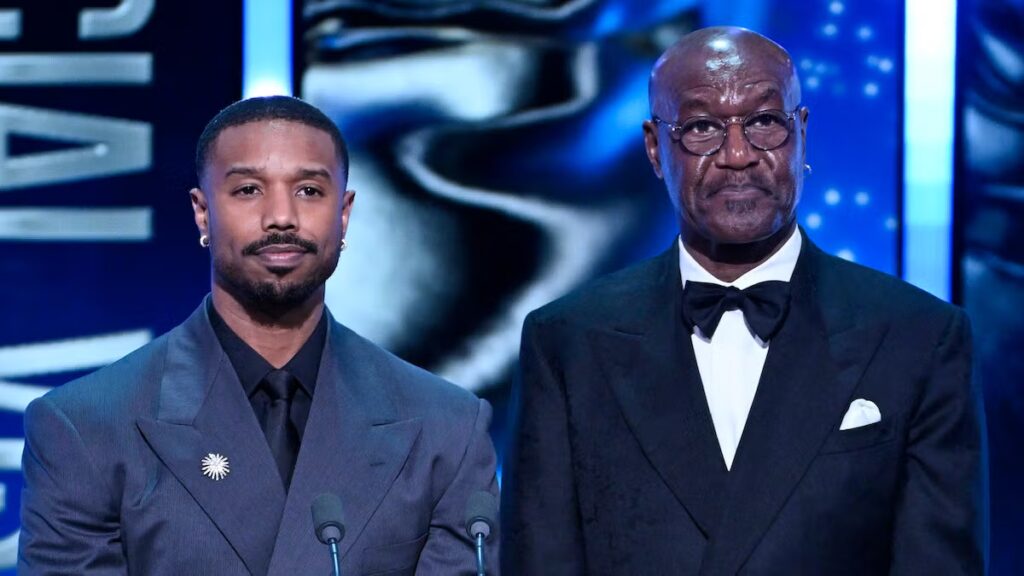
That’s the fallout from Sunday’s EE BAFTA Film Awards, during which Tourette’s syndrome activist John Davidson, the subject of the film “I Swear,” erupted in epithets at the stage from the audience, including yelling the N-word as “Sinners” stars Michael B. Jordan and Delroy Lindo presented an award.
Davidson left the hall during the first half-hour of the show, and host Alan Cumming explained the outbursts and thanked the audience for “understanding and helping create a respectful space for everyone.” Later, he added, “Tourette’s Syndrome is a disability and the tics you’ve heard tonight are involuntary, which means the person who has Tourette’s Syndrome has no control over their language. We apologize if you are offended tonight.”
But when the BBC broadcast of the ceremony aired two hours later, the shouted slurs were still audible, despite the fact that the show was being edited to fit its time slot. The offensive language wasn’t removed until Monday morning, when BAFTA and the BBC issued apologies, almost 24 hours later.
“At the BAFTA Film Awards last night our guests heard very offensive language that carries incomparable trauma and pain for so many,” the BAFTA statement began. “We want to acknowledge the harm this has caused, address what happened and apologize to all.”
Still, the initial “we apologize if you are offended” statement rankled many as weak tea. And the failure to make edits on a show that is known for being trimmed on the fly seemed to be the exact wrong way to react to a regrettable situation.
How did it go so badly? As usual, the show began at 5 p.m. in London but the broadcast didn’t begin until 7 p.m., with the BBC editors cutting the show down to two hours as it was going on. The version that aired showed a dozen of the 28 awards in quick montages and edited out a winner saying “Free Palestine” and Paul Thomas Anderson using the word piss.
But it didn’t cut Davidson’s outbursts. According to a report in The Guardian that didn’t give a source, “It is understood that the producers overseeing the ceremony for the BBC were doing so from a truck and say they simply did not hear the slur.”
But it was heard in the auditorium clearly enough that Cumming was asked to address it onstage twice, which makes the lack of communication between the hall and the editing truck all the more inexplicable. When they heard the host’s comments, did the editors not think they should try to find what he was talking about? (TheWrap asked BAFTA and BBC representatives about the failure to edit the offensive comments but did not receive a response.)
Backstage, meanwhile, no apologies or explanations were forthcoming to Jordan and Lindo, the latter of whom told Vanity Fair he and Jordan “did what (they) had to do” in the moment, but that neither of them were approached by BAFTA officials afterwards.
Watch the moment with Lindo and Jordan onstage below. (Warning: The clip audibly includes Davidson shouting the slur.)
Delroy Lindo says him and Michael B. Jordan did “what we had to do” to continue presenting at the BAFTAs after John Davidson shouted the N-word in an involuntary tic. He said he wishes “someone from BAFTA spoke to us afterwards.” (Source: https://t.co/CetXlW2PDv) pic.twitter.com/QM425fPt2M
— DiscussingFilm (@DiscussingFilm) February 23, 2026
“Sinners” production designer Hannah Beachler, meanwhile, said Davidson shouted at her later in the evening. “The situation is almost impossible, but it happened three times that night, and one of the three times was directed at myself on the way to dinner after the show,” she said in a statement. “And a third time at a Black woman. I understand and deeply know why this is an impossible situation. I know we must handle this with grace and continue to push through. But what made the situation worse was the throw away apology of ‘if you were offended.’”
BAFTA, like the motion picture academy that awards the Oscars, went through its own #SoWhite protests in the second half of the 2010s, after they’d failed to have Black acting winners in eight of the last 11 years and had only seven Black performers out of the last 100 nominees in their acting categories. (Most famously, 10-time Oscar nominee and two-time winner Denzel Washington has never received a BAFTA nomination.)
In 2020, the organization announced a revamping of its rules and a campaign to increase the diversity of its membership. “Everybody acknowledged this was a year where there were very strong contenders among people of color in the acting categories, and among female directors,” BAFTA film committee chair Marc Samuelson told TheWrap at the time. “And when we assessed the process of BAFTA voting, the conclusion was that it wasn’t nuanced enough to give the films a level playing field and a fair chance.”
The organization also instituted diversity standards for some of its top categories, putting standards in place that would be used as models for the Academy of Motion Picture Arts and Sciences when the Academy Awards made a similar move in the Best Picture category.
“Everybody who’s thought deeply about it knows it’s a tremendous problem and knows it’s going to take a long time,” Samuelson added.
But the specter of #BAFTASoWhite still hung over the organization, which faced criticism as recently as 2023, the last year it had no Black acting winners. (Since then, the supporting-actress category has gone to a woman of color every year, with Da’Vine Joy Randolph, Zoe Saldana and Wunmi Mosaku winning.)
It’s that history that now shadows BAFTA in the aftermath of Sunday’s show, in which the fact that “Sinners” won three awards is overshadowed by the epithet hurled (inadvertently) at three of its artists.
“I don’t know why it’s so hard for people to have empathy for Michael B. Jordan, Delroy Lindo, Hannah Beachler and John Davidson,” wrote The Black List founder Franklin Leonard on X. “Each of them deserves it.” He later added, “A fun thought experiment is ‘what would they have let Davidson yell at the Prince and Princess during the BAFTAs and still broadcast it?’”
Thierry Mabonga, who portrays Davidson’s lawyer in “I Swear,” chimed in on TikTok linking the BAFTA moment to a scene in the film where Davidson begins “hurling abuse at me, and it’s very offensive.”
“This is the condition, the disease of Tourette’s syndrome,” Mabonga said. “John cannot control what he says. In fact, that’s the whole point of why we’re making this film, we’ve made this film, ‘I Swear,’ is to educate people about Tourette’s syndrome. And how can you say that he can’t be there at the awards? This is a film about his life. This is a film about him. Absolutely he has to be there, and absolutely it’s great that he was there. And I don’t know if some of the actors there were told in advance about someone with Tourette’s being there. Hopefully they would have been told therefore prepared for that kind of stuff that happened.”
“Regardless, John has Tourette’s. Enough said.”
But, of course, it’s not enough said. BAFTA is learning that lesson the hard way.
Davidson’s film “I Swear” will open in U.S. theaters on April 24, distributed by Sony Pictures Classics.
The post BAFTA’s N-Word Debacle Was a Perfect Storm of Bad Hearing, Bad Decisions and Bad History | Analysis appeared first on TheWrap.