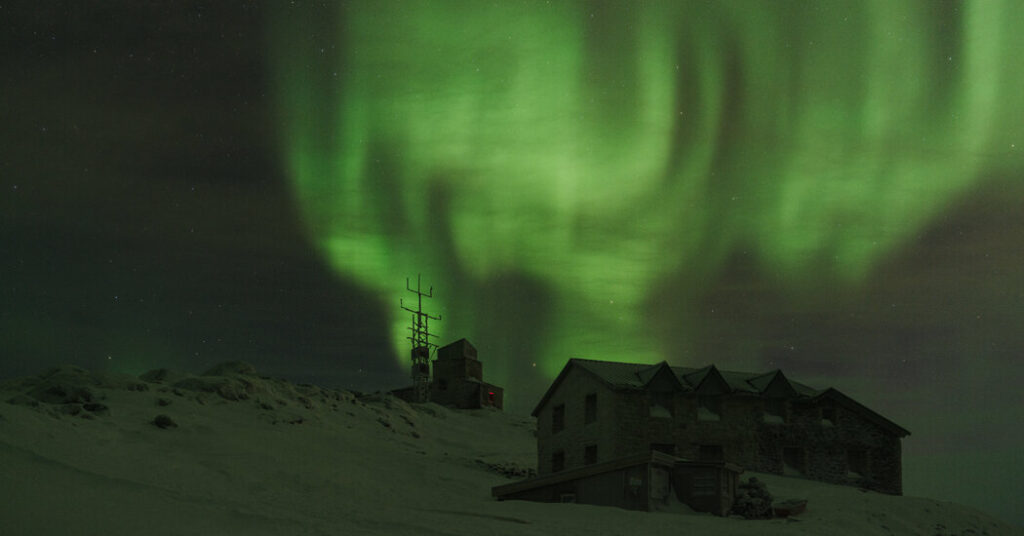
The world’s first permanent northern lights observatory occupies a small stone building atop Mount Halde in Norway. Built in 1899 by Kristian Birkeland, a physicist and Arctic explorer, the observatory was an aerie from which scientists of the early 20th century could study the auroras that shimmered and blazed across the Arctic skies at night.
Norway is widely regarded as the birthplace of auroral research; it was there that auroras were scientifically observed, analyzed and photographed. As the Danish writer Erik Johan Jessen wrote in 1763: In Norway, “the northern lights in great measurement have their home.”
Living on the windswept Halde in winter was arduous, and in 1926, research was shifted west to Tromso, where measurements of solar events and Earth’s magnetic field continue.
But this summer, a century after the original observatory closed, a sophisticated new radar system is expected to begin operating in Skibotn, a town partway between Tromso and Halde, where an array of 10,000 antennas will probe Earth’s upper atmosphere to try to provide a detailed understanding of auroras and space weather.
Peak aurora
In the far north, the mystery of the northern lights was explained through myriad tales, like dancing maidens and the spirits of dead children. Sailors at sea often returned to land rather than risk being grabbed and whisked off by the spectral lights.
In the late 19th and early 20th century, Dr. Birkeland developed and tested the first solid scientific theory. As charged particles from the sun interact with Earth’s magnetic field, they collide with atoms in the atmosphere, which release energy in the form of light.
Different colors result depending on the particles involved; green and red come from oxygen atoms, for instance, while purple comes from nitrogen.
Dr. Birkeland and his assistants conducted measurements of auroras at the observatory on Halde, estimating their altitude by triangulating between the observatory and a nearby mountain. They found that they typically occur at 50 to 300 miles high.
After Mr. Birkeland left Halde, he continued testing his theories through lab experiments, simulating Earth’s magnetosphere on a small magnetized ball known as a terrella.
In World War II, German forces destroyed the observatory; restoration began in the 1980s. “History lives on our premises,” said Hakon Haldorsen, the founder of Friends of Haldetoppen, a historical society. “If we don’t take care of the building, no one will find the story.”
Arcs, curtains and coronas
Northern Norway is ideal for studying auroras, not least because it sits above the auroral oval, a ring-shaped region centered around Earth’s magnetic north pole where solar particles tend to concentrate.
When research moved to the Auroral Observatory in Tromso (later renamed the Tromso Geophysical Observatory), scientists mapped hundreds of aurora colors, from eerie green to dawn-like red, and categorized the phenomenon’s many forms, including arcs, curtains and coronas.
The cupboards in the basement of the Tromso observatory are filled with old magnetometers, glass plates of aurora photographs and folders of geomagnetic data. Njal Gulbrandsen, a space physicist at the observatory, sees these relics as a legacy. “When I do my work,” he said, “I have to think of whoever comes after me.”
Scientists in Tromso maintain a decades-long database of magnetic measurements. “It’s the job of the observatory to maintain the long time series,” said Magnar Gullikstad Johnsen, the head of the observatory.
The same measurements are also vital in helping scientists predict space weather, when solar events can disrupt Earth’s upper atmosphere and scramble communications and damage power grids.
In the 1980s, the European Incoherent Scatter Scientific Association, or EISCAT, began operating large radar systems near Tromso to precisely measure the ionosphere, the part of the upper atmosphere ionized by solar radiation.
Today, the general physics of the northern lights is widely accepted, said Asgeir Brekke, a space physicist at the Arctic University of Norway in Tromso. What is less clear, he added, are “the details,” including what accounts for variations in particle density and for the aurora’s motions.
Plasma in 3-D
Along the Northern Lights Route, a winding road that traverses 300 miles of northern Norway, sits EISCAT 3D, one of the world’s most advanced scatter radars and the trailblazing younger sibling of the radar site near Tromso. A 300-foot-wide array of 10,000 antennas will study Earth’s ionosphere by transmitting radio waves and measuring how they are scattered by free electrons there.
The radar will coordinate with two similar sites in Finland and Sweden. Scientists can control the direction of the radio waves beamed from the antennas and illuminate the whole sky in seconds. With the data gathered, they can create three-dimensional images of plasma, or ionized gases, that arise from disruptive space weather and create spectacular auroras.
Dr. Johnsen likened auroral science to microscopy: The better the instrument, the better the magnification. As scientists zoom in on Earth’s protective sheath, they get ever closer to grasping the microphysics that make it work.
Auroras envelop the sky, and they have varying features, like big waves and tiny curves, he said, adding: “To understand the physical nature of things is to understand what happens on the very basic levels.”
Alexa Robles-Gil is a science reporter and a member of the 2025-26 Times Fellowship class, a program for journalists early in their careers.
The post Norway’s Century-Long Watch on the Northern Lights appeared first on New York Times.