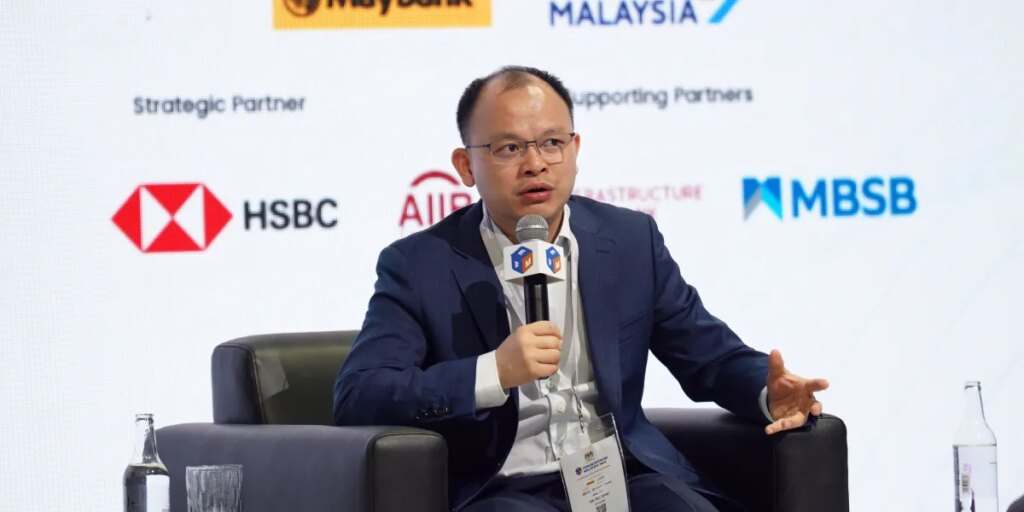
Bill Deng, CEO of China-based fintech platform XTransfer, thinks stablecoins can help finally digitize business-to-business transactions, often still stuck in a world of PDFs and emails.
Much of cross-border trade now operates around the clock. Ports, airports, and fulfillment centers work at all hours of the day.
But “when it comes to money, there’s no 24/7 infrastructure,” Deng complained during an interview with Fortune on the sidelines of the Forum Ekonomi Malaysia in Kuala Lumpur in early February. Business-to-consumer and peer-to-peer financial transactions–even across borders–can now be done in minutes. Yet, in the business world, “they negotiate deals via pro forma invoices, and they still exchange information via email,” he says.
Stablecoins–digital tokens tied to a fiat currency like the U.S. dollar—can make payments “more transparent, faster, and with a much lower cost,” Deng argued. “For domestic payments, stablecoins do not add that much value. But for cross‑border transactions, they can be extremely valuable.”
Several governments, including the U.S., Japan, and the Chinese city of Hong Kong, have set up regulatory frameworks for stablecoins. The total market value of all stablecoins is now $300 billion, up by 75% year-on-year. But there’s still a long way to go before stablecoins start to play a role in cross-border payments: A McKinsey estimate put annual stablecoin payments at only $390 billion, or just 0.02% of the total.
Small- and medium-sized enterprises throughout the developing world often turn to unregulated “shadow banking” systems to get money across borders. For example, there’s “hawala,” a centuries-old form of money transfer that predates the formal international banking system. In a typical hawala transaction, a customer pays cash to a broker in one country, and a corresponding broker in the destination country pays out the equivalent to the intended recipient. Hawala is often faster than traditional banking, and extends to areas underserved by traditional financial infrastructure. “It’s become the mainstream for SMEs in many developing countries,” Deng explained.
Yet due to its use by criminal networks, governments have scrutinized hawala and other shadow finance systems for money-laundering. Because hawala operates outside the formal banking system, its funds sometimes mingle with proceeds from fraud or other crimes. When banks detect these tainted flows, they freeze accounts.
“Banks are reluctant to provide services to SMEs, which forces enterprises to use hawala, and as a result, banks are even less willing to serve them,” Deng says.
XTransfer is already helping companies navigate a global tangle of anti-money-laundering regulation; Deng claimed AI helps his company do compliance more accurately than traditional banks at just 5% of the cost.
He also noted that stablecoins might help governments trying to keep an eye on illicit financial flows. Stablecoin transactions can hold data about the sender, receiver, and the purpose of a payment, making it easier for regulators to act quickly if something looks suspicious. “If there is some criminal evidence to show that the money needs to be frozen, issuers can freeze it within one second,” he explained.
Deng and five other co-founders established XTransfer in 2017 as a B2B version of Alipay, the ubiquitous Chinese payments service. Deng had spent over a decade in the payments sector, first at Visa, then at Alibaba affiliate Ant Financial. After several of his colleagues left to start their own businesses, including ride-hailing firm Didi, Deng decided to make the jump to become a startup founder too.
XTransfer serves over 800,000 enterprises, almost half of which are outside of China; The firm now processes over $12 billion in payments each month, and over 2% of China’s exports. In late 2025, the firm signed strategic partnerships with Malaysia’s Maybank, Thailand’s Kasikornbank, and Taiwan’s Bank SinoPac.
Still, XTransfer is getting a front-row seat to shifting trade flows, sparked by U.S. President Donald Trump’s decision to slap a wide array of tariffs on U.S. imports. (On Feb. 22, the U.S. Supreme Court deemed many of these tariffs to be illegal; Trump has vowed to maintain tariffs anyway).
Deng says the U.S. share of payments flowing through XTransfer’s platform has dropped from 22% a few years ago to just 9% today. In contrast, flows from “Global South” countries now account for 70% of the total.
XTransfer’s business in Asia, Africa, and Latin America grew 106% in 2025, with Africa surging more than 270%, according to a January press statement.
In the long run, Deng sees trade as shifting away from individual manufacturing powerhouses like China, with supply chains becoming more like a network connecting different smaller economies. And he argues Chinese business can help play a role in fostering the growth of manufacturing sectors elsewhere.
“The first thing locals think about Chinese people is that they’re wealthy,” he says, with a laugh. “Many Chinese people are bringing business into these countries–just like how the U.S. and Britain brought business into China 40 years ago.”
The post Stablecoins could finally bring cross-border payments into the digital age, argues XTransfer CEO Bill Deng appeared first on Fortune.