During the heaviest snowfall in New York City since 2016, which closed the city’s schools, shuttered Broadway and caused the city’s airports to cancel thousands of flights, New Yorkers still needed their Shake Shack veggie burgers and White Castle shrimp nibblers.
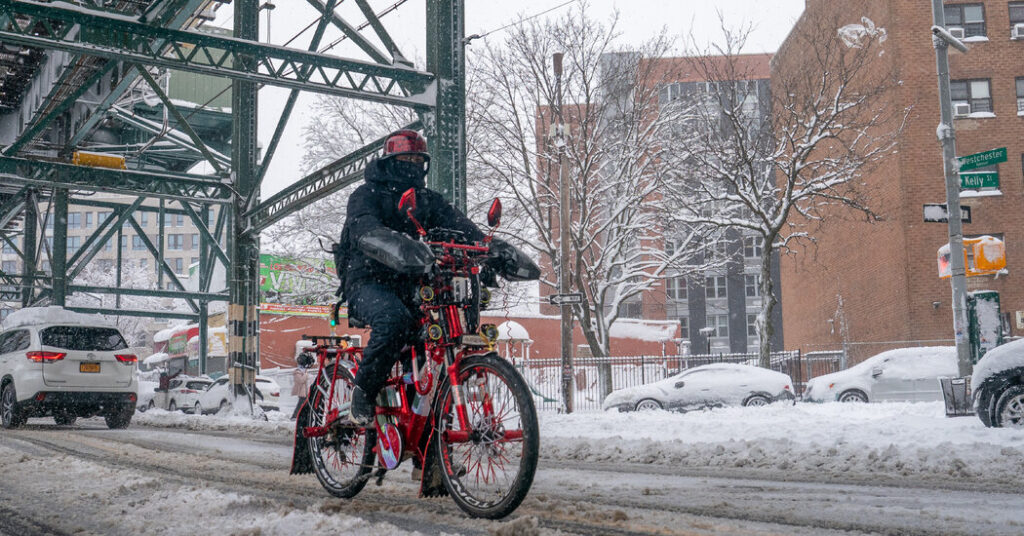
The burden of carrying food from busy restaurants to cozy apartments fell, as it always does, to the city’s legion of food delivery workers. Even though Mayor Zohran Mamdani declared a state of emergency that banned all but essential vehicles like ambulances, police cars and utility trucks from the roads, the 80,000 deliveristas were among those exempt.
That meant that any deliverista who felt daring enough was welcome to cycle the streets in near-blizzard conditions. It was treacherous going.
José Lino was delivering two orders of food to the Upper West Side of Manhattan when his bike’s battery died. It was 7 p.m. on Sunday night, and the blizzard was already hitting New York City hard. Mr. Lino made his deliveries, then logged off the Grubhub app on his phone.
He would make no more money that night. With a dead battery, he was forced to pedal his 60-pound bike home to his apartment in East Harlem through the rapidly accumulating snow, Mr. Lino said. He nearly wiped out three times.
“It was very hard, and I was very far from home,” said Mr. Lino, 39, an immigrant from Guatemala who decided to stay home on Monday as the snow continued falling heavily and winds gusted up to 60 miles an hour. “The app companies, they don’t care. They’ll send you four or five miles away from your house, even when the weather is bad. It’s not worth the risk.”
By Monday afternoon, after nearly 20 inches of snow had been recorded in Central Park, some of the delivery app companies were offering workers a surge fee of $4 per delivery to incentivize them to stay on the streets, said Ligia M. Guallpa, executive director of Deliveristas Unidos, which represents the workers.
“We are deeply concerned because during extreme weather conditions like a snowstorm, delivery work becomes more dangerous,” Ms. Guallpa said.
Even with the city’s permission to keep working, it appeared that many delivery workers stayed home.
“I wish I could do delivery, but no one’s available today,” said Hassan Alborati, the manager of Gardenia Deli in Chelsea. “Nobody showed up for deliveries.”
DoorDash suspended deliveries in New York at 8:30 p.m. Sunday, half an hour before the city’s travel ban took effect, Jenna Price, a spokeswoman for the company, said. The company said it would keep service suspended through at least 6 p.m. Monday.
Grubhub stopped dispatching workers at 7:30 p.m. on Sunday, not long after Mr. Lino’s e-bike battery died. By 2 p.m. on Monday, the company had resumed deliveries in Manhattan but kept its business paused in the other four boroughs until conditions improved, according to a spokesman, Najy Kamal.
Instacart continued to send workers to deliver food throughout the storm, said Charlotte Healow, a spokeswoman. Uber Eats did not respond to requests for information on Monday.
Experts in municipal law agreed that the mayor of New York has broad emergency powers, and that Mr. Mamdani could have chosen to ban all two-wheeled vehicles, including those piloted by delivery workers, from the streets. That might have left some disabled and otherwise immobile New Yorkers without food, however, and all delivery workers without pay.
And though Mr. Mamdani made the exception for food delivery, in a news conference on Monday afternoon, he advised New Yorkers to stay indoors, not to order takeout, and to prioritize health and safety, even while trying to help out.
“Make an enormous pot of soup and bring it to your neighbors upstairs,” the mayor said.
It appeared that some workers, and perhaps some delivery companies, may not have abided by the self-imposed bans. Workers with Transportation Alternatives, a nonprofit advocacy group, successfully ordered food from Grubhub after the company said it had stopped service on its app, according to receipts sent by Charlie Baker, a spokesman for Transportation Alternatives.
“It sounds like they may not be being completely honest,” Mr. Baker said of Grubhub’s announcement that it had suspended operations.
Mr. Kamal, the Grubhub spokesman, said the company had stopped facilitating delivery orders during the shutdown, but that restaurants could remain online and continue accepting orders.
“My guess is that it was a self-delivery restaurant that chose to stay open,” he said.
The snowstorm seemed to partially reignite the yearslong debate over the best ways for New Yorkers to get their meals delivered while making sure that the workers bringing them are safe and well paid. Workers have complained that even with the surge pricing, they ran the risk of receiving negative reviews for being delayed, even in a blizzard. That was one reason Mr. Lino decided to stay home on Monday.
“If I go out today and get the flu, or I get injured, I can’t work tomorrow,” he said, “which makes it hard to make money.”
Late on Monday, after the sun had set, Mr. Kamal, the spokesman for Grubhub, sent an email to The New York Times. “We’re pausing Grubhub-managed deliveries overnight again (in all NYC, incl. Manhattan),” he wrote. “Will re-assess in the a.m.”
Wesley Parnell, Emma Goldberg and Dana Rubinstein contributed reporting.
Christopher Maag is a reporter covering the New York City region for The Times.
The post Even in a Blizzard, Food Delivery in New York City Continues appeared first on New York Times.