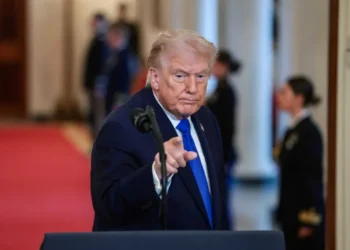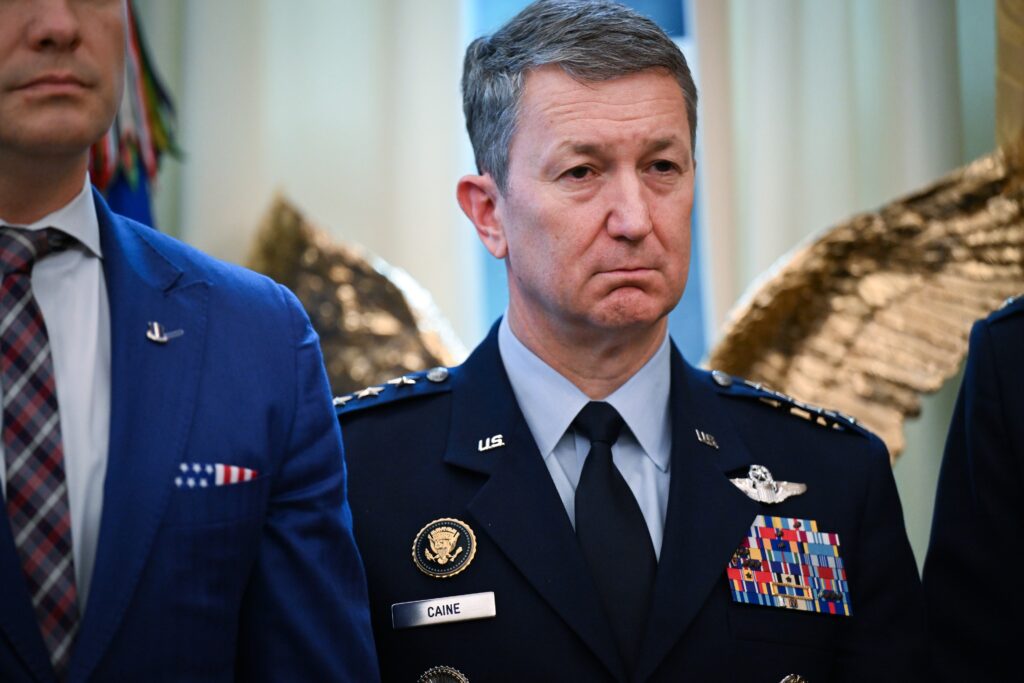
As the Trump administration weighs an attack on Iran, the Pentagon’s top general has cautioned President Donald Trump and other officials that shortfalls in critical munitions and a lack of support from allies will add significant risk to the operation and to U.S. personnel, according to people familiar with internal discussions.
Gen. Dan Caine, chairman of the Joint Chiefs of Staff, expressed his concerns at a White House meeting last week with Trump and his top aides, these people said, cautioning that any major operation against Iran will face challenges because the U.S. munitions stockpile has been significantly depleted by Washington’s ongoing defense of Israel and support for Ukraine. Gen. Caine’s remarks at the White House meeting have not been previously reported.
Separately, in Pentagon meetings this month, Caine also has raised concerns about the scale of any Iran campaign, its inherent complexity and the possibility of U.S. casualties, one person said. The general has said that any operation would be made all the more difficult by a lack of allied support, this person said, speaking like others on the condition of anonymity to discuss private conversations.
In a statement, Caine’s office said that in his role as the president’s top military adviser, the chairman “provides a range of military options, as well as secondary considerations and associated impacts and risks, to the civilian leaders who make America’s security decisions.” Caine, the statement adds, “provides these options confidentially.”
White House spokeswoman Anna Kelly said Trump listens to a “host of opinions on any given issue and decides based on what is best for U.S. national security.” She described Caine as a “talented and highly valued member of President Trump’s national security team.”
The White House meeting on Tuesday included Vice President JD Vance, Secretary of State Marco Rubio, CIA Director John Ratcliffe, Defense Secretary Pete Hegseth and White House adviser Stephen Miller, one person told The Post.
Caine’s views, reported earlier by Axios, are seen as highly credible by the administration because of the successful execution of two other major operations he has overseen: the assault on Iran’s nuclear sites in the summer and the January raid to capture Venezuelan President Nicolás Maduro. Caine, said one person familiar with his conversations, will support whatever decision the president makes, as he did with previous operations, and does not want to be seen as taking any option off the table.
The scale of an Iran campaign could vary significantly depending on Trump’s objectives.
Taking out Iran’s missile program would require hitting hundreds of targets across a country more than three times the size of Iraq. Those targets could include missile launch sites, many of them mobile; supply depots; air defense systems; and the transportation networks used to move those weapons, a former defense official told The Post.
If the objective is to overthrow Iran’s supreme leader, Ayatollah Ali Khamenei, as Trump has mused publicly, the target set would expand dramatically to thousands of sites, including command-and-control nodes, security services, and key buildings tied to Khamenei. Such a campaign could extend for weeks or months, require much more munitions and expose U.S. forces to more intense retaliation, the former defense official said.
The administration has assembled a massive strike force in the Middle East, and Trump has acknowledged that he is also weighing a limited strike aimed at pressuring Tehran into a deal to restrict its nuclear program on terms favorable to Washington. Iran has expressed a willingness to make a deal, but disagreements remain over Iran maintaining a uranium enrichment capability, among other issues. Talks between U.S. and Iranian negotiators are scheduled to resume this week in Geneva.
Some U.S. officials oppose a limited strike because it could trigger an unpredictable cycle of tit-for-tat violence, including Iranian attacks on U.S. military and diplomatic personnel in the region, said a person familiar with the deliberations.
Advocates for a limited strike point to Iran’s modest response to previous U.S. and Israeli strikes, including telegraphed counterstrikes aimed at limiting the risk of U.S. casualties. But opponents say Trump’s open deliberating about regime change and the growing influence of hard-liners in Iran’s military establishment may invite a more lethal response.
U.S. allies in the region, some of whom met with Trump last week to convene his Board of Peace, also worry that a limited strike would push Iran away from the negotiating table.
An attack on Iran could further strain U.S. relations with its regional allies. A senior Persian Gulf official told The Post that Arab countries have informed Washington that they would not allow their bases to be used for a strike against Iran. Iran’s threat to retaliate against any country that supports the U.S. operation have also raised questions about Washington’s ability to secure flyover rights.
One former Pentagon official said the lack of allied support significantly complicates the mission. “How are we going to be able to do this, especially if the Arabs don’t give us overflight? How are you going to hit hundreds, if not thousands, of targets across the country?” the former official said.
Two munitions critical to the defense of U.S. military personnel against Iranian-launched ballistic missiles — Terminal High Altitude Area Defense, or THAAD interceptors, and Patriot missile systems — have been extensively used in recent military operations in the Middle East. Patriot missiles also remain one of the most in-demand items by Ukraine as it defends against Russian missile attacks.
But the U.S. produces only several hundred of both defenses each year — far less than would be needed, said Ryan Brobst, deputy director of the Center on Military and Political Power at the Foundation for Defense of Democracies.
The Navy, too, has a limited supply of its standard missiles, a must-have if the U.S. is going to limit risk to the thousands of U.S. military forces that have surged to the region. But ship-launched SM-2, SM-3 and SM-6 munitions have been rapidly consumed as the Navy has protected vessels in the Red Sea against Iranian-proxy forces in Yemen and defended Israel against ballistic missiles.
Because of their complexity and production constraints, it can take two years or more to produce each replacement missile, said Mackenzie Eaglen, a senior fellow at the American Enterprise Institute. “There’s no quick fix to this problem,” Eaglen said.
The U.S. military’s supply of those missiles is globally managed and allocated, meaning one pot is shared by commands worldwide depending on need. No one has everything they need, a U.S. official told The Post.
Munitions stockpile levels dropped so low last year that the Defense Department abruptly requested almost $30 billion from Congress to purchase a range of high-end missiles and interceptors. The request was only partially fulfilled in the Pentagon budget passed last month, according to lawmakers.
Katherine Thompson, a senior fellow at the Cato Institute who recently left the Pentagon, said that the United States “is not currently prepared to resource simultaneous conflicts” and that any extended conflict with Iran “would likely come with significant trade-offs for higher-priority interests.”
The United States has surged forces to the region in part to mitigate risk to U.S. personnel there and Israeli targets, but a dangerous numbers game persists. As long as Iran retains a missile arsenal, American and Israeli forces would have to absorb incoming fire or destroy Iran’s launch sites at scale, a former defense official said.
“That is the dynamic,” this person said.
As the Trump administration deliberates, it has assembled the largest military buildup in the Middle East since the 2003 invasion of Iraq. On Monday, the U.S. ordered the departure of nonemergency U.S. government personnel and family members from the U.S. Embassy in Lebanon amid fears that Iran’s proxy Hezbollah could be drawn into the conflict.
Trump’s special envoy to the region, Steve Witkoff, told Fox News over the weekend that the president is “curious” why Iran hasn’t “capitulated” to U.S. demands, given the looming threat of a military attack.
“Why, under this pressure, with the amount of sea power and naval power over there, why haven’t they come to us and said, ‘We profess we don’t want a weapon, so here’s what we’re prepared to do?’ And, yet, it’s sort of hard to get them to that place,” he said.
Iranian Foreign Minister Abbas Araghchi responded on social media, saying: “Curious to know why we do not capitulate? Because we are Iranian.”
Dan Lamothe, Noah Robertson, Alex Horton and Aaron Schaffer, in Washington, and Suzy Haidamous, in Beirut, contributed to this report.
The post Trump’s top general foresees acute risks in an attack on Iran appeared first on Washington Post.