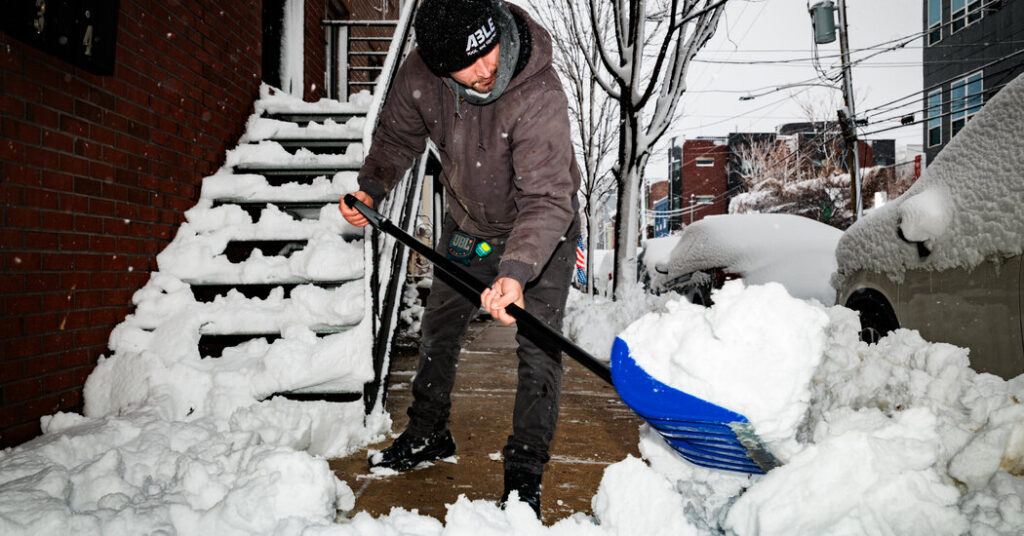
If you’re planning to shovel snow, be careful.
While the snow from the season’s previous storms was light, easily lofted and tossed aside, the heavy, dense snow from the current storm carries a different set of risks.
The National Weather Service often refers to this heavy accumulation as “heart attack snow” because the physical exertion required to move it is significantly greater. Research has also linked snow shoveling to slips and falls, lower back injuries and sudden cardiac arrest. For people who are older, unaccustomed to strenuous exercise or living pre-existing health conditions, the heavy lifting needed to clear this snow can be dangerous and occasionally fatal.
Why is this snow so heavy?
Snow is composed of frozen water crystals, but the amount of water in snow can vary, changing its weight.
Meteorologists often characterize this with the snow ratio, or the amount of snow relative to the amount of water it melts down to.
In a dry storm, for example, snow crystals are light and fluffy such that an inch of snow might melt down to only 0.05 inches of water — a 20-to-one ratio. This kind of snow occurs when the “growth zone” — the atmospheric layer where snowflakes form — is humid and well below freezing, but the flakes then fall through dry air near the ground.
But in a particularly wet storm, like the one hitting the Northeast and Mid-Atlantic this week, temperatures hover near freezing, so the edges of snowflakes start to melt. These water molecules act as a microscopic glue, allowing crystals to bond together. In such storms, the snow-to-liquid ratio can drop to five to one, meaning an inch of snow contains 0.20 inches of liquid — four times the weight of the drier variety.
Dry crystals stack delicately like a house of cards, while wet crystals gel together and become compact.
How can I shovel snow safely?
Cold weather can already irritate your airways, raise your blood pressure and contribute to dehydration. Shoveling snow only stresses your body further.
If you need to shovel, experts recommend waiting about an hour after you wake up, because your muscles might still be stiff and heart attacks are more likely in the early morning. Similarly, avoid heavy meals, caffeine and smoking before you shovel snow to avoid placing added strain on your heart.
Before you step out, make sure to hydrate, stretch and warm up indoors (think walking in place, gentle squats, shoulder rolls and arm circles), said Stephen Cheung, a professor of kinesiology at Brock University in Ontario. And layer properly, opting for mittens instead of gloves and avoiding cotton clothing, which holds onto moisture and thus loses its ability to trap heat. Also make sure to wear boots with good grip to avoid falls.
Keep your hands about a foot apart on the shovel to maximize stability and leverage, which can help limit muscle strains. Tackle the snow in thin layers, since multiple lighter loads are easier than a few heavier ones. And take frequent breaks indoors.
Protect your back by bending your knees and powering the movement with your legs. Avoid tossing snow, especially over your shoulder or to your side, since that can increase the risk of stressing your back or falling on slick surfaces. Instead, push snow away, or scoop small amounts and walk it to a snow pile.
And if you feel any chest tightness, dizziness or sudden shortness of breath, stop shoveling immediately and call 911.
Simar Bajaj covers health and wellness for The Times.
The post How to Shovel Snow Safely appeared first on New York Times.