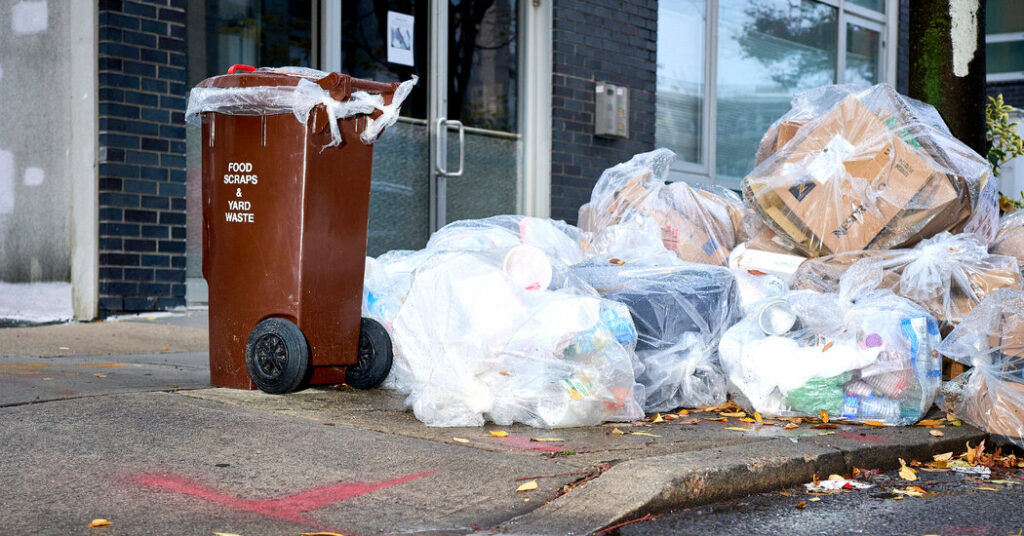
It’s time for building owners in New York who have been throwing banana peels and coffee grounds into their regular trash to get with the city’s curbside composting program. Under the administration of Mayor Zohran Mamdani, it is being fully enforced again, no exceptions.
“Since Jan. 1, we have been enforcing across the board,” said Vincent Gragnani, a spokesman for the Department of Sanitation in a statement. So far this year, the department has issued 425 summonses for failure to separate food and yard waste, he said.
New York’s curbside composting program — the largest in the country — took several years to plan and ramp up. And since last spring, when composting became mandatory in all five boroughs, confusion about the program has lingered, especially among owners of smaller buildings.
In April, just weeks after the city started to assess property owners’ fees for failing to separate their food and yard scraps from their garbage, the mayor at the time, Eric Adams, paused the penalties for smaller buildings until the end of 2025 to “conduct additional outreach and education on composting,” his office said in a statement. During the past three years, the Sanitation Department has conducted more than 1,500 information sessions, sent mailers to every New Yorker and issued more than 40,000 warnings, Mr. Gragnani said.
Sticking to the schedule set by Mr. Adams, the Mamdani administration in January resumed imposing fines for anyone failing to abide by the composting rules, from owners of high-rises in Midtown Manhattan, to squat walk-ups in Canarsie, Brooklyn, to single-family homes with yards in Staten Island. The penalties, the same as those for failing to recycle, range from $25 to $300, depending on the size of the building and the number of infractions.
New Yorkers produce roughly eight million pounds of residential food waste each day. When the waste rots in landfills, it produces greenhouse gases, including methane, which contribute to global warming. The curbside program aims to significantly reduce those emissions by diverting much of the waste from landfills and sending it instead to facilities that turn it into finished compost or into a biogas, a renewable fuel, that provides power to homes.
By law, every building in the city should have a dedicated container for food and yard scraps. Residents can call 311 to report landlords who have failed to do this. All food — even meat scraps and bones, as well as uncoated paper plates and pizza boxes — should go into these receptacles.
“New Yorkers should not overthink this,” Councilwoman Sandy Nurse said when the program was introduced. “Is this something I can eat? Or grow? Cool, it goes in the bin.”
To store food waste at home before it gets transferred to a larger bin for pickup, New Yorkers can use any container with a lid, such as an oversize peanut butter jar or a plastic bag that they can wash out and reuse. Many residents store their waste in freezers to avoid the smell.
There is evidence that the mandatory program is catching on. During the second week of April, when the enforcement of curbside composting had begun, the city collected nearly 3.6 million pounds of food and yard waste, more than three times the amount collected during the same week in 2024, according to the Department of Sanitation. By late November, the weekly collection had hit a new peak, nearly doubling, despite the pause in some fines.
“We know that increasing participation takes time, and we continue working to remind New Yorkers that composting is required, and incredibly simple,” Mr. Gragnani said.
“Just set out food and yard waste in a container on your recycling day,” he said. “We pick it up.”
Hilary Howard is a Times reporter covering how the New York City region is adapting to climate change and other environmental challenges.
The post If You’re Not Composting in New York City, It Could Cost You appeared first on New York Times.