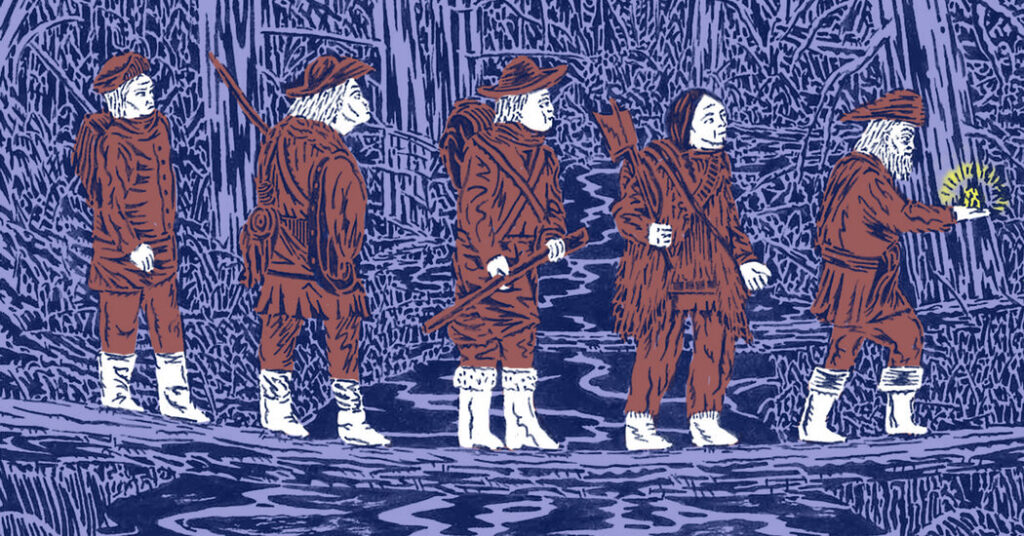
WHITE RIVER CROSSING, by Ian McGuire
Ian McGuire chronicles unvarnished avarice and evil intent like few others writing today. In novels like “The North Water,” a literary haymaker about an unusually grim 19th-century English whaling voyage, and “The Abstainer,” a brooding thriller set largely in Manchester, England, during the Irish struggle to end British rule, McGuire looked unblinkingly into the past and — given the current state of the world — found that things weren’t so foreign there. His latest, “White River Crossing,” sees him continuing in this mode.
Set in the 1760s in the woods and barrens of the northern Canadian interior, the novel tracks a party of three Englishmen and four Indigenous guides on an expedition for rumored gold. Their starting point is a remote outpost of North America’s oldest corporation, the Hudson’s Bay Company, which started as a fur-trading business in the 17th century and helped colonize vast stretches of the continent.
Commissioned by a wonderfully repulsive company man named Magnus Norton, who has surrounded himself even on the outskirts of colonial civilization with a grotesquerie of riches that include “brass lamps and tapestries and oil paintings of dogs,” the small party must travel hundreds of miles through little-known territory, overcome local opposition, locate and extract the gold and make the monthslong journey back with it. Things don’t go well.
This is not just because John Shaw, Norton’s lieutenant and the party’s leader, is a thug and a rapist cut from much the same loathsome cloth as Henry Drax, the chilling antagonist of “The North Water,” but because flaws abound in the little band.
Nabayah, a Dene chieftain’s adopted son and the party’s principal hunter, is at first indifferent and then terribly abusive to his wife, Keasik. Abel Walker, Norton’s callow teenage nephew — who dreams of owning a manor house and congratulates himself not for stopping a sexual assault but for simply not participating in it — falls easily under the sway of Shaw. Even seemingly more redeemable characters like Thomas Hearn, who is something like the group’s conscience early on, prove otherwise by the end.
For the better part of “White River Crossing,” McGuire shapes his investigation of the age-old costs of extractive capitalism with the precision and power he’s rightly known for. Whether he is describing “tree limbs whitely groined with snow”; or a wounded wolf that “twists itself about like a python and sinks its serried teeth” into an arm; or a pair of beleaguered party members, far from home, belting out “The British Grenadiers,” “the brave English words” furling and flapping vainly above their heads, the language feels spring-loaded, evocative, alive.
Less successful are several moments where the footsore, underfed characters engage in stilted inner monologues: “Yet if lustfulness is common and natural among every race,” Hearn says to himself, “however primitive or refined, then so surely is jealousy.”
The prose bends toward reductive abstraction most often in the sections told from the perspective of its Dene and Inuit characters. We can attribute this in part to McGuire’s need to account for languages and minds he doesn’t have easy access to, but the results include overblown, caricatured pronouncements, like this one from an Inuit shaman at a moment of crisis: “Help me, oh wise ones. … Tell me what I must do now. Can I face down this dreadful demon all alone?”
Perhaps it was being on less-sure footing that led McGuire to include an author’s note at the start of the novel in which he underscores both his considerable research and the blind spots he encountered, particularly stemming from the dearth of written records by the Native peoples of the region. A selected bibliography, which lists more than 25 primary and secondary sources, appears at the end.
The late, great Hilary Mantel, whom McGuire cites in his note, was as famous for the copious research she undertook in writing modern classics like “Wolf Hall” as for how seamlessly she metabolized it into her prose, and if she felt the need to comment on her process she did so in the back matter.
McGuire himself felt no need to start “The North Water” with a base-covering overview of his investigations into brutal harpooners, child abuse and 19th-century insurance fraud schemes, and it’s hard to see what, beyond drawing attention to the gaps that any novelist working with the past must face, such a gesture achieves here. Better to have left the vivid wraiths of the hard, dark, long-dead world he can so powerfully conjure to speak for themselves, as they do in this anguished, telling exchange:
“Do you believe in the gold like I do, Abel?” Shaw whispers. “I mean do you truly believe?”
“Of course,” Abel says, too scared to contradict him. “I believe in it. I swear I do.”
WHITE RIVER CROSSING | By Ian McGuire | Crown | 271 pp. | $29
The post How Much Does Capitalism Cost? Ask These Prospectors. appeared first on New York Times.