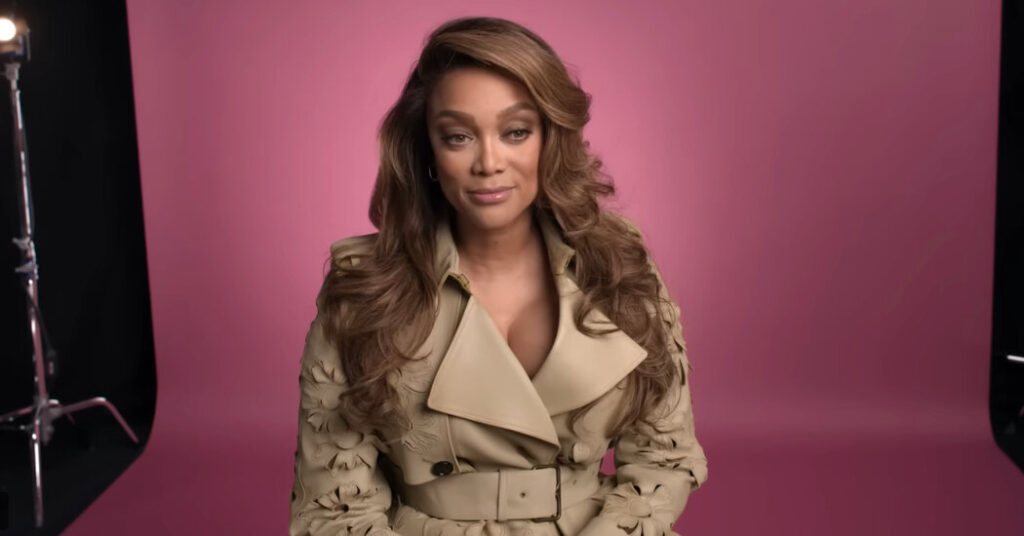
It isn’t until the very end of the Netflix docuseries “Reality Check: Inside America’s Next Top Model” that Tyra Banks, wearing a tan trench coat and framed by luscious waves of brown hair, owns her part in the insanity that was the popular early 2000s competition show. Well, kind of. She offers an offhand acknowledgment, tossed out with a banal little speech about evolving from mistakes: “Continue to evolve, ‘cuz that’s what we’re all doing.”
She’s interrupted by a television test pattern. The series cuts to Dani Evans, the “ANTM” Cycle 6 winner who was only allowed to continue on the show after consenting to a dental procedure to close the gap in her teeth. “Girl, that is absolutely ridiculous,” Evans snaps. “Perfect time to stop.”
In the discourse since the docuseries’ release, Tyra Banks is on trial again, much as she was during the pandemic when internet commenters rediscovered the show and posted videos reacting to its retrograde sensibilities. Most specifically targeted Banks, whose antics were the draw of the series, which ran for 15 years. But she’s far from the only figure from to have profited off reality TV’s exploitative early practices. So why is Banks such a popular target?
Consider her original means to success. The fashion model: a symbol of American consumerism, a person presented and posed to sell a story, an idea, a product. And because the model is in service of the product, she must be appealing to a wide range of consumers. She must reflect what the United States finds beautiful.
There’s not much space for a Black woman in this idea. What territory Banks carved out, she did so knowing it wouldn’t exempt her from upholding this industry’s standards and, in some way or another, submitting to its demands. Undeniably, as one of the first Black supermodels, and as the first Black model to grace the cover of magazines like GQ and Sports Illustrated’s swimsuit issue, Banks achieved icon status that gave her the leverage to sell a TV show.
Throughout the docuseries Banks punts on the question of her accountability running “Top Model,” which she created, hosted and executive produced. She says more than once that she didn’t have the final say in production decisions. But she does describe pushing for casting choices and story lines. Tellingly, Banks also says, “I do feel like I can feel and taste what people want to see.”
Audiences were already being fed gruesome, sadistic entertainment from shows like “Survivor” and “Fear Factor,” and craved sensationalist TV, Banks says, positioning herself as humble waiter to the hungers of an insatiable public. More than once she says some of the absurd TV moments in “Top Model” (for example: photo shoots where the models wear brown and blackface, or pose as homeless in couture) were just about the show meeting the times.
In the most famous moment in “Top Model” history, Banks explodes at one young Black model, Tiffany Richardson, during an elimination. “We were all rooting for you” — what Banks exclaims in the climax of this on-camera meltdown, became the statement that launched a million memes and impressions. Even the other judges sitting behind her appear shocked by Banks’s emotional outburst, which starts with a reprimand of the contestant for her flippant attitude and somehow ends up focusing on Banks’s personal struggles.
The clip can be — and still often is — dismissed as typical of the kind of craziness that defines the most titillating reality TV moments, but that is only a shallow read. It is shocking and theatrical. But if we take the scene as an emotionally honest moment, and not just contrived TV spectacle, then it’s a jarring reveal. Even a woman who has spent years sublimating, perhaps even exploiting, her race to be perceived as media-friendly and nonthreatening lets the facade drop for a second and is reduced to the angry Black woman stereotype. Banks herself seems so blindsided by the force of her emotions, as though she were floating on a cloud of her best intentions — new models, new industry, new beauty standards — just to be dragged down and flattened onto the screen of reality entertainment.
It was a misstep Banks had been expert at avoiding in a career full of televised code switches. But the inherent contradictions of being both mentor and boss are evident throughout her history: Juxtapose Banks body-shaming a young Black “Top Model” contestant with her demanding her own body-shamers “kiss my fat ass” on her talk show in 2007. Pair clips of Banks advocating for the agency of female models with her brushing off a young Black contestant’s complaints of on-set harassment.
Of course Banks is a hypocrite. She is, after all, a businesswoman caught in the same bind as any Black woman who seeks influence and power in spaces defined by whiteness. Was there any real way for a Black supermodel-slash-entertainment mogul to exist in American pop culture without these same ideological fractures?
I’m not sure that there was. That’s far from a defense of Banks, who has profited from the trauma done to these young women in the name of entertainment and who has, all these years later, continued to brush off her culpability.
But I also think the ongoing judgment of Banks, who now lives in Australia, is ultimately immaterial. I think back to the early years of her fame, in particular the year 2000, when I watched a trifling little Disney TV movie called “Life-Size” as a child. In it, Banks played Eve, a doll owned by a grieving preteen (Lindsay Lohan) who magically brings her to life. Eve’s a plastic packaged product in a world of white dolls. She doesn’t neatly fit into the context of real life, but she’s Black and still seen as beautiful. She’s still magical. To me that seemed, in its own small but significant way, a wonder.
Maya Phillips is an arts and culture critic for The Times.
The post The Never-Ending Trial of Tyra Banks appeared first on New York Times.