
President Donald Trump is forcing Democrats to rethink their 2026 midterm strategy, pushing their focus deep into traditionally red states where GOP loyalty has long seemed untouchable.
The Democratic Congressional Campaign Committee on Monday unveiled the first dozen candidates in its “Red to Blue” program, a high-stakes effort to flip Republican-held districts ahead of the 2026 midterms.
The list blends long-standing targets, including Representatives Juan Ciscomani of Arizona, Zach Nunn and Mariannette Miller-Meeks of Iowa, and Scott Perry of Pennsylvania, with newer faces such as Andy Ogles of Tennessee and Chuck Edwards of North Carolina.
Many of these districts delivered double-digit victories for Trump in 2024, and the median district voted for the president by 8.5 points—signaling that Democrats are counting on significant swings to make these races competitive.
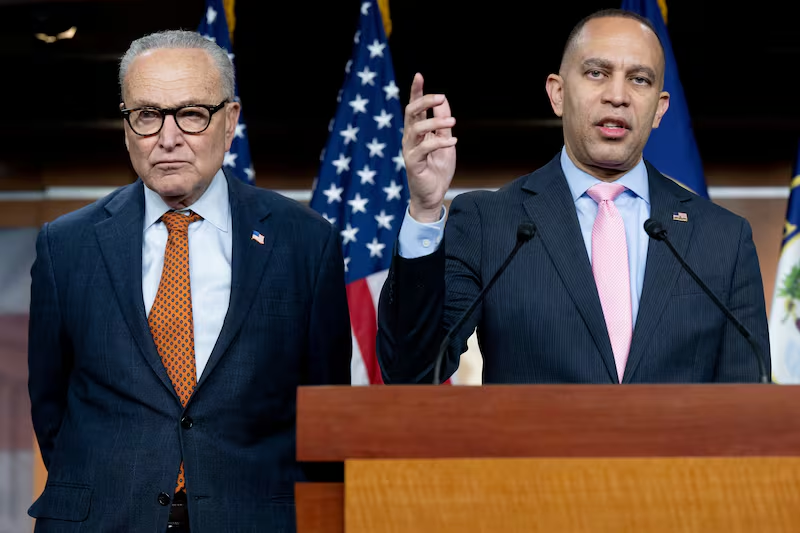
House Minority Leader Hakeem Jeffries told reporters last week that Democrats are expanding the map of potential pickups from 39 to 44 seats.
“The battlefield was just expanded in terms of the seats that are in play from 39 to 44,” he said. “We only need to net three.
“It’s happening. Democrats are going to take control of the House. The only question is, ‘What’s the margin?’”
Democratic Representative Suzan DelBene framed the recruitment drive as a sign of momentum.
“House Democrats are on offense and poised to take back the majority, thanks in large part to the strength of our candidates,” she said in a statement.
Republicans, however, slammed the effort. National Republican Congressional Committee spokesperson Mike Marinella derided the lineup as “recycled losers, far-left activists, and full-blown socialists who will be soundly rejected by voters across the country.”
“Someone needs to buy the DCCC a gift card to help pay for all the lipstick they’re putting on the pig that is their recruitment class,” he said, according to Axios.
The DCCC rollout comes amid a wave of GOP anxiety over the party’s midterm prospects.
In 20 state legislative special elections this year, Democrats have outperformed Trump’s 2024 benchmarks by 10 to 14 points in races across northern and central Virginia, New York City, east-central Minnesota, and southeastern Connecticut, fueling fears in GOP circles that the president’s performance may no longer guarantee easy victories in previously secure districts.
Even in districts long considered solidly Republican, GOP candidates are struggling to match Trump’s 2024 performance. In a north-central Oklahoma state House race on February 10, a Republican secured a win by just 28 points—a sharp drop from the 58-point margin Trump carried in the same area two years earlier.
And in a surprising upset in Tarrant County, a longtime Republican stronghold in the Texas state Senate, Democrat Taylor Rehmet defeated a Trump-backed GOP candidate in January, capturing more than 57 percent of the vote.
Meanwhile, according to analysis by The Downballot and Sabato’s Crystal Ball, if Democrats achieve a swing similar to the 2018 midterms—when they gained a 6.5-point advantage over Trump’s 2016 margins and picked up 41 seats for a 235‑199 majority—they could net 12 additional seats in 2026, giving them a 227‑208 majority under the latest redistricted maps.
“While it is tempting for many in our party to wish away these results, the pattern is clear that there is at least a current 10-point Democratic over-performance from Trump 2024—and it’s built on a fired-up Democratic base and a sleepy GOP base,” one unnamed GOP operative told Axios last week.
It comes as polls have put Trump’s popularity at a historic low in recent days, while Trump’s net approval is deep in negative territory on several key issues.
That includes the economy and immigration—both of which were key issues for voters in the 2024 election.
YouGov/Economist polling shows that since the beginning of his second term, Trump’s net approval on immigration has dropped from +11 points to -11 points, while his rating on the economy has dropped from +12 points to -23.
Recent surveys have also shown that Trump is losing support among key voter groups that propelled him into the White House in 2024, such as young men, Hispanics, and non-college-educated Americans.
And the latest Marist poll, conducted between Jan 27-30, found that 55 percent of residents nationally say the direction in which Trump is moving the country is change for the worse, up from 51 percent in April 2025.
As a result, two Republican strategists told Axios earlier this month that they believe the Republican majority in the Senate may be difficult to hold on to in the midterms in November.
“A year ago, I would have told you we were almost guaranteed to win the Senate,” one of the GOP operatives said. “Today, I would have to tell you it’s far less certain.”
The post Trump Collapse Shifts Dem Midterm Focus Deep Into Red States appeared first on The Daily Beast.