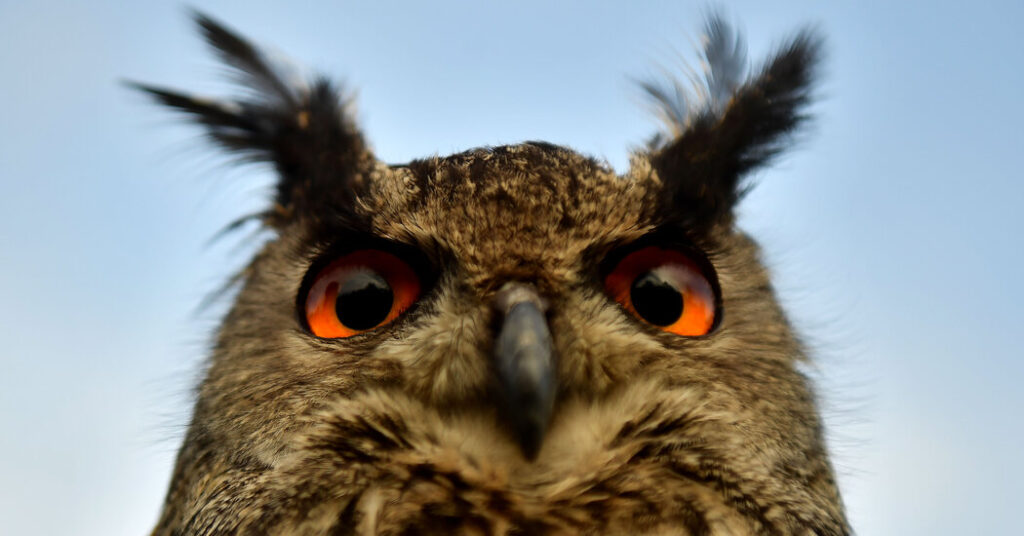
Look at just about any vertebrate and you’ll see two eyes looking back at you. Falcons circling overhead have two eyes, just like hammerhead sharks roving through the ocean.
Scientists have long puzzled over how the vertebrate eye first evolved. A pair of new studies suggest a strange beginning: Our invertebrate ancestors 560 million years ago were cyclopes, with a single eye at the top of their head, scientists now propose, that only later split in two.
Charles Darwin fretted a lot about the exquisite complexity and sophistication of the vertebrate eye as he developed his theory of evolution. “The eye to this day gives me a cold shudder,” he confided to his friend, the American botanist Asa Gray, in 1860. Somehow evolution had produced the eye from many parts, such as the lens and retina, through tiny changes through the generations. Darwin couldn’t say for sure what that sequence of changes was.
But he was encouraged by the diversity of simpler eyes among invertebrates. Some are mere lumps of pigment that detect light; others are simple cups lacking lenses.
“When I think of the fine known gradations,” Darwin wrote to Gray, “my reason tells me I ought to conquer the cold shudder.”
Yet opponents of evolution continued to cast doubt on the idea that eyes could evolve. Even in the 1990s, creationists claimed that natural selection would need many billions of years to produce an eye — far more time than life has existed on Earth.
Dan-E. Nilsson, a neurobiologist at Lund University in Sweden, grew so annoyed by these claims that he estimated how long it would actually take for a patch of light-sensitive cells to evolve into an image-forming eye. “I thought, Heck, that’s an easy calculation, let’s do that,” Dr. Nilsson recalled.
In 1994 he and Susanne Pelger, a colleague at Lund, concluded that an image-forming eye could evolve in just a few hundred thousand years. “It’s not precise in any way at all, but it goes to show that there is plenty of time for eyes to evolve,” Dr. Nilsson said.
The model only addressed how the shape of eyes evolved. In actuality, many other changes occurred along the way. New proteins had to emerge that could bend light in the lens, for example, while others absorbed light in the retina.
In 1994, scientists didn’t know enough about those microscopic details to develop a hypothesis for how they evolved as well. Three decades later, that’s no longer the case. “There’s lots of molecular data now that we can use that is extremely powerful,” Dr. Nilsson said.
He and other vision experts have now joined forces to develop a hypothesis for how vertebrate eyes evolved.
“You look at all the evidence in your head, and it suddenly clicks,” said Tom Baden, a neurobiologist at the University of Sussex who collaborated with Dr. Nilsson. They and their colleagues unveiled their detailed scenario for the evolution of vertebrate eyes on Monday in the journal Current Biology.
“What we’ve done is, we’ve provided a plausible set of steps that got us there,” Dr. Baden said.
The scenario starts about 560 million years ago, when our invertebrate ancestors lived mostly buried in the ocean floor. They stuck out their brainless heads to filter bits of food floating by.
On the top of their heads, Dr. Nilsson and his colleagues propose, these forerunners of vertebrates possessed a single patch of light-sensitive cells. Those cells tracked the cycle of day and night, setting the animals’ body clocks, and also provided simple clues about their position, so that the animals could keep their heads just high enough to eat without being eaten.
Some of the descendants of this cyclopean ancestor left their burrows and started to swim. They were still simple creatures with tiny brains, and they still filtered food from the water they swam through. But now they needed more information about their environment.
Their single eye grew more complex. Cup-shaped depressions evolved on either side, sensitive to the direction of incoming light. (Different light-sensitive cells became active depending on where they sat along the curve of the cups.) Dr. Nilsson and his colleagues argue that these were the forerunners of the retinas in our own eyes.
An awareness of the direction of light helped the animals travel through the water, enabling them to stay upright and stable.
“It becomes dimmer in a large part of the visual field and not in another,” Dr. Nilsson said. “That tells you that you’re tipping in one direction or another.”
Over millions of years, our filter-feeding ancestors evolved into tiny fish, complete with brains and mouths they could use to catch live animals. Dr. Nilsson and his colleagues contend that this transformation could not have happened without an additional change to the eyes.
“There is a better place for them, on either side of the head,” Dr. Nilsson said.
As these proto-retinas moved to the sides of the head, the wiring between the light-sensitive cells made new connections, producing sharper vision, Dr. Nilsson and his colleagues propose.
These early fish could now sense the flow of their surroundings as they swam forward. “It provides a whole new way of moving through your environment and avoiding obstacles,” Dr. Nilsson said.
But as the new eyes migrated to their new positions, the animals still retained the ancestral eye on top of their heads. While it could not provide details about their surroundings, it continued to provide vital information, such as the overall level of light. Modern fish still have a light-sensitive patch of cells on top of their heads, known as the pineal gland.
“It’s a compelling new idea, but the jury is still out,” said Karthik Shekhar, a computational biologist at the University of California, Berkeley, who was not involved in the study. One way to test the idea, he said, would be to compare the activity of cells in the pineal gland and the retina in many vertebrate species. If Dr. Nilsson and his colleagues are right, the cells in the two organs should have deep molecular similarities — a sign of the deep evolutionary link.
Dr. Baden said that he and his colleagues were starting to make those comparisons in zebrafish. “This is the start, not the end,” he said.
But new fossil discoveries suggest that the evolutionary course of eyes may have taken some surprising turns that Dr. Baden and his colleagues hadn’t envisioned in their hypothesis.
In recent years, paleontologists in China and England have been studying some of the earliest vertebrate fossils, which date back 518 million years. These show traces of eyes on the sides of the head, complete with lenses and retinas. But at the top of the head, there is a second pair of eyes, complete with lenses and retinas.
Jakob Vinther, a paleontologist at the University of Bristol, speculated that early vertebrates — small animals hunted by big invertebrates — may have benefited from the extra-wide field of view that four eyes provided.
“I believe that the reason why they got four eyes is because they were at the bottom of the food chain,” Dr. Vinther said.
Dr. Nilsson speculated that the extra eyes might have evolved thanks to a drastic change to vertebrate DNA. Some studies hint that, early in the evolution of vertebrates, the entire genome was duplicated. An extra set of genes may have given rise to an extra pair of eyes.
Dr. Vinther said that vertebrates may have later lost the extra pair of eyes as they evolved into top predators. “As you move up the food chain, you don’t need to have distributed vision,” he said. “The eyes become a little obsolete.”
Vertebrates may have lost their extra eyes, but the ancient light-sensing tissue on the top of their head endured. As fish came on land, the pineal gland survived, and humans still possess it in our heads today.
In mammals like ourselves, however, the pineal gland has sunk into the dark depths of the brain and can no longer detect light directly. Instead, light signals from our eyes get relayed to our pineal gland, prompting the neurons there to release different hormones depending on the time of day. Our pineal gland barely holds onto its ancient legacy as our original eye.
Future experiments may reveal more about how the vertebrate eye evolved over a half-billion years. Until then, Dr. Nilsson said, he’d love a time-travel machine to see if his theory is right.
“Just give me one hour back 600 million years ago,” he said, “so I could look at those animals that were there and see what kind of eyes they actually had.”
Carl Zimmer covers news about science for The Times and writes the Origins column.
The post The Rise of Eyes Began With Just One appeared first on New York Times.