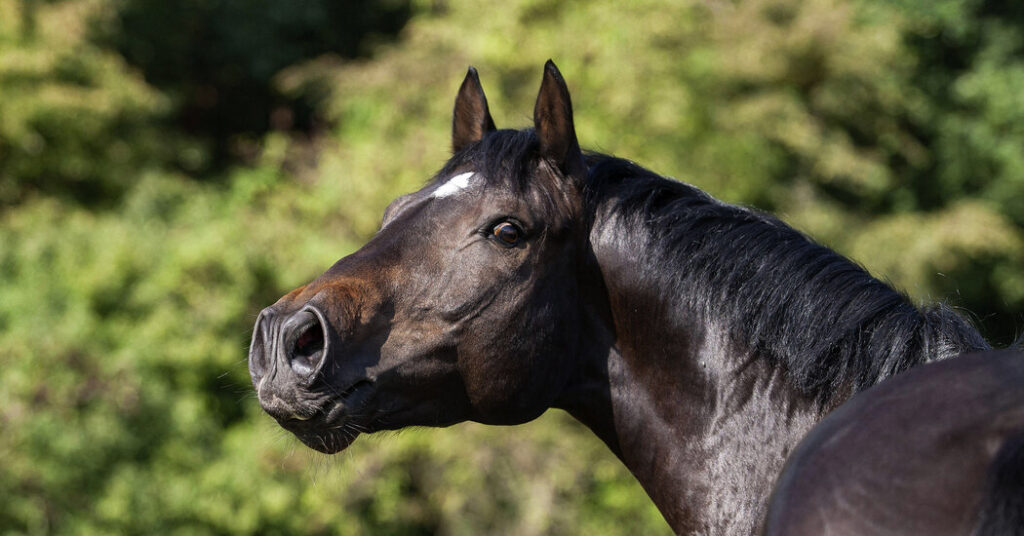
In a laboratory in France, researchers studied the voice boxes of horses, adding tubes and helium to figure out the mechanics of how horses actually whinny.
The scientists learned that a whinnying horse is essentially whistling and singing at the same time, according to a paper published in the journal Current Biology on Monday.
“Horses have been domesticated over 4,000 years, and somehow we still didn’t know till now how they make sounds,” said Elodie Briefer, an associate professor at the University of Copenhagen and one of the paper’s senior authors.
The voice box, or larynx, is a muscular tube that contains tissues that produce sound when air passes through them. In general, big animals have big voice boxes and big vocal folds (also known as vocal cords), which vibrate slowly to produce low, rumbly sounds. Horses, with their high-pitched whinnies, seemed to buck this trend.
Over a decade ago, Dr. Briefer was analyzing a spectrogram — a visualization of a sound wave’s frequency — of a horse’s whinny when she noticed something strange: two distinct high- and low-frequency sounds, happening simultaneously.
“Everyone thought that horses were making frequencies that were much higher than predicted by the body size,” Dr. Briefer said. “They hadn’t realized that actually below that high pitch, there is a low pitch.”
Dr. Briefer published these findings in 2015, but even then, she said that some of her fellow scientists “didn’t believe that these were really two different tones.” In the new study, she and her colleagues set out to document how the two tones were produced within a horse’s larynx.
First, the researchers used an endoscopic camera to capture video footage of horses’ larynges in action. When the horses made low-pitched sounds, their vocal folds vibrated, similar to humans’ when singing. When the horses made high-pitched sounds, the structures in the larynx remained still.
To get an even closer look at the mechanics of a horse’s voice box, the researchers built a machine that could replicate the biomechanical process of a whinny.
In David Reby’s laboratory at the University of Lyon Saint-Étienne, the team connected a horse larynx to a flow of air. Once again, the researchers observed that the high-pitched sound hadn’t come from the vibration of vocal folds, but rather from forcing air through the larynx: essentially, using the larynx itself as a whistle.
For Tecumseh Fitch, a professor at the University of Vienna and another senior author of the paper, the “crucial clincher” proving that the high part of a whinny was a whistle occurred when they swapped out compressed air for helium.
Sound travels faster in helium than in regular air, but the way a sound is produced affects how it will interact with that medium. A sound produced by a plucked guitar string or a vibrating vocal fold would still come out at the same frequency in air or helium, because those physical vibrations themselves are still happening at the same speed.
(The “Donald Duck voice” produced by breathing in helium is caused by a different phenomenon, when the vocal cords vibrate at their normal frequency, but then harmonic resonances of the resulting sound bounce around in the helium-filled vocal tract.)
But a sound produced by an aerodynamic whistle, like a penny whistle or a flute, would become higher if the air being forced through that whistle was helium.
When the researchers forced helium through the horse voice box, “the frequency went way up,” Dr. Fitch said — a sure sign that the high part of a whinny is indeed a whistle. This type of vocalization has been observed in the ultrasonic squeaks of rodents, but this is the first time it has been documented in a large animal.
“This is going to be a landmark paper in terms of stimulating research into vocalizations in equids,” said Sue McDonnell, an adjunct professor at the University of Pennsylvania School of Veterinary Medicine who was not involved with the project.
Dr. McDonnell said that the evolutionary history of horse vocalizations and their meanings remain a mystery, in part because horses on farms are much chattier than feral horses. “Most of the vocalizations that you hear under domestic situations are stress vocalizations,” she said.
She also noted that additional studies into horse vocalizations might further distinguish the various sounds that horses make, including nickering, neighing or squealing.
“If you pay attention to them under natural conditions, you realize that a whinny is not a whinny is not a whinny — they’re all different types,” Dr. McDonnell said. And even among horse experts in different regions, there is disagreement: Some sounds that Dr. McDonnell would call a neigh, others might call a whinny.
Research into the shades of meaning of all these sounds could also improve the well-being of horses, she said.
As for people who work with horses, Dr. McDonnell added: “It’d be really good if they knew what these horses were trying to say.”
Audio by Elodie Briefer
The post How a Horse Whinnies: With a Whistle and a Song appeared first on New York Times.