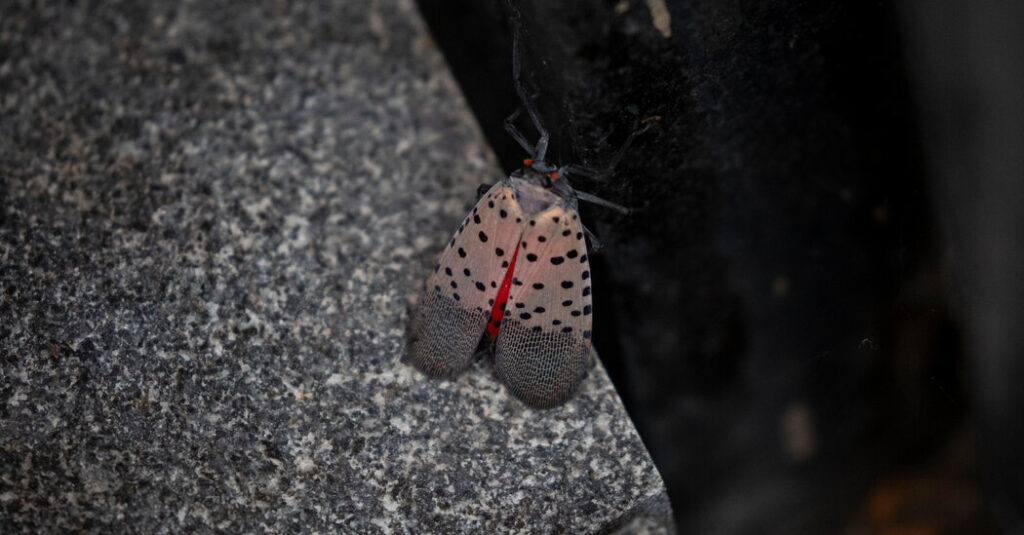
Spotted lanternflies do not necessarily seem like the most formidable foes. As invasive insects, they can do serious damage to crops, but they are also weak fliers whose bright red hind wings make them highly visible. So when they were first discovered in the United States in 2014, in a single Pennsylvania county, it seemed possible to contain or even eradicate them.
Of course, that’s not what happened. Instead, the insects, which are native to parts of Asia, have spread rapidly throughout the Eastern United States, invading nearly two dozen states. They have shown a particular affinity for urban habitats, forming thick summer swarms in New York City, Philadelphia and other major cities.
Now, researchers have proposed one potential explanation for the insects’ astonishing success: They were pre-adapted to urban living. The lanternflies that made their way to the United States, the research suggests, descended from a lanternfly population living in urban Shanghai, where they may have evolved to withstand the stresses of city life.
“We think that was maybe a key factor in why they eventually did become invasive,” said Kristin Winchell, a biologist at New York University and an author of the new study, which was published this month in Proceedings of the Royal Society B: Biological Sciences.
The implications extend beyond spotted lanternflies. Indeed, the results suggest that in a highly connected, rapidly urbanizing world, cities could function as “evolutionary training grounds,” endowing organisms with the traits they need to spread into new environments, said Fallon Meng, a doctoral student at New York University and an author of the study.
Scientists believe that spotted lanternflies were introduced to the United States just once and that they arrived by an indirect route. Previous research has suggested that the insects initially spread from Shanghai, where they are native, to South Korea, where they became an invasive pest in the 2000s. (In South Korea, as in the United States, the insects seemed to thrive in cities.) From there, they spread to the United States, most likely by hitching a ride on shipped goods.
In the new study, the researchers analyzed the genomes of lanternflies collected from multiple locations in the Northeastern United States and Shanghai.
The Shanghai specimens, the researchers found, could be divided into multiple populations: Lanternflies collected from urban parts of Shanghai were genetically distinct from those collected from rural, forested locations.
In contrast, lanternflies collected in New York, New Jersey and Connecticut displayed much less genetic diversity overall and appeared to be members of a single population. This American lanternfly population, the genetic analysis suggested, seemed to descend from the urban lineage of Shanghai lanternflies, rather than the rural one.
The lanternflies from urban Shanghai and the United States also possessed changes in genes involved in the biological response to stress and the detoxification of chemicals, such as pesticides and environmental pollutants.
“And so that said to us that maybe these bugs already adapted to the urban environment in Shanghai,” Dr. Winchell said, “and so that then maybe primed them to be able to tolerate similar stressors like pesticides and new diet and new climate when they arrived in another urban environment.”
The researchers also found evidence that, despite their low genetic diversity, the lanternflies had continued to evolve since their arrival in the United States. In particular, they saw signs that natural selection had been acting on genes involved in pesticide resistance and climate adaptation, including cold tolerance.
“We see genetic clues that the lanternflies are adapting to thermal stress,” Ms. Meng said.
That could be a sign that the insects have been adapting to colder climates as they’ve spread into more northern states. “So that is a little bit troublesome, because that suggests that this invasion might continue to ratchet up and spread farther north, perhaps, than we anticipated,” Dr. Winchell said.
And it could now be American cities that are acting as evolutionary incubators, helping lanternflies develop the traits they need to continue conquering new territory.
“Cities can generate novel conditions that can allow a species to become invasive and globally successful,” Dr. Winchell said.
Emily Anthes is a science reporter, writing primarily about animal health and science. She also covered the coronavirus pandemic.
The post Cities May Be ‘Evolutionary Training Grounds’ for Spotted Lanternflies appeared first on New York Times.