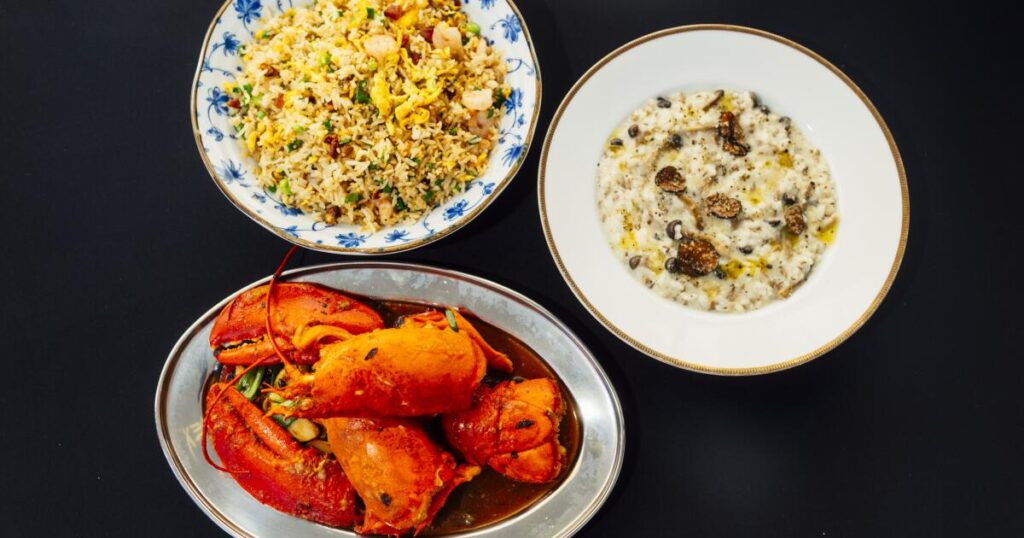
One of the best dishes I ate last month was a paper plate of fried rice prepared by a robot named Robby.
The grains were slick with soy sauce, each one caramelized and tinged with smoke. Generously studded with threads of soft scrambled eggs, browned lap cheong, plump shrimp and chopped scallions, it was a plate of fried rice that could have come from the weathered wok in my grandmother’s kitchen. Instead, I was standing in a trailer in the parking lot of a company called Next Robot in Walnut.
Next Robot creates and manufactures robotic cooking machinery, including Robby, a 550-pound automated wok capable of preparing 17.64 pounds of food at a time.
It looks like a big, vertical washing machine drum that holds the food and spins while it cooks. Above, beside and below the drum are hidden compartments that carry various seasonings and sauces that automatically drop into the wok according to specific recipes. There is no fire required, with the wok reaching temperatures of up to 700 degrees Fahrenheit.
Your own Robby is available for about $1,200 a month, for a three-year lease.
The company is part of a global robot cooking marketexpected to be valued at more than $9 billion in the next decade, with dozens of companies making everything from fully automated kitchens to robotic arms that mimic the movements of a human chef.
Robby is programmed to speak English, Chinese, Japanese, Spanish, Italian, French and Korean, but can speak any language by request in less than an hour. It’s a machine that can prepare fried rice like my grandmother’s, but it still needs a human to operate, at least for now.
I watched as Nguyen Bui, culinary director for Next Robot, selected a recipe from a screen on Robby, prompting the machine to offer a list of ingredients. The wok began to heat up and season itself with oil that shot out of a compartment above the wok. Over the course of about four minutes, Robby told Bui when to load each ingredient, with a countdown on the screen to signal the time between each step. The rice spun around the drum, with Bui dropping in the sausage, eggs and shrimp when prompted. After the rice was finished and removed from the wok, Robby power-washed itself.
“It’s important to preserve these traditional dishes that are hard to make,” says Giggs Huang, co-founder and CEO of Next Robot. “And we can do it with the help of AI, machinery and robotics.”
Huang, who comes from an e-commerce background, says the idea for Robby spawned from a love of dining out at restaurants. After hearing from multiple friends in the industry, Huang and his partners created an automated stir-fry machine designed to replicate wok hei, or the complex smokey flavor you get from cooking in a wok at high temperatures. It’s a technique that incorporates precise timing and temperature control, and a lot of practice. Robby is designed to get it right every time.
“Our restaurant friends are struggling because of operation inefficiency issues,” he says. “We started with stir fries because it’s hard. All the prep work can be standardized, but the technique part can be really hard.”
One of those friends was Tomas Su, who was the first to design a restaurant around Robby in the kitchen. Su and his partner Kelvin Wang opened the first Tigawok on Sawtelle in 2024, just months after Robby was ready. It’s a restaurant that offers miniature bowls of a wide range of familiar Chinese American dishes like orange peel chicken and chow mein, but also mapo tofu and red braised pork belly. Ingredients are prepped in a central kitchen and cooked at the restaurant’s various locations by Robby.
In the last year and a half, Su and Wang have opened three Tigawok locations and plan to open two additional restaurants in the next two months. It’s a pace of expansion Su says he wouldn’t be able to achieve without the help of Robby.
“When you’re thinking about a chain of restaurants with multiple locations, people complain about the inconsistencies at the locations,” Su says. “This issue will kill your brand if you have 10 to 15 locations. Robby-style cooking machines solve this problem.”
But while Tigawok may be in hyper-expansion mode now, Su says there were issues early on with the machines. Because of the nonstick coating on the woks, they needed to be replaced every one to two weeks. After reporting back to Huang and his team, the woks were changed to carbon steel, and now last for up to three years.
“That’s more than a regular cooking wok,” says Su.
Now, there are 300 Robbys in operation around the world at around 100 different businesses. There is an airline catering company using Robby to make hundreds of pounds of scrambled eggs each morning to service multiple airlines. The Coronado School District uses Robby in its central kitchen to make everything from kung pao chicken to Philly cheesesteaks for its students.
Huang is using real-time feedback from the school, airline and restaurants to make ongoing improvements to Robby and its software. But some of the most important feedback comes from Bui, a private chef who previously cooked at some of the most acclaimed restaurants in the state, including Commis in Oakland and Rustic Canyon in Los Angeles. Bui is what Huang calls a super user, focused on developing recipes and testing the limits of the machines.
“On the creative side I think it’s really empowering because ironically, I don’t know how to use a wok,” Bui says. “But it’s given me ability to make dishes that need high skill in the wok. That fried rice, I wouldn’t know how to have that wok hei and that evenness, but I can understand the robot and I can make recipes around that.”
During one visit to the Next Robot warehouse, Bui prepared carbonara, scrambled eggs and risotto in Next Robot’s newest machine, Al Dente. Slimmer than Robby, it’s a single pan with an automated arm that loads ingredients and stirs whatever is in the pan.
“One thing I was having issues with Al Dente was flipping food, because of the way the arms are, it just kind of laterally moved food and sometimes you’d have an issue where the top wouldn’t cook,” Bui says. “I let Giggs know, gave him some ideas and we had a prototype of a new arm in like a month and a half.”
For Bui, and most chefs, achieving consistency with each dish is Robby and Al Dente’s greatest flex.
“Unless you train someone to really use a wok and they have enough experience, it’s very inconsistent,” says Bryant Ng, chef-owner of Jade Rabbit, a fast-casual Chinese American restaurant in Santa Monica. “The hardest thing for all restaurants to do is be consistent. I could see how this [Robby] could be very helpful.”
While the machines can be helpful, they inevitably raise the uncomfortable question of where we draw the line. If a machine can cook for us, will it replace chefs in the kitchen entirely?
Ng and his wife Kim were behind Cassia, the groundbreaking Santa Monica restaurant that for nearly a decade dazzled diners with Ng’s singular style of Chinese, Vietnamese and Singaporean cuisines. It was a restaurant that won every conceivable accolade, but was forced to close in early 2025 as operational costs skyrocketed.
At Jade Rabbit, Ng has two woks in his kitchen, operated by two line cooks. For him, the possibility of an addition like Robby isn’t about eliminating people, it’s about streamlining operations.
“If I could rebuild Jade Rabbit today, I would put in one traditional wok and one of the robot woks and still have the same amount of people to free them up to do more tasks that aren’t necessarily cooking,” says Ng.
For Next Robot, Robby and Al Dente are just the beginning. The company is already working on developing a smaller version of Robby and thinking about an automatic grill. Huang says he might introduce platform services that will allow chefs to develop recipes they can either sell exclusively to users or charge per use via Robby or Al Dente.
“We have to live with AI,” says Huang. “It’s not our competitor, but something we can use to work efficiently as a tool. We just need to adapt fast enough.”
The post Robots are heading into the kitchen. Should we welcome them? appeared first on Los Angeles Times.