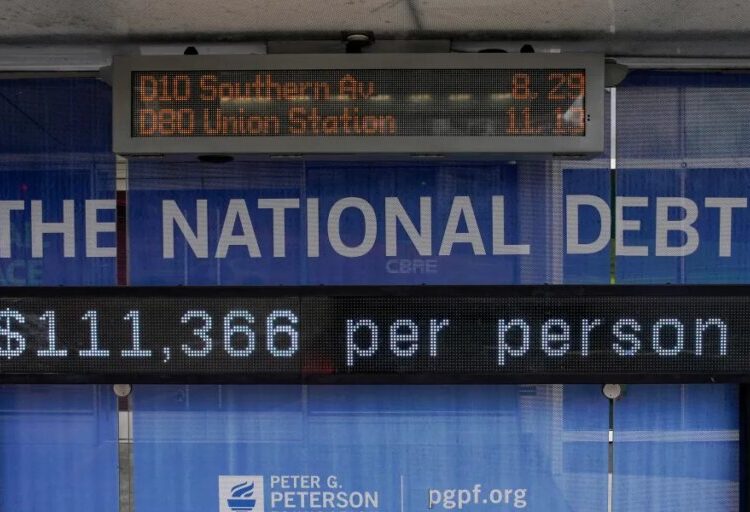
Americans are in serious debt. Together, we owe nearly $1.3 trillion in credit card debt alone; our average balance is around $6,500 each. Owing that much can be scary, not to mention overwhelming. And all of that debt has created some seriously strange political bedfellows: President Donald Trump has proposed capping credit card interest rates at 10 percent for one year, and a bipartisan group of lawmakers, including Sens. Bernie Sanders (I-VT) and Josh Hawley (R-MO) and Rep. Alexandria Ocasio-Cortez (D-NY), is into the idea too. (Banks, unsurprisingly, are not.)
Key takeaways
- Department stores started extending credit to customers around the beginning of the 20th century.
- Banks got in on the credit game as a way to keep customers and make money during the white flight of the 1960s.
- The Supreme Court eventually ruled that interest rates were determined by where the company extending credit was based, and not where customers lived. This sent banks to states with fewer regulations, and interest rates went higher.
But how did credit card interest rates get so high — upward of 24 percent — in the first place? That’s a question for Sean Vanatta, a professor at the University of Glasgow and author of the book Plastic Capitalism: Banks, Credit Cards, and the End of Financial Control, which tells the history of the credit card industry in the United States.
Vanatta says the story starts at department stores around the turn of the 20th century: “These are huge palaces of consumption. They’re in part marketing themselves on the availability of credit. You initially get something called a credit token. They eventually are cards that have your name, your account number, and your address embossed on them. This connects to a mechanical billing system that then creates carbon paper slips that are then billed to your house.”
So how did we go from these paper slips to the credit industry we have today? Vanatta answers that question and more on the latest episode of Explain It to Me, Vox’s weekly call-in podcast.
Below is an excerpt of our conversations, edited for length and clarity. You can listen to the full episode on Apple Podcasts, Spotify, or wherever you get podcasts. If you’d like to submit a question, send an email to [email protected] or call 1-800-618-8545.
How did credit go from department stores to the banking industry?
The department stores after World War II begin to expand outside of the central cities and compete with small local merchants. What begins to happen in the 1950s, and then to a much bigger extent in the 1960s, is that banks get into the credit card market. The banks go around to the small stores and say, “Listen, we can pull you all together into a centralized credit plan, and then you’ll be able to offer credit that competes with department stores.”
At the same time, there’s the development of what are called travel and entertainment cards. You have business executives who need to wine and dine clients and who are traveling all the time. For them, it’s cards like Diners Club and American Express, which are really built on enabling you to more easily manage your expense account, to entertain clients, to impress people that you have a gold American Express card.
In the 1950s and 1960s, banks are increasingly looking to consumers as a new source of loans: home mortgages or auto loans. But if you’re the biggest bank in Chicago and all of the affluent customers are moving out to the suburbs, you have a problem. Banks under state laws in some states couldn’t build more than one branch, so all the biggest banks are built in the city center where the businesses are. Banks like Continental Illinois, like the First National Bank of Chicago, all begin to see credit cards as a way to attract these affluent customers, to get them to continue to do their banking with central city banks. It’s really about suburbanization, it’s about white flight out of cities, and that is part of what’s driving banks into the credit card market in the 1960s.
What did these early cards feel like? You know, if I’m out to dinner with my friends, you throw that heavy gold card on the table, but I imagine the cards did not feel like that.
You start to get the plastic cards in the late 1950s, and this is real innovation. There’s an inventor who essentially invents the equipment to emboss plastic cards. He goes and sells this idea to Bank of America and eventually to American Express. If you look at an old American Express credit card, it has this little thing at the bottom that says “member since” and then a two-digit date. The reason that exists is because this inventor wanted to demonstrate that his machine could emboss more numbers than other competitors, and this was a way to market that embossing technology.
“There’s all sorts of things like credit card points, which help the most affluent people get further rewards for spending money they were already going to spend.”
Oh, that’s so wild. I just thought it was just so you can flex how long you’ve had that card!
But that’s part of it, right? It’s like credit is a kind of status. And so the American Express card in particular has always tried to build itself up as this status symbol.
When credit cards came out, were there any rules around the types of interest that could be charged?
One of the reasons why banks found credit cards attractive is because it was a new technology, and it wasn’t regulated. Banks were charging very high rates on credit cards. Consumers would tend to pay between one and a half and two percent a month. People are not very good at math, so that seemed cheap.
Then in 1968, Congress enacted something called the Truth in Lending Act, which says you have to present interest rates as a simple annual rate. So all of a sudden, people are seeing, “Oh, I’m being charged 18 percent or 24 percent.” And that is a huge shock. So what happens is the states tend to limit rates to between 15 and 18 percent. The rules in each state are different and kind of complicated and as banks are developing their sort of credit card networks, they begin to mail cards across state lines.
There’s a big fight centered around a bank called the First National Bank of Omaha, which begins mailing cards into Iowa and Minnesota. The interest rates in Nebraska are not especially high but they’re a little bit higher than what’s allowed in Iowa and Minnesota. From a consumer’s perspective, if you live in Iowa and you only ever use your card in Iowa, why would you expect that Nebraska interest rates are what would apply to you?
So then the state attorney generals and individual consumers begin to sue the First National Bank of Omaha saying that they’re charging too much. This creates a whole slew of legal cases that end up in the Supreme Court. The Supreme Court says, “Well, the law is pretty clear. The bank is in Nebraska, so the transactions are in Nebraska, and so Nebraska law applies.”
So the Supreme Court rules that it’s where a bank is based that all of this is factored on, not where the customer is?
That’s right. You have these nationwide networks, which become known as Visa and Mastercard. A bank can then locate itself in whichever state has the most favorable regulations and solicit cardholders across the country. In the 1970s, Citibank is one of the largest banks in the country, but it can’t build branches outside of New York. It’s a huge global bank. They have offices all across the world. Its bankers are some of the most sophisticated in terms of figuring out what the rules are and figuring out how to circumvent them.
Citi is borrowing money and the rates at which it borrows money begin to skyrocket in the late 1970s as there’s a massive wave of inflation. The Federal Reserve really ratchets up rates to try to combat inflation. The problem that Citibank has is New York has really strict interest rate restrictions at the time. So all of a sudden Citibank is paying more for the money that it’s borrowing from investors than it can charge cardholders. And so every time someone uses a Citibank card, Citibank is losing money. Citibank needs some kind of fix, and they find it in South Dakota, which didn’t have any restrictions on credit card interest rates.
Citibank comes to them and says, “Listen, we’d love to put hundreds of jobs in your state. If you’ll just invite us to open a branch or open a bank there, we’ll move our credit card division there.” And that’s what happens. Citibank relocates to South Dakota and then is able to charge whatever interest rate they want. Delaware enacts a law that enables the same thing. So most big banks actually move their credit card operations to Delaware. And that in turn leads to things that we recognize, where it’s really hard to get a card with a decent interest rate and banks have the freedom to change those rates as they will.
When I don’t pay my credit card in full and I have to pay that interest, where does that interest go?
It goes to the banks. Credit card lending is consistently one of the highest profit areas for banks. And you see that banks that specialize in credit cards make much more money than banks that don’t. Part of it is profits to stockholders. Then there’s all sorts of things like credit card points, which help the most affluent people get further rewards for spending money they were already going to spend. A lot of it goes to advertising. There’s this kind of circuity to it where you are paying for advertising to encourage you to do the thing that you probably don’t want to do. But the banks would say, If we’re going to grant people with lower credit scores credit, they’re riskier. And for most people to have access to credit, we need to charge them higher rates.
What you see if you look at US history over the last 70 to 80 years is the economy runs on household borrowing. Mortgages, car loans, credit cards. Now it’s “buy now, pay later.” You see that household debt goes up and up and up and up. You add student loans into that mix. And people feel that precarity. They feel that risk. They feel the weight of all of that debt. But it’s the most affluent, the people who have access to the airport lounges, who have the high points cards, who get all the benefits and the rest of us pay all the costs.
The post How Americans learned to love the credit card appeared first on Vox.