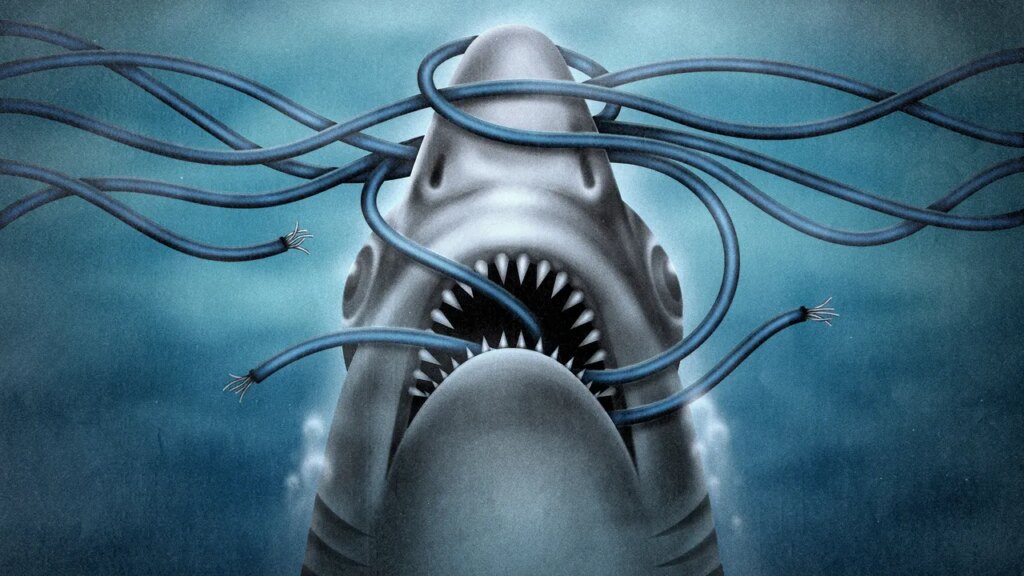
Sharks are innocent. Or at least they’re not eating the internet. As a family of cartilaginous fish, sharks are collectively not guilty of most, if not all, charges of biting, chomping, chewing, or otherwise attacking the underwater network of fiber-optic cables. The people who build and maintain the nearly 600 subsea cables that carry almost all of our intercontinental traffic—supporting just about every swipe, tap, Zoom, and doomscroll anywhere on the planet—have a love-hate relationship with this myth, which has persisted for decades. They might even hate that I’m starting this piece with it.
Things Fall Apart
Rolling out this week, WIRED’s journalistic commissions on technological decommissions—from broken-down electric cars to falling-down space stations.
If a cable is suspended over the seabed, a shark might gum it as it explores. Sometimes they’ll lunge for a cable that’s being pulled out of the water. But for a shark to actually bite a cable, you’d have to wrap it in fish, much as you’d hide a pill in a hunk of cheese for the dog. Rats can be a threat on land, because their incisors never stop growing, so they like to file them down on semisoft cables. But nobody ever asks about rats, maybe because, as a friend of mine pointed out, “sharks make you cool, but rats sound like you have a problem.”
Sometimes people ask about satellites or, especially in Sweden (where I live), about alleged sabotage in the Baltic Sea. But historically, shark bites have commanded the most attention. The myth began nearly 40 years ago, with the development of a subsea fiber-optic cable known as TAT-8. TAT-8 practically invented the concept of an internet cable, and now that it’s ready for retirement, I spent time with the offshore workers, crew members, and engineers who are in the process of pulling it off the seabed. That’s the real story of subsea cables—not sabotage or sharks, but the humans who take care of the physical stuff that keeps all of our digital communication flowing.
Fiber-optic transmission is a near-magical way of carrying information by pulses of light. Most people don’t even think about how quickly we’ve accepted instantaneous communication as normal, even those of us who can remember when an international phone call had to be booked in advance. The more people I meet in this industry, in this network of networks of people and things, the more insulting it sounds to hear that “we” only notice it when it breaks. (Who is this “we,” I always want to know?) Billions of people are able to walk around not noticing this infrastructure because of the daily work of a few thousand people, sometimes at sea, other times buried under piles of permits, surveys, and purchase orders for thousands of kilometers of cables that will join the millions of kilometers of cables on the seabed that ensure that our planet is continuously being hugged by light.
I also need to clear up something else. Most people call them “internet cables,” but technically, fiber-optic transmission was developed for telephone calls. One of the people involved was an English scientist named Alec Reeves, who also spent his time working on psychokinesis and telepathy. With fiber, voices become light, pulsate across spiderweb-thin strings of glass, and become voices again in your handset on the other end. Maybe there isn’t that much of a conceptual leap between that and moving things with your mind.
TAT is short for Trans-Atlantic Telephone, and TAT-8—built by AT&T, British Telecom, and France Telecom—was the eighth transoceanic system across the Atlantic. It was the first to use optical fibers to transmit traffic between Europe and the United States. Fiber optics for communication had only been worked out in theory in the 1960s, and terrestrial cables were first used in the 1970s. But using this technology to span continents was practically tantamount to human galactic expansion.
When TAT-8 went into service on December 14, 1988, the science fiction writer Isaac Asimov spoke on video link from New York to audiences in Paris and London: “Welcome everyone to this historic transatlantic crossing,” he said, “this maiden voyage across the sea on a beam of light.” AT&T made a TV ad, in which an earnest voice-over promised a “worldwide intelligent network” where people could send information in any format to anyone they want. Cue the montage of telephone operators: “This is the AT&T operator. You have a call booked for Poland?” “I have your call to Russia.” “What city in Cuba are you calling?” If they were looking to inspire viewers, it wasn’t with the promise of the internet, which was still too niche for most of us to comprehend, but with the end of the Cold War.
TAT-8 would witness the fall of the Berlin Wall, the birth of the World Wide Web, the end of the Soviet Union, the dotcom boom, the end of Tory rule in the UK and the beginning of the Bush years in the US, the September 11 attacks, the dotcom crash, and the dawn of social media (it was Friendster). Rather than being the last cable ever needed, as had originally been believed, it was full to capacity within 18 months, by which point there were other cables, like PTAT-1 across the Atlantic and TPC-3 in the Pacific. By 2001, the TAT series was up to number 14. After developing a fault that was too expensive to be worth fixing, TAT-8 was taken out of service in 2002.
It’s been sitting on the seabed until now.
TAT-8 is currently being pulled up and sent for recycling by Subsea Environmental Services, one of only three companies in the world that’s made cable recovery and recycling its entire business. Cable companies sometimes recover their own cables after they take them out of service, and some retired cables get new life in scientific research or military use, but most of them—most of the 2 million kilometers of it all—are still right where their former owners left them. The seabed is a lot busier than you might think, so these operations are clearing space for new cables, along routes that are proven and efficient, rather than disturbing new sections of the sea floor. And there’s good money in old cables if you know what you’re doing.
It’s after midnight on a cool August night, and my friend Fiona Marron—here to take photos and videos—and I are watching Subsea’s brand-new diesel-electric cable recovery vessel, the MV Maasvliet, dock in the Portuguese port of Leixões, just outside of Porto. The 14 people on board are two weeks overdue because hurricane season arrived early, and they had to dodge storms Dexter and Erin, which meant they collected more stress and less cable than expected. During the next week or so, they’ll offload 1,012 kilometers of TAT-8, resupply the ship, then set out again to pick up another load.
They drop the gangway, and there are hugs between the crew and Peter Appleby, operations manager from Subsea. Up on the bridge, we meet Captain Alex Ivanov, who has been at sea for 30 years and still takes pictures of sunsets. He scrolls through his phone to show Peter a blazing red and orange sky, then photos of some of the dorado he caught, because when cable ship people aren’t fishing for cable, some of them go fishing for fish.
Peter asks how Alex likes the ship. Alex helped design it, and this is only its fourth trip out since it left drydock in January 2025. The captain says he loves the diesel electric—the Maasvliet runs on three industrial Volvo truck engines—even though he says it isn’t as stable as the Rebecca, the company’s other vessel. The bridge is high-tech and modern, but everything is touchscreens and sensors, and he says if he loses power, he loses everything. Then he zips off, getting ready for tomorrow, when he’ll hand charge of the ship over to another captain, Vlad. Vlad will show up wearing a new T-shirt that says “Everything can go wrong at sea” on the front and “Not on my fucking watch!” on the back.
Everyone who has been at sea will tell you that the most important people are the captain and the cook, and all good captains are servant leaders and will concede that the cook is more valuable. Crew members are from Ukraine, Russia, Poland, Nigeria, and Kenya, and the cook knows everyone’s comfort foods. Misha, the cook who’s now rotating out, heard one of the crew talking about how much he loved khinkali, Georgian soup dumplings, and the next Sunday they were on the tables. Peter always brings cottage cheese, cream cheese, and cabbage when he meets a ship in port. I’m suddenly aware that I’m not just a guest on a ship, I’m a middle-aged mom who has shown up at someone’s home without snacks or a host gift. Fiona and I are also the first strangers any of these people have seen in two and a half months.
I’m here in Leixões because I’m a researcher in the material culture of the subsea cable industry, and I consider it my business to help people understand that the networks we rely on are made of physical things, created and maintained by people, so that we can stop saying infrastructure is invisible as if the people are invisible too.
Another way to irritate a cable nerd is to suggest that low-Earth-orbit satellites—which are unreliable in bad weather, are harder to repair, and need to be replaced every five years—will one day be our main source of connectivity. Satellites are still an important component for resilient physical infrastructure, especially in areas with few or no fiber connections, but they haven’t been able to compete on capacity since the 1990s.
Back in the 1970s, though, satellite technology seemed so promising that the Federal Communications Commission made it clear to AT&T: If you don’t do something revolutionary with cables, we’re not going to grant permission for any more intercontinental submarine connections. At the time, cables relied on copper, and there’s only so much capacity you can cram into a bundle of wires. So, in 1978, Bell Labs, along with its British counterpart, STC, committed to installing a nearly 6,000-kilometer-long submarine fiber connection between the US, UK, and France. In Holmdel, New Jersey, Bell Labs began testing out cables, and in 1985 the company deployed its first live test system, known as Optican-1, between two of the Canary Islands. Optican-1 worked, but it had a series of what are called shunt faults, where damage to the insulation interrupts the electrical signals.
Now, here come the sharks. Elaine Stafford was the project manager for Optican-1. In 1986, she was a rare young woman on the scene, on her way to Paris to present an update on the cable at the first of what would become the industry’s main research and development conference. “I’m supposed to be giving this huge talk, that there’s this wonderful technology and it’s working fine, and it’s going into service, but we had this big question mark,” she recalls. They didn’t know what had caused the faults.
Jack Sipress, who in Stafford’s recollection was two levels above her at Bell Labs, got on the bus to the conference center. “And he says, ‘I have the shark teeth,’” Stafford tells me. “He pulls them out and says, ‘These were pulled out of the faulted cable.’ So we went to the conference and announced to the world that it was shark teeth.” AT&T even included four pages about shark-bite mitigation in its 36-page press kit for TAT-8.
To be clear, there still isn’t consensus that the sharks caused the shunt fault. Sipress wasn’t lying about the teeth, but it’s hard to know what really happened. Stewart Ash, who was part of the UK team at STC, insists that most shark claims really are false. If the Optican-1 was installed with too little slack, though, and hung above the seafloor in some areas, a shark might’ve munched down. “While we at STC didn’t believe it,” he says, “we were swept up in the frustration or fear that sharks could interrupt these very important, brand-new cables.”
To be absolutely sure, AT&T funded research at two aquariums: in Mystic, Connecticut, and Sarasota, Florida, where researchers let some dogfish and lemon sharks get a little hungry and then tested to see if they bit any of several different cables that were emitting electrical fields in different patterns. They didn’t, except in seemingly random cases. (To be certain about this myself, I took my shark-obsessed 5-year-old to a local aquarium, where we spent 15 minutes trying to figure out how a friendly 3-foot dogfish, whose mouth looks like the coin slot of an old payphone, could do more than give a cable a soft boop.) Experts also went out into the ocean and pulled different species of sharks onto the deck to force-feed them sections of cable. Sometimes they bit—wouldn’t you? But there was absolutely no pattern.
Still, in the 1980s, despite there being no firm evidence that sharks were attracted to anything specific about the cables, the teams decided it wouldn’t hurt to build TAT-8 with a layer of steel between the polyethylene insulation and the fibers. They sent shark teeth to the NYU School of Dentistry, to have molds made and mounted onto shark jaw simulators, which then chomped on sections of cable. The result was that lightweight deep-sea fiber was produced, from the start, with what they called “fish bite protection,” which helps against abrasions and other types of everyday damage that can happen in the sea. Turns out, we owe sharks a thank-you, and probably an apology for the force-feeding.
It’s morning in Leixões. On the deck of the Maasvliet, I hover over a pile of TAT-8’s repeaters. A long-haul submarine telecommunications cable needs repeaters to boost the optical signal to cross the distance, and TAT-8 had more than 100 of them, each encased in a watertight, pressure-tested housing that could survive up to 8,000 meters down. A rubberized cone stretches from each side of the repeater, sheathing the cable, making the whole piece about 2 meters long. In a pile, they look like a dead kraken, ready for one last writhe on the dewy deck.
Repeaters weigh about 400 kilograms. It takes three people to pull one out of the water, cut it free from the cable, and slide it down a special ramp onto the deck. The rubber casings are stamped with the dates when each one rolled off the line—July 27, 1987, December 23, 1987, February 19, 1988, and so on—and there are identification numbers and instructions painted on them. Human hands painted the casings before they went into the water 38 years ago, and it’s humans who pull them out, also with their hands.
Everything about the cable recovery operation needs to be learned on the job, from somebody who carries the knowledge in their body. A lot of the new crew relies on Stephen, who has chosen to stay at the position of coiler, the rank of ordinary seaman, rather than rising up the ranks as many of the others have. He’s been with Subsea for 15 years, since the company started, and he trains everyone. He loves the teamwork and wouldn’t dream of going onto a cargo ship—too much waiting around.
At sea, it’s part of a coiler’s job to stand in the cable tanks in the ship’s hold and grab the cable as it comes through the hatch from the deck above. You grasp it, and as the ship tosses, you walk backward in slow circles to coil the cable in a neat stack, because fiber cable has to be coiled by hand. You need to keep it tight, and you don’t want to break the cable. It’s hard to get used to, Stephen says, because you get dizzy. Another coiler describes the shifts as 14 cigarettes long. Eight hours divided into half-hour blocks so you don’t get too woozy: 30 minutes on, 30 minutes off, up the ladder for two cigarettes.
Peter, the operations manager, hands two pairs of utility gloves to Fiona and me. Do we want to go into the hold? Fiona says yes instantly. I take longer. It’s 10 meters down a vertical ladder, but I didn’t travel here to just stand at the top of a ladder and shout “What’s it like down there?”
The ship’s hold has five cable tanks, each about half full. Most people are surprised when they see how small a submarine telecommunications cable is, but even those are usually the black and yellow steel-armored portions used in shallow water. This cable, from the deep-sea sections, is the diameter of a taper candle, and it looks like giant cooked spaghetti. I try to imagine being in here when it’s 30 degrees Celsius, the ship tossing up and down, and trying to walk in slow, backward circles.
Now I want to know how the cable gets from the seabed into the hold in the first place. Stephen, again, is the person to ask. He turns down the music—a mix of Ukrainian techno, American classic rock, and a medium dose of death metal—to tell me about what everyone here seems to agree is the most exciting part of cable recovery: catching the cable.
First, you sail to the spot where you’re pretty sure your cable is. They have a route positioning list, a spreadsheet that shows the precise coordinates of every joint, splice, and repair—along with who did it. They know where the cable has been plow-buried, where and exactly when a repeater was laid, and the type of cable at every section: double-armored, single-armored, lightweight-armored (the contemporary name for the “fish-bite-proofed” cables). To take the cable off the seabed, all you get is a hook, a rope, those coordinates, and your senses. It’s roughly the same method they used in the 19th century when they needed to recover failed telegraph cables from the deep sea.
A flat grapnel hook, known as a “flatfish,” is dropped off the bow. It falls past blobfish, anglerfish, the giant versions of crab and octopus, and below the deepest-dwelling sharks, down where fish have antifreeze for blood and names like “fangtooth” and “faceless fish.” “When it touches the bottom,” Stephen says, “we stop.” They have to keep the hook flat on the bottom, so they can start what they call the cutting run, sailing slowly toward the cable, at a speed of about one knot, dragging the flatfish. “The speed matters,” he says. “When we get to the position, we slow down to keep it from flying or dancing.” Everything Stephen tells me sounds like trying to fly a kite in space, except this is all done on the deck of a ship, with ocean swells sometimes over 3 meters—if the swells hit 4, it’s too harsh to work.
Once the hook is in place, you have one job: Keep your eye on the line, watch for a bite. Someone spots tension in the rope, or the winch makes a move. Whoever sees it calls out. Sometimes it’s been three hours, sometimes 24, of rope-dropping and winch-watching. They cut, pull, start the bow roller and winch, and wait to find out if the flatfish has the right catch. I repeat a question Fiona has been asking everyone: Do you cheer when you catch it? Of course they do.
Captain Alex has been working with Subsea since its early days. “In the beginning, I didn’t have any idea how to capture the cable on the ocean floor and bring it on board,” he says. Cables weren’t laid to be picked up again. “Sometimes it’s difficult to find. The cable can shift from its initial position or be blocked by gravel or sand.” They’re still figuring it all out. As Subsea cofounder John Theodoracopulos puts it: “I liken a lot of what we do to cleaning up space junk or all the oxygen bottles that are left at base camp at Everest.”
Now that I’ve seen all the planning and experience that goes into an operation to find and recover a cable, it’s even harder to take seriously the idea that enemy saboteurs are regularly pulling this off. A more legitimate concern is disturbing the seabed, but researchers at the UK’s National Oceanography Center have started looking into the environmental impact of decommissioning, and it’s not as much as you might think. The biggest impact seems to come from grapnel runs and from the vessels themselves. Very few cables in service today cross sensitive ocean habitats. Where that’s the case, they leave those segments in place. They also only recover cable that’s sitting on the surface of the seabed, and they know exactly where it all is because of that spreadsheet. Cables don’t even tend to attract sea life colonization very often. The “reef effect” makes a cool story, but it seems that, just like sharks, most sea life is just not that into cables.
Departing crew members are starting to say their goodbyes. Captain Vlad is passing out nuts and chocolate; Alex will do the formal handover later today. Chief engineer Sergei is just about done with the maintenance work needed to hand over to the next chief engineer, also named Sergei. He barrels through the bridge, beelining to the “good” coffee machine. “This coffee machine is my wife!” he shouts. He’s from Crimea, and he’s been a seaman on and off since he was 16. It’s his hobby, the best job in the world.
In a few days, the cable tanks will be empty. Next, a cargo ship will arrive. The bales will be loaded “breakbulk,” as it’s called—directly into the hold, the way it was done before containerization—and brought to South Africa, to Mertech Marine, which also specializes in cable recovery, which Theodoracopulos tells me is a “collegial competitor.” Mertech is the only cable salvage company with a recycling facility of its own. It will break the cables down: steel, copper, two kinds of polyethylene.
Fiber was the successor to copper, but that’s just the transmission part. Fiber-optic cables still have plenty of copper in them, and it’s of especially high quality. The International Energy Agency says we’ll be running short of copper within a decade if the manufacturing world can’t find more of it, so thousands of kilometers of it is nothing to sniff at. The fiber itself is just about the only part of the cable that doesn’t make sense to recycle, but there’s lots of steel, and that will become things like game and vineyard fencing. Polyethylene is one of the easiest plastics to recycle, and that will be sent to a facility in the Netherlands, where it will be turned into pellets that can be used for non-food-grade plastics. By the time you read this, you could be squeezing your shampoo from the remnants of the first fiber-optic cable that crossed the Atlantic, most of which spent 38 years deeper in the sea than the Greenland shark, which is known for being centuries old and extremely sleepy.
And what about the rest of what went into the TAT fiber systems? Bell Labs was eventually sold to the French company Alcatel, which closed the Holmdel facility in 2006. It spent close to a decade as the largest empty office building in America and is now a mixed-use complex called Bell Works, although it’s probably most recognizable as the headquarters of Lumon Enterprises in the Apple TV show Severance. The current owners found 18 kilometers of subsea fiber from an early sea trial for TAT-8 in the basement, and they commissioned an architecture firm to come up with ideas for what to do with it, among them a giant slinky. No one has used the old Ocean Simulation Lab for a production set, but you can also rent that—on a production location website, you’ll find it labeled a “mad scientist’s lair.”
Some of the TAT-8 people are still around because there are two things that keep people in the subsea business: They like people, and they love messy problems. “Even way back then,” says Stafford, the Optican-1 project manager, “it was connecting the world, doing things right, doing things well.” The contrast between this world and what’s happening at the application layer isn’t lost on me. And the shark research makes a lot more sense—they had a big bet, a blank check, and an almost heroic sense of pride in their work that drove them to go down even vanishingly small rabbit holes.
I suppose there’s a third reason a lot of the people are still around: Most people in this tiny industry are Generation X or older, and sometimes they cart around so much institutional knowledge that they can’t retire. Stafford is near retirement age, and the guy who introduced me to her, Jean Devos, got his start making telegraph cables in the north of France in 1961 and still works as an adviser. He’s 87. The first thing Stafford said to me on Zoom was, “How is he? Does he look well?” The subsea world has been trying to recruit and train younger talent for at least the past decade, so the industry vets can get their rest.
Now it’s my turn to leave, so I’m climbing around the ship, saying my goodbyes, having a few last chats in the smoking area outside the crew quarters—where everyone is when they aren’t working. I was promised a small piece of TAT-8, and now I have it. Before I get to the airport, I wrap my cable bundle in a shirtdress and pack it in my carry-on, a little panicked as I realize it looks a lot like a bundle of dynamite. The Subsea guys also gave me a branded baseball cap, which has a stylized cross-section of submarine cable on it. I put it on in the airport, in case it can answer questions about what’s in my bag. Except, how many people know what subsea cables look like? And you can’t wear a hat through security, so it goes into the bucket. Nobody asks any questions.
What Say You? Let us know what you think about this article in the comments below. Alternatively, you can submit a letter to the editor at [email protected].
The post Say Goodbye to the Undersea Cable That Made the Global Internet Possible appeared first on Wired.