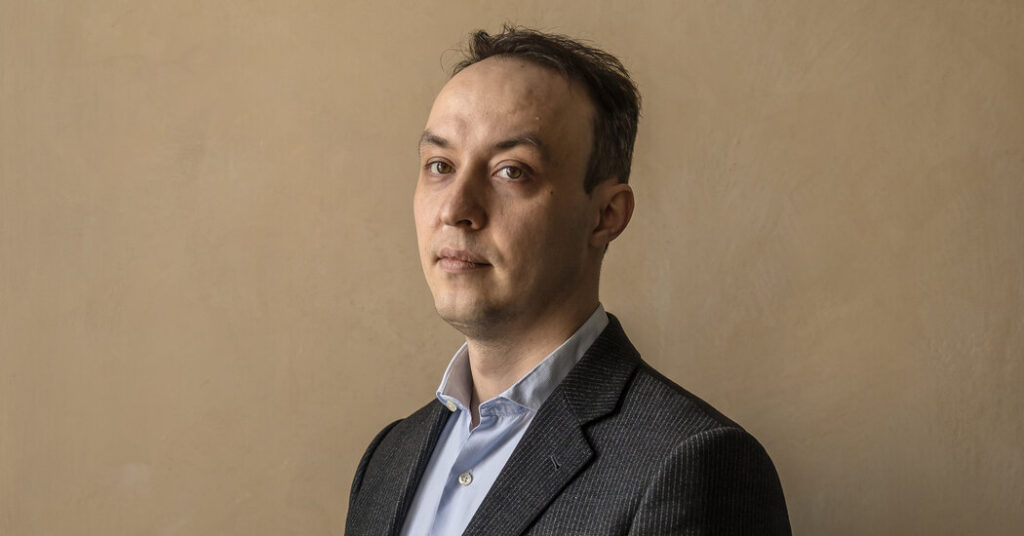
In mid-January, Vladyslav Vlasiuk, a little-known Ukrainian bureaucrat tasked with the high-stakes work of jamming the gears of Russia’s war machine, convened about 30 Western ambassadors and diplomats inside the Ukrainian presidential compound in Kyiv.
As the envoys sat around an oval table, a slide deck lit up a large screen behind Mr. Vlasiuk. “This is a very friendly meeting,” he told the room, “even though there may not be very pleasant information.” He then clicked through slides showing which countries had yet to put sanctions on major Russian oil companies, and how tons of Western-made electronic components continued to turn up in Russian weapons.
“We’re just trying to share our arguments to encourage you guys to do more,” Mr. Vlasiuk said, carefully choosing his words, “to help you guys put more pressure on Russia.”
As round after round of U.S.-mediated talks bring peace no closer in Ukraine, Kyiv believes that only sustained pressure will force Moscow to compromise. Ukraine relies on its Western allies to help with this on two fronts: providing battlefield weapons and imposing economic sanctions.
Securing the second is Mr. Vlasiuk’s job. As President Volodymyr Zelensky’s commissioner for sanctions policy, he has spent four years lobbying Western allies to tighten the screws on Russia’s funding for its war effort.
The work has been arduous, yielding little evident success early on as Russia’s economy, buoyed by military-related spending, continued to grow. But cracks are now beginning to show, fueling hopes in Ukraine that Russia’s war engine may finally be running down.
Along the way, Mr. Vlasiuk has had to prod Western countries that initially wavered on imposing tough sanctions, wary of the blowback on economies that were heavily dependent on Russian energy imports. And he has had to devise countermeasures to Moscow’s efforts to shield its economy from sanctions and keep its natural resources flowing on global markets through evasion schemes, in what often felt like an endless Whac-a-Mole game.
To keep sanctions front and center, Mr. Vlasiuk has traveled to dozens of Western capitals. He said that many of the European Union’s sanctions had stemmed directly from Kyiv’s recommendations, including the bloc’s anticipated 20th sanctions package. The European Union had been expected to adopt the package on Monday, but it now appears likely to be blocked by Hungary’s opposition, though it could still pass eventually.
After four years of sanctions that bruised but never broke the Russian economy, Mr. Vlasiuk is betting that 2026 will be the tipping point. In his recent presentation to Western diplomats, which included envoys from Britain, France and Canada, he pointed to signs of strain related in part to sanctions. Russia’s economy grew by less than 1 percent last year, and in November, the country’s oil export earnings hit their lowest monthly level since the 2022 full-scale invasion.
“Many experts say that 2025 was the cracking year,” Mr. Vlasiuk, 36, said in a recent interview in Kyiv. He added, sounding hopeful, “And now things will snowball.”
Nothing destined Mr. Vlasiuk to become Kyiv’s point man on sanctions. A lawyer by training, he spent the prewar years moving between private practice and government work. After the country’s 2014 civic uprising sparked a nationwide push for more transparent institutions, he helped reform the Ukrainian national police and justice ministry.
A few weeks after Russia invaded in early 2022, Mr. Vlasiuk got a call from a law school friend, Daria Zarivna, who then worked in Mr. Zelensky’s office as an aide. The first round of Western sanctions on Russia had had little effect, and Ms. Zarivna had been tasked with assembling an international group of experts to formulate stronger measures.
Mr. Vlasiuk acknowledged that he knew “almost nothing” about sanctions when he took the job as secretary of the group. He plunged in by “reading papers and meeting with experts from morning till night,” Ms. Zarivna said.
The group of experts produced its first report in April 2022. Its opening recommendation aimed at the lifeblood of the Russian economy: “Enact a complete ban and embargo of Russian crude oil, oil products, gas and coal.”
But in a pattern that would become a recurring frustration for Mr. Vlasiuk, Western governments held back, wary of the economic fallout for their countries. Instead, a U.S.-led plan imposed a price cap on Russian crude oil in late 2022, banning exports sold above $60 a barrel. The strategy was meant to make a dent in the Kremlin’s energy revenue while avoiding a global oil shock.
“Most partners lack the bravery to hurt themselves” to weaken Russia, Mr. Vlasiuk said.
Moscow quickly found a way around the price cap. In November 2023, Mr. Vlasiuk’s aides analyzed customs data and found that nearly all seaborne Russian crude oil had been sold above the cap in the previous month. Russia, they realized, was bypassing the measure by shipping its oil through a so-called shadow fleet of tankers operating outside Western intermediaries and sending false geolocation signals.
“We will keep the findings confidential for now,” Mr. Vlasiuk wrote in an email to American, British and E.U. officials overseeing sanctions on Russia, which he showed to The New York Times, “but the situation requires immediate action.”
Kyiv recommended blacklisting the ships. But once again, Kyiv’s allies proceeded cautiously. The United States initially placed sanctions on only 40 vessels, a small fraction of the shadow fleet. The European Union took more than six months to blacklist the first ships.
“Western countries were hesitant to crack down on it because they were afraid of interrupting the Russian oil exports,” said Janis Kluge, a Russia expert at the German Institute for International and Security Affairs.
Over time, the European Union largely weaned itself off its dependence on Russia energy, making it easier to impose sanctions. It has now blacklisted more than 600 vessels.
Kyiv is also pinning its hopes on a bipartisan bill in the U.S. Senate that would put harsh new sanctions on countries that do business with Moscow. But the bill has yet to reach a vote amid fluctuating signals from President Trump on the level of pressure he wants to exert on Russia.
To push partners to move faster, Mr. Vlasiuk often favors bluntness over diplomacy. He has called out governments on social media and delivered sharp critiques behind closed doors. Lately, he said he had been “angry” with Japan for failing to prevent its electronic components from being re-exported by third-party countries into Russia’s weapons production. Russia imported more than a million Japanese components last year, he said.
“I was yelling at them: ‘Come on people, do something!’” Mr. Vlasiuk recalled of his exchanges with Japanese counterparts.
To make the consequences of lax sanctions more tangible to his partners, Mr. Vlasiuk has brought fragments of Russia missiles and drones fired at Ukraine to meetings, highlighting which of his counterparts’ countries supplied the components found in the wreckage.
“It really comes home to you when you see the wrecks of these drones and missiles,” said David O’Sullivan, the European Union’s sanctions envoy.
Mr. Vlasiuk’s latest advocacy campaign is to push European countries to seize ships in Russia’s shadow fleet, a step the United States has taken with vessels linked to Venezuela.
“Dear E.U. member states: why not apply the same forceful measures against sanctioned shadow fleet oil tankers that the U.S. has already used?” Mr. Vlasiuk wrote on X last month.
Mr. Kluge, the Russia expert, called the seizures “probably the most effective immediate way to stop Russian barrels from being exported,” because they would make any crew think twice before shipping Russian oil.
But he said he doubted that Europe would act, given limits on such seizures under international law. While the United States largely ignores those restrictions, he said, Europe abides by them.
Mr. Vlasiuk said he had pressed for ship seizures during a recent tour of European capitals. “The common response is: ‘We’re OK in principle, but,’” he said. “A lot of but.”
Olha Konovalova contributed reporting.
Constant Méheut reports on the war in Ukraine, including battlefield developments, attacks on civilian centers and how the war is affecting its people.
The post The Ukrainian Bureaucrat Working to Squeeze Russia’s War Machine appeared first on New York Times.