Democratic attorneys general are bracing for President Donald Trump to interfere in the midterm elections — and war-gaming how to stop him.
The party’s top prosecutors have been strategizing for months about how to counter a series of increasingly extreme scenarios they fear could play out this fall. They have huddled in hotel conference rooms and over Zoom meetings to run tabletop exercises anticipating the president’s moves and choreographing responses.
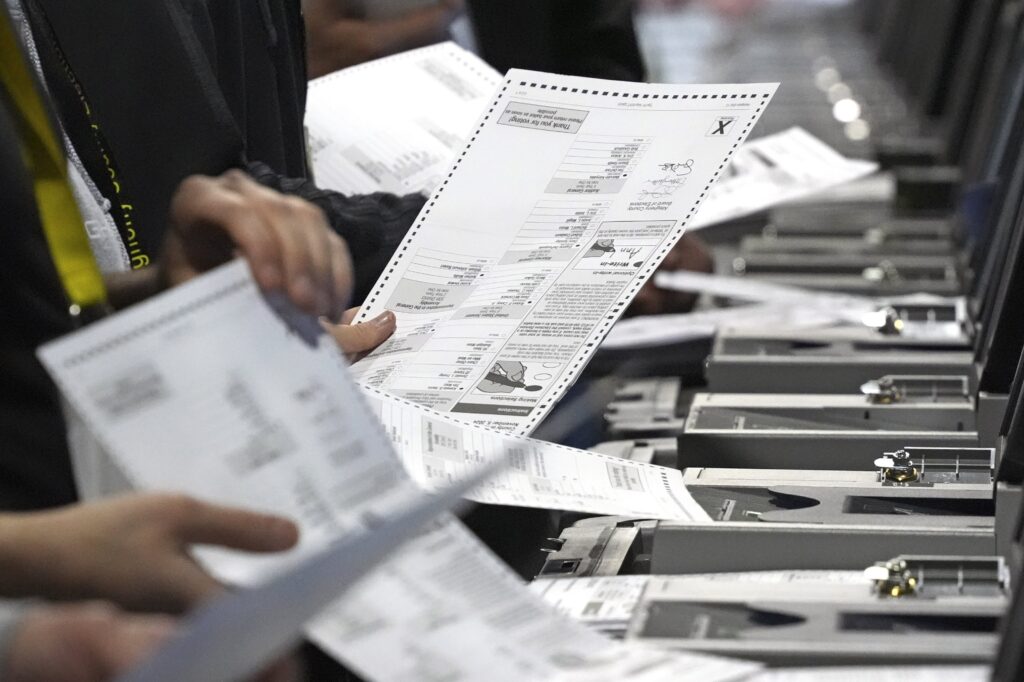
They’re preparing for the administration to potentially confiscate ballots and voting machines, strip resources from the postal service to disrupt the delivery of mail ballots, and send military members and immigration agents to polling locations to intimidate voters. They’re readying motions for temporary restraining orders to preserve election materials and remove armed forces from voting sites.
And, as the president attempts to assert federal control over elections, seize voter data and relitigate false claims of fraud from 2020, they’re monitoring Trump and his allies’ every word about elections for clues about what his administration could do next.
“[Trump] wants to continue to have his party prevail, seemingly by whatever means necessary,” California Attorney General Rob Bonta said. “So we have to be ready for that, sad and tragic as it is.”
The Democratic attorneys general, some of whom battled Trump’s election-subversion tactics in the courts in 2020, have already challenged the president’s efforts to overhaul election administration and access sensitive voter data ahead of a midterm contest that could turn him into a lame duck.
Nineteen of them banded together to sue the administration last spring over Trump’s sweeping executive order targeting voting rules, most of which has since been blocked by courts. When the Department of Justice dispatched election monitors to polling locations in New Jersey and California last November, Bonta deployed his own observers in his state in response.
But the president’s more recent moves have prosecutors ratcheting up their preparations for November, five Democratic attorneys general said in interviews.
Earlier this month, Trump called on Republicans to “nationalize” voting and suggested the federal government should intervene in election operations in swing-states’ predominantly blue cities like Atlanta, Detroit and Philadelphia — places that have been central to his election conspiracy theories for years. House Republicans passed one set of voting restrictions and are teeing up another, though the measures are unlikely to clear the Senate. And Homeland Security Secretary Kristi Noem raised alarms among Democrats when she said her department is working to ensure “that we have the right people voting, electing the right leaders.”
Trump and his allies’ rhetoric is the type of “red-alarm fire that people need to take very seriously,” said Washington Attorney General Nick Brown, who leads the Democratic Attorneys General Association’s election protection working group.
“He will try anything,” Brown said, so “we have to just sort of think creatively about: If you were the president and you were trying to invalidate an election or undermine an election, what are the oddball, ludicrous, unconstitutional theories that you might advance?”
White House spokesperson Abigail Jackson fired back in a statement accusing Democrats of “plotting to undermine commonsense election integrity efforts supported by a vast majority of Americans” and arguing existing law gives the Department of Justice “full authority to ensure states comply with federal election laws, which mandate accurate state voter rolls.”
“President Trump is committed to ensuring that Americans have full confidence in the administration of elections, and that includes totally accurate and up-to-date voter rolls free of errors and unlawfully registered non-citizen voters,” Jackson said. “The President has also urged Congress to pass the SAVE Act and other legislative proposals that would establish a uniform standard of photo ID for voting, prohibit no-excuse mail-in voting, and end the practice of ballot harvesting to ensure the safety and security of our elections.”
Democratic attorneys general have panned the SAVE Act as an attack on the right to vote and urged Congress not to pass it and other measures Trump is pushing.
They also fear the Trump administration could aim to intimidate legal voters by sending Immigration and Customs Enforcement agents to polling locations.
ICE chief Todd Lyons said in a congressional hearing earlier this month that there’s “no reason” for ICE officials to be deployed to polling facilities. But MAGA influencer Steve Bannon, a former White House strategist, is encouraging the president to take that step to prevent noncitizens from voting, despite its rare occurrence. He’s also urging Trump to send in troops, further stoking Democrats’ concerns.
When asked about Bannon’s comments during a briefing earlier this month, White House press secretary Karoline Leavitt said while she “can’t guarantee that an ICE agent won’t be around a polling location in November” she hadn’t “heard the president discuss any formal plans to put ICE outside of polling locations,” calling the question “disingenuous.”
Democrats aren’t reassured.
“If the president said, ‘Look, I want my ICE people to protect American elections … go to all these polling places and stand out in front with guns,’ I think they would do it,” said Attorney General Keith Ellison of Minnesota, where an immigration enforcement surge earlier this year resulted in two deaths. “And I think we all need to be prepared to deal with that problem.”
Several Democratic attorneys general said they’re particularly alarmed after the FBI seized voting records in Fulton County, Georgia, based on a referral from Kurt Olsen, an attorney who worked with Trump to undermine the 2020 election results. They’re now bracing for similar seizures in other places Trump has previously targeted over debunked claims of voter fraud.
Those concerns are heightened in battleground states with contests that could decide control of Congress.
“We recognize that what happened in Fulton County could happen in Detroit. Not because there’s any merit to claims that anything wrong happened in Detroit, but because we know that those claims will be made again,” said Democratic Attorney General Dana Nessel of swing-state Michigan.
“The president and his administration know and understand that Democrats don’t win statewide in Michigan without counting the Detroit vote,” she added. “So of course Trump wants to undermine in people’s minds the integrity of Detroit elections, even though that’s not borne fruit whenever that has been investigated.”
Democrats in states that rely heavily on mail-in ballots are also girding for an assault on the voting system that Trump is trying to eliminate, but that GOP operatives and even some Republicans in Congress support as a way to keep voters engaged in non-presidential years.
They are worried about Trump weaponizing the postal service, either by again blocking funding for the agency or installing allies to slow operations. And they cautioned that his push to discount ballots that are postmarked by Election Day but arrive afterward could disenfranchise voters in states with grace periods. The Supreme Court is due to consider a case on ballot deadlines next month.
Democratic attorneys general, meanwhile, will argue in a lower court next week in a multistate lawsuit seeking to permanently block portions of Trump’s executive order — which includes cutting off mail ballots and requiring documentary proof of citizenship for the national voter registration form — from taking effect.
Nevada Attorney General Aaron Ford, who is co-leading the lawsuit alongside Bonta, urged his counterparts to “stay nimble.”
Trump “likes to sow chaos because he thinks it’s going to throw people off their game,” Ford said. “But he has met his match when it comes to the Nevada attorney general’s office; he’s met his match when it comes to the Democratic attorneys general.”
Elena Schneider contributed to this report.
The post How Dem attorneys general are war-gaming to push back on Trump election meddling appeared first on Politico.