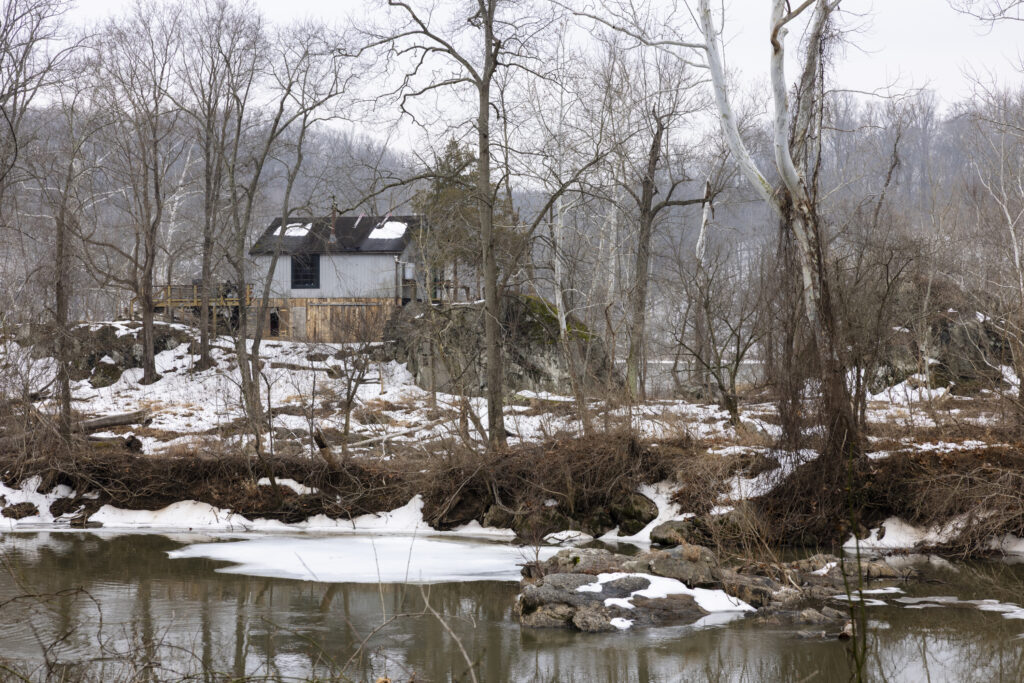
The easiest way to reach Minnie’s Island is to paddle in a canoe through a small channel between two mounds of sediment in the Potomac River.
“That’s the magic portal to the island,” Carolyn Finney said with a kind of wonder in her voice, standing on the C&O Canal and looking out across the water on a recent morning.
Finney is one of a dozen or so stewards who have made the eight-acre collection of small islands into a haven — tending to its invasive vines, bringing scout troops and young fishers to its shores, and restoring the 100-year-old cabin perched on top of it. The land sits about 50 yards from the shoreline of the Potomac River’s Maryland side, but it feels a world apart from the highways and suburban neighborhoods that surround the area.
For the last month, those who take care of Minnie’s Island have not been able to get to it, because a collapsed sewage pipe dumped hundreds of millions of gallons of wastewater into the river around it. The sewage spill, just a half-mile upstream of the island, spewed E. coli and even the bacteria that causes staph infections into the water, according to testing by University of Maryland scientists. Outrage over the spill — now largely contained with a temporary, albeit fragile, fix — was localized to the D.C. region in its early aftermath. Then, last weekend, President Donald Trump waded into the conversation, lambasting regional Democrats for an allegedly “incompetent” response.
Even as it has taken on political resonance and served as a proxy for broader tensions between the president and local leaders, the disaster at its core has been most acute for the Potomac’s most dedicated users — the kayakers, the vine-pullers, the fishers. For some, like the watermen downriver, the river is their livelihood, and perceptions about its uncleanliness could be economically damaging. For others, like the Minnie’s Island community, it is a second home. The spill has them reflecting on the vulnerability of their beloved waterway, and wondering when it will be safe to return to a place they treasure.
“It’s not a religious institution or anything like that, but imagine a church or a social organization like that that gets cut off from its facility” — that’s what this feels like, said Tim Bragan, a member of the Minnie’s Island Community Conservancy board, about the river and the island.
The conservancy is a relatively new organization, but the island has a far longer history.
Its first formal owners were John Trammel and Minnie M. Jenkins, who secured control of the land in 1904. It passed through various private hands in the decades that followed — including those of a zoologist, a CIA historian and later a lawyer who lived on the island himself and commuted daily to his law office.
In 1994, a family donated it to the Potomac Conservancy, according to a history of the island prepared by Joe Saliunas, who chairs the Minnie’s Island Community Conservancy board. The organization was established in 2021 by a group of four residents who wanted to restore the island, which had fallen into disuse. (“Nature very quickly retakes itself,” Saliunas said). The Potomac Conservancy transferred ownership to the Minnie’s Island Conservancy, which has spent the past several years fixing the cabin on the island, protecting its native plant life and facilitating community access to the space. Even in winter, it’s not unusual for members of the conservancy community to visit the island three or four times a week, provided the river is not frozen.
From the cabin’s perch, a person can see an uninterrupted view of the Virginia forest across the Potomac — a remarkable slice of wilderness inside the Beltway.
Bragan grew up whitewater kayaking on the river in the 1980s. Now, he is raising his family alongside it, taking his 13-year-old son, Aran, fishing at Minnie’s after school twice a week when the weather is good. They happened to be there fishing on Jan. 19, the day the spill was identified.
That day, as Aran was paddling back to shore with his dad, he noticed the water was cloudy. There was an odor, too.
Neil Shaut, director of facilities for the conservancy, was also on the river that day, working on window trim at the Minnie’s Island cabin, when he noticed the smell of sewage. The next day, after D.C. Water publicized the pipe collapse and spill, he went back and identified a surefire sign that something in the water had gone terribly wrong.
“I noticed that there were small dead fish in the river close to the landing,” Shaut said. He took a picture.
No one from the conservancy has been back on the island since.
In a normal year, about 600 million gallons of sewage are dumped into the Potomac River, the result of overflows after rainfall. It’s a problem D.C. Water, the quasi-governmental agency and utility that supplies drinking water to the region, has been working to fix with a multibillion-dollar tunnel project. In the span of just 10 days after the spill, the broken sewage pipe dumped upward of 200 million gallons of wastewater into the waterway.
Within about a week of the spill’s start, D.C. Water crews set up a bypass system to reroute the sewage away from the broken part of the pipe. That system has largely held, though it got overwhelmed by a glut of non-disposable wipes on Super Bowl Sunday. Until the pipe is fixed, the system remains vulnerable, officials say. D.C. Water authorities say they hope the pipeline will be restored to use by mid-March. Longer-term repairs could take nine to 10 months.
Minnie’s Island plans are on hold. Aran said he is worried about the fish — including the upcoming shad run, an annual celebration for anglers fascinated by the local fish. Finney said the group had started discussions with D.C. summer camps last year about getting more kids to visit the island; those talks are on pause for now as residents wait for firmer answers about water safety.
“I’ve got 30 trees and shrubs on order that were scheduled to be delivered in late February so we could plant them before they break bud,” Saliunas said. “I’m going to need to reschedule that.”
Still, he maintains hope for recovery. Even as uncertainty persists about how the spill might affect the river’s ecosystem in the months to come, nature is resilient, Saliunas said. While E. coli levels near the spill remain well above safe limits, they now hover around safe recreational levels downriver in Washington.
“It’ll be interesting through this year to make observations,” Saliunas said, “to see what story nature is telling us about the impact.”
As Saliunas and Finney walked together along the canal on a recent morning, they reflected on how they have watched their small island and tended to it over the years.
For Finney, the experience of paying such close mind to one space in nature has affirmed something important about the human relationship to the Earth. “Everybody can find their own path to cultivate, to steward,” she said.
“You really get to know a piece of land — how it changes month to month, even week to week,” Saliunas said.
They pay attention to when the birds begin nesting. To when the snapping turtles lay their eggs, and the raccoons dig them up and eat them. To when plants begin to bloom. To when the snakes come out of their hiding places. Saliunas, a certified Maryland Master Naturalist, said they have identified 220 different native species on the island — foxes and deer, beavers and muskrats. They have spotted river otter tracks, too — though they haven’t seen an otter. A couple years ago, a highlight for him was the common merganser ducklings that hatched and grew up by the island.
Saliunas remembers watching the mother duck with her 14 little baby fluffs. “They’re the handsomest looking animals,” he said. By August or September, the babies had grown into what he likened to a “teen gang,” sticking together and terrorizing the local fish.
Whatever happens this year, Saliunas said, he will probably notice.
“I’m a river person,” he said.
The post A Potomac island was their haven. A sewage spill made it unreachable. appeared first on Washington Post.