LONDON — As sordid allegations engulfed Prince Andrew, the middle of her three sons, Queen Elizabeth displayed the eternal hope of a mother. Charles, heir to the throne, showed the cold impatience of a sibling. And William, the embarrassed dismay of a nephew.
Countless families deal with a difficult relative. In the House of Windsor, he was the not-so-grand Duke of York — now reduced to Andrew Mountbatten-Windsor after being stripped of his royal titles over his ties to convicted sex offender Jeffrey Epstein.
Andrew has long been a thorn in the royal family’s side as he denied allegations of sexual misconduct, and yet again and again new evidence revealed his ties to Epstein were far closer and went on far longer than he admitted.
But the three generations of the royal family each confronted the challenge differently, reflecting their own personal stake in Andrew’s downward spiral.
Last week, after Mountbatten-Windsor was arrested in connection with potential misconduct during his time as a trade envoy, King Charles III issued a terse, first-person statement — extremely rare for a British monarch. “Let me state clearly: the law must take its course,” Charles said.
It was a clear move to place institutional distance between the monarchy and his beleaguered brother who, if charged with a crime, would present his brother’s realm with the extraordinary spectacle of the crown prosecuting one of its own.
Royal commentator Craig Prescott saw the moment as emblematic of a broader shift. “Charles didn’t prevaricate about this. His statement was released very quickly,” Prescott said, adding: “You get the sense that William would have gone much further, much earlier.”
Each generation, in other words, has less and less tolerance for Windsor’s wayward son.
The late Queen Elizabeth II, by contrast, moved with characteristic restraint. Andrew had always insisted no wrongdoing, but the horizon has been darkening for years.
In 2011 — 11 years before Elizabeth’s death — photographs surfaced of Andrew strolling through Central Park with Epstein, already a convicted sex offender. Virginia Giuffre, one of Epstein’s trafficking victims, later accused Andrew of having sex with her when she was 17. A photograph of Andrew with his arm around Giuffre’s bare midriff became an indelible image of the scandal.
And yet the royal gates remained open, as Elizabeth refrained from acting against her son.
Not after the photographs. Not after the allegations. Not for years.
It was only after Andrew’s disastrous 2019 appearance in an interview on the BBC’s “Newsnight,” that she moved. Four days after the broadcast, Buckingham Palace announced that Andrew would step back from public duties “for the foreseeable future.”
His exile, however, was no banishment to the Tower of London. Instead, the prince who had proclaimed that he did not perspire in a bid to refute Giuffre’s description of a night out dancing with him, was allowed to continue living in Royal Lodge, a 30-room mansion, on the Windsor estate, out of sight but not cast out.
Two days after stepping back from royal duties, Andrew was photographed riding horseback with his mother at Windsor.
“The only person willing to be seen with him was his mother,” Tina Brown wrote in her book, “The Palace Papers.” Brown reported that while Charles and William believed Andrew was “toast,” the late queen and her second son hoped that, with time, he might return to public life in a diminished role rather than face permanent banishment.
Elizabeth was known to have a “particular bond” with Andrew, royal biographer Tessa Dunlop said in an interview. When Andrew was born in 1960, Elizabeth was already an experienced monarch and mother. She had more time to devote to him and, according to Dunlop, a visible soft spot.
According to biographers, Andrew’s formidable self-confidence can be traced to a childhood in which criticism was in short supply. That air of inviolability continued into adulthood. He reportedly kept dozens of stuffed animals meticulously arranged on his bed at Buckingham Palace.
After more than two decades in the Royal Navy, Andrew sought a career that might have elevated him beyond his role as a royal spare. Elizabeth backed his appointment as a U.K. trade envoy, overriding concerns from Charles, then a prince, over his suitability for the job.
As recently as 2022, less than six months before her death, the queen signaled support. Andrew played a prominent role at his father Prince Philip’s memorial service, escorting his 95-year-old mother down the aisle at Westminster Abbey — a striking public gesture of solidarity. This was shortly after Andrew finalized an out-of-court settlement — reportedly around £12 million — with Guiffre, ending her lawsuit against him without admitting liability or wrongdoing.
The source of the funds used to pay the settlement has never been publicly confirmed.
Charles has taken a different approach. While monarchies may have once solved family embarrassments with dungeons and beheadings, Charles has used the modern tools available — blunt press releases, the stripping of titles and withdrawal of patronages.
In the months that preceded Andrew’s arrest, Charles stripped Andrew of his prince and Duke of York titles and he ousted him from Royal Lodge, relocating him to Sandringham, a private residence of the British monarch. His new home is reportedly a five-bedroom property — diminished circumstances by royal standards, but not exactly hardship.
If Elizabeth kept the gates ajar, Charles has been pulling up the drawbridge.
The brothers were never close, and Andrew’s scandals have long shadowed the institution they were born to serve. Charles’s reign has been marked by sharper boundaries and decisive action after revelations that Andrew had misled the public about when he cut off contact with Epstein.
In an interview with the BBC, Ailsa Anderson, a former press secretary to Queen Elizabeth II, praised the “swiftness” of Charles’s response and suggested the late queen “wasn’t in possession of the facts that the king is today.”
Others, however, are less charitable. Writing on Substack, royal historian Andrew Lownie argued that the palace could have acted much earlier.
“King Charles deserves little praise for acting only in the face of undeniable evidence,” Lownie wrote. “The royal family could at any point have taken the time to check Andrew’s story.” It “defies belief,” Lownie added, that they would not have sought internally to establish whether a 2001 alibi held up, whether Andrew remained in contact with Epstein, and whether he had abused his position as trade envoy.
Prince William, a millennial royal, has indicated even less patience with his uncle.
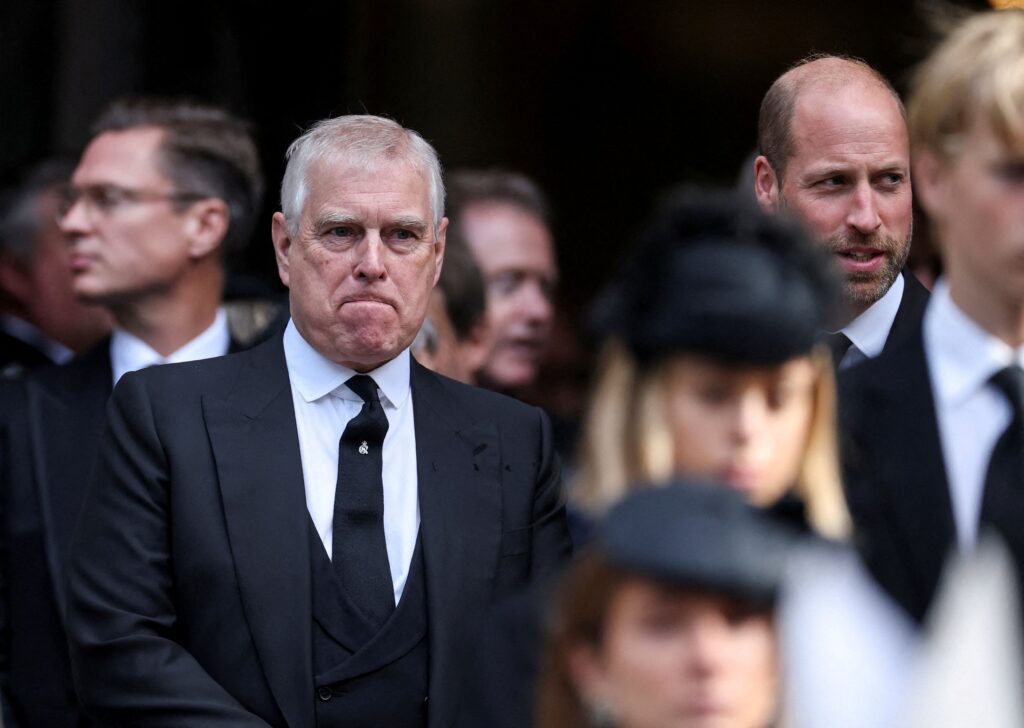
William did little to hide his discomfort at a funeral outside Westminster Cathedral last year. Andrew appeared eager to talk, laughing even; William kept a straight face, nodding but without warmth. The family frost was visible, and the clip went viral.
In a recent interview with actor Eugene Levy, William remarked that “change is on my agenda, change for good.” He did not speak of banishment or reckonings. But the symbolism was hard to miss — arriving on an electric scooter, tieless, lingering over a pint at a neighborhood pub.
William and his wife, Catherine, broke their silence on the Epstein revelations earlier this month, stating they were “deeply concerned” and that their thoughts remain with the victims. Palace officials have indicated William supported his father’s hard line following Andrew’s recent arrest.
Charles is 77. The clock is not abstract anymore.
“They need to clean the stables before William takes on the role,” Lownie said in an interview. “He doesn’t want to inherit this.”
The post As Andrew fell, Queen Elizabeth II held out hope, and Charles and William fumed appeared first on Washington Post.