Before “Survivor” made its TV debut in May 2000, the skeptics were out in full force.
“Viewers might get tired of watching mud-splattered bedraggled contestants slapping mosquitoes or hunting for bird eggs,” a Newsday TV reporter predicted. “This show caters to all the worst qualities of mankind: elitism, selfishness and sneaky behavior,” a writer for South Carolina’s Post and Courier complained. Another dismissed it as a “stunt show.”
But as everyone would learn, America actually adored watching bedraggled contestants acting selfish and sneaky, especially when it involved 16 castaways marooned on a remote island in the South China Sea as they voted each other off one by one. The series premiere captured 15 million viewers and grew all summer until more than 51 million watched as Richard Hatch — a 39-year-old corporate communications consultant — was crowned the champion, winning $1 million and a place in the TV history books.
Though broadcast network ratings aren’t what they used to be, the loyal “Survivor” fan base has never tuned out. And on Wednesday, the show will kick off its landmark 50th season on CBS. In the beginning, the network and executive producer (and future “Apprentice” creator) Mark Burnett touted the show as a grand social experiment — contestants from a wide array of backgrounds and viewpoints, a microcosm of society coming together to collaborate and compete in a mission of survival.
Yet fans ultimately did thrill to the less-exalted stuff — the dining on bugs and rats, the sometimes comical attempts to build shelters while being pummeled by thunderstorms, the quirky characters and trash-talking, the soap-operatic plotting and scheming that took place between the self-serious staged “challenges” — which were often just relay races with whimsical set design.
Much has been written about how the series — based on the Swedish show “Expedition Robinson” — changed TV forever, kick-starting decades of reality competition shows and teaching executives that there’s nothing more fascinating than putting ordinary people in extraordinary situations. The show has also changed hundreds of lives over the years, and none more so than the people who signed up that first season with no real idea what they were in for.
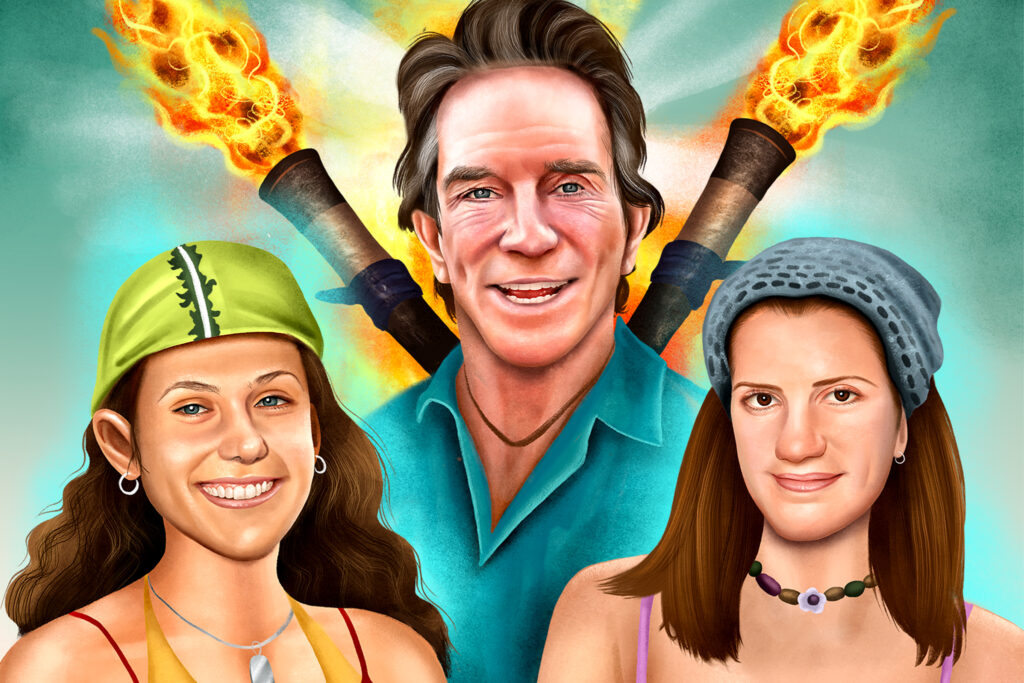
We talked to Kelly Wiglesworth (Hatch’s runner-up) and Jenna Lewis (now Lewis-Dougherty, who was voted off in Week 9) via Zoom and host Jeff Probst by email about the unexpected impact of being on that legendary first season.
The psychological impact
Even in recent years, contestants admit to being unprepared for the psychological toll of reality shows — so it was especially magnified for the Season 1 “Survivor” cast whose only comparison was MTV’s “The Real World,” which had regular meals and significantly fewer insects. Wiglesworth, a river guide from Las Vegas, expected a “super gnarly physical” competition. She wasn’t quite ready for the mind games.
“That was something that I had to really navigate on the fly there,” said Wiglesworth, who was in her early 20s at the time. “No food, no sleep, no comfort, you know, just brutal living environments. Everyone’s out to get you. You’re constantly shifting and scheming scenarios all day long.”
Wiglesworth was also an integral part of a scene that is still cited as one of reality TV’s most iconic moments: Fourth-place finisher Sue Hawk’s famously scathing “snakes and rats” speech. Unhappily forced to cast a vote for either Wiglesworth or Hatch as the season’s winner, Hawk denounced Wiglesworth, whom she felt had betrayed her earlier in the season. “If I were to ever pass you along in life again and you were laying there, dying of thirst, I would not give you a drink of water,” Hawk said in her speech. “I would let the vultures take you and do whatever they want with you, with no ill regrets.”
What was it like hearing that on national television, knowing that tens of millions of people were hearing it, too? “It sucks when someone says horrible things to you, but you know, there was no merit to what she said,” Wiglesworth told The Post. “But it stung, especially with how vulnerable I was in the moment.”
However, Wiglesworth said, it turned into a defining moment for her, personally. She calmly responded that she was sorry that Hawk felt that way — no one emerged from the game with clean hands, after all, and Hawk did her own share of backstabbing, Wiglesworth noted — adding that she just hoped the others would vote how they felt was best.
“I felt sorry for her,” Wiglesworth told The Post. “I saw her as this pathetic, angry person … and I was like, I have two options: I can go full Jerry Springer with this, or I can take the high road.” Even though she lost, she remains proud of how she reacted in the moment. “I was surprised at myself, but impressed that I handled it the way I did. … And that made the experience amazing.”
To this day, Wiglesworth said, she receives Instagram messages from people who admired her gameplay on that first season. She returned to compete on Season 31 with other former contestants getting a second chance. “It’s not just a female thing, but I definitely get a lot of praise and messages from females,” she said. “Saying, like, ‘Wow, you were an inspiration and you’re a great role model to women and little girls.’”
The real-life impact
One of the media narratives during summer 2000 was the question of whether CBS could keep the winner a secret: The entire season had filmed off the coast of Borneo in March and April, four months before the finale was to air in August. Theories swirled, but the network managed to keep a lid on things — though not for a lack of effort by sleuth-minded fans. Jenna Lewis-Dougherty, then a single mom and student in her early 20s, recalled going to an event where actor Richard Dreyfuss stopped her in an elevator and tried to get her to tell him who won. This was not an isolated incident as the cast made the high-profile promotional press rounds.
“Whenever we showed up there were celebrities — huge celebrities — but the celebrities would run over to us,” Lewis-Dougherty said. This was years before stars developed direct lines of communication with the public via social media, so this first generation of reality TV characters seemed like some kind of mesmerizing hybrid — famous but accessible, everyday people who showed their raw selves and personalities on TV every week.
“It’s a Pandora’s box, man. I think it was the precursor to social media … there’s good and bad, right?” she told The Post. “I think about this all the time.”
Lewis-Dougherty was on Season 8 for “All-Stars,” and will return again for Season 50 — this time, she knows better what to expect. During the first season, she remembers signing contracts that warned them the show wasn’t 100 percent guaranteed to air, so it was easy to sort of forget the cameras were around. During one challenge where the contestants had to eat squirming beetle larvae, she started seriously questioning whether anyone would want to watch this: “Are they going to be like, ‘This is awful for society, look at what they’re willing to do for a million bucks!’ or are they going to be like, ‘Yay, this was amazing, look at what these people are willing to do for a million bucks!’”
The season threw back the curtain on contestants’ personal lives, from Hatch talking about his life as a gay man to dairy farmer Dirk Been openly reading his Bible. Lewis-Dougherty spoke about wanting to show herself as a strong single young mother, a demographic that rarely got positive exposure in the media, and she still gets messages from women who thank her for this representation. In one memorable episode, all of the castaways received VHS tapes from family members wishing them well — except for Lewis-Dougherty, who missed out on seeing videos of her baby twin daughters who were staying with her parents.
It had the potential to be a gripping moment of television, but Lewis-Dougherty didn’t want to reveal her vulnerabilities. She knows that things have evolved for reality show contestants, some of whom use their emotions as leverage; but at the time, she wanted to keep her feelings private.
“I remember pushing people off when my video didn’t come and tears running down my face,” she said. “And I was just thinking, ‘You cannot look weak or they will vote you off.’”
The TV impact
When Jeff Probst was hired on “Survivor,” he was in his late 30s and had worked most recently as an “Access Hollywood” correspondent and host of VH1’s “Rock & Roll Jeopardy!” He had never seen anything like “Survivor” — but neither had anyone else. At the time, ABC’s “Who Wants to Be a Millionaire?” was steamrolling everything else in the ratings — until CBS took the plunge with its new show.
“It premiered in the summer, a time when networks rarely took big swings, and it showed that audiences would show up for something genuinely new — not a variation on an existing format, but a bold, risky experiment built around real people, real stakes, and real uncertainty,” Probst said. “‘Survivor’s’ success didn’t just change how networks thought about summer programming, it widened the aperture on what kinds of shows could work in prime time at all.”
He remembers the rawness of Season 1 when the show was finding its footing: You can see the cameras in some shots. The torches representing each voted-off contestant (“The tribe has spoken,” in Probst’s immortal catchphrase) were extinguished with a half coconut shell attached to a stick. The host had to cut his own hair. But no matter how slick and routinized the show ultimately became, it still feels to him like an unfolding experiment.
“We still don’t script outcomes or chase perfection,” said Probst, who was eventually promoted to executive producer and showrunner. “We trust the players and we let the format do the work.”
Even now, he said, it’s difficult to grasp the enormity of the show, though various moments stick with him: The time he hosted the “All-Stars” season finale in 2004 at Madison Square Garden, or when he realized that journalists stopped referring to him as “the host of ‘Survivor’” and just cited him as “Jeff Probst,” no descriptor needed.
The show changed his life professionally (he’s a four-time Emmy winner) and personally (he met his wife at a Christmas party thrown by Burnett) and he also still thinks about how the series reflects human nature. He was genuinely stunned when Hatch, considered the villain of the first season, was voted the winner; he thought viewers would be too angry to watch a second season. But it was a valuable lesson about humanity itself.
“At the time, I didn’t understand what the game had just revealed. Richard’s win showed that once you put people under real pressure, the outcome becomes unpredictable, because human behavior is unpredictable,” Probst said. “People don’t vote based on a single value system. They vote based on relationships, self-interest, fear, respect, resentment and often all at once.”
“And in many ways,” he added, “That unpredictability is what ‘Survivor’ has been about ever since.”
The post Season 1 of ‘Survivor’ changed TV. And these losing contestants’ lives. appeared first on Washington Post.