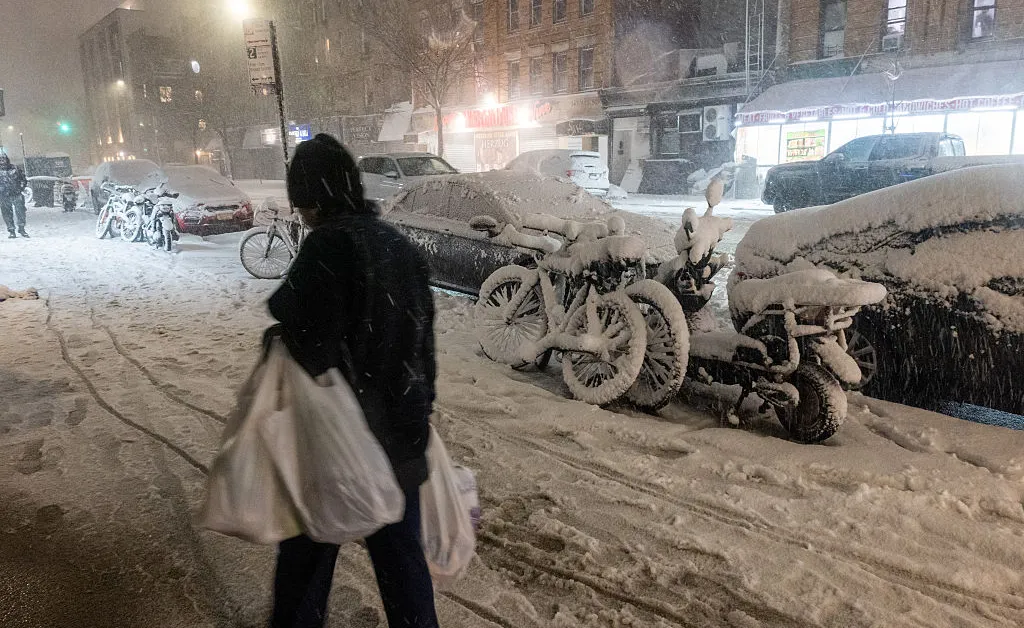
A major winter storm blanketing the East Coast—which is expected to bring up to two feet of snow and whipping winds—is expected to cause “nearly impossible” travel across states in the region, according to the National Weather Service.
[time-brightcove not-tgx=”true”]
With harsh conditions expected to last until Monday, several governors have declared states of emergency, with some prohibiting commercial land travel. Air travel was also severely disrupted: tracker FlightAware reported almost 3,500 cancellations of flights within, into, or from the U.S. as of 11 p.m. on Sunday.
Here’s what to know about travel bans and restrictions by state amid the storm.
Connecticut
Gov. Ned Lamont declared a state of emergency across Connecticut on Sunday, and additionally signed an emergency order prohibiting all commercial vehicles on limited access highways from 5 p.m. Sunday. The prohibition, which stays in effect until lifted, does not apply to emergency response and recovery vehicles, such as those for public safety, utilities, or those carrying necessary personnel and supplies.
“Everyone statewide is strongly urged to avoid all unnecessary, non-essential travel,” Lamont said in his announcement. “Plan ahead, get to where you need to be by early Sunday evening, and remain there throughout the duration of the storm.”
Delaware
Gov. Matthew Meyer declared a state of emergency Sunday, and imposed a statewide driving warning urging increased caution. Stricter rules were imposed on the Kent and Sussex counties: prohibiting anyone from operating motor vehicles, unless they are lawfully exempted, including if they are designated as essential personnel.
Massachusetts
According to Gov. Maura Healey’s office, the Massachusetts Bay Transportation Authority will operate subway trains and buses at reduced levels on Monday, similar to its scheduled operations during Sunday, citing severe weather conditions. Rail lines will also operate based on their corresponding storm schedules. Meanwhile, all ferry services are suspended Monday.
The Massachusetts Department of Transportation imposed travel restrictions on box trucks, tractor-trailer, tandem, and special permit trucks on interstate highways, though truck deliveries of food, fuel, and medical supplies are exempted.
“It is critical that people stay off the roads tonight and tomorrow,” said Healey, who also activated the National Guard and directed the state’s non-emergency executive branch employees to work from home, while urging private employers to do the same.
New Jersey
Gov. Mikie Sherill urged all New Jersey residents to “use caution, stay off the roads, and follow all safety protocols during the storm” on Saturday, when she declared a state of emergency for the state, taking effect Sunday.
NJ Transit, the state’s public transportation provider operating the bus, train, and light rail network, suspended services on Sunday. By 6 p.m., bus, light rail, and Access Link services for people with disabilities were halted, and rail service suspension followed at 9 p.m. The operator said it will assess the storm’s impacts overnight to determine when it is safe to resume services.
State police also issued a travel restriction on all vehicles—with exemptions for first responders and those with emergency reasons—from operating on state, county, municipal, and interstate roadways from 9 p.m. on Sunday, to 7 a.m. on Monday, though the New Jersey Turnpike is exempt from the restriction.
New York
Gov. Kathy Hochul declared a state of emergency in several counties in New York state. In her announcement, Hochul said that starting 4 p.m. Sunday, empty commercial vehicles and tandem tractor-trailers are banned from travel on I-84 and all roads south of I-84, including all Thruway system roads. Other commercial vehicles are restricted to the I-84’s right lane, as well as all roadways south of I-84, including the Thruway system roads in Orange, Rockland, and Westchester counties.
According to the Metropolitan Transport Authority, which covers the New York metropolitan area, some express subway lines have been operating locally in preparation for the winter storm. Bus services will continue, but road conditions may affect it.
The Long Island Rail Road service, stretching from Manhattan to Suffolk County in Long Island, will be suspended by 1 a.m. Monday until conditions improve. The Metro-North Railroad will also limit its services, operating on an hourly schedule on some lines and on a weekend schedule on others. The MTA’s paratransit services will end taking reservations starting at 9 p.m., and the MTA is contacting customers who booked rides after to possibly schedule their rides earlier or cancel them altogether.
New York City Mayor Zohran Mamdani announced a local state of emergency. A travel ban is in effect from 9 p.m. Sunday to 12 noon Monday, which means the city’s streets, highways, and bridges are closed to all vehicles, save for essential and emergency trips.
The Staten Island Ferry will also modify its schedule starting at midnight, operating with hourly service until 6 a.m. and then every 30 minutes after 6 a.m.
“This blizzard is serious,” Mamdani said. “Stay inside.”
The post Several States Lock Down Amid East Coast Blizzard appeared first on TIME.