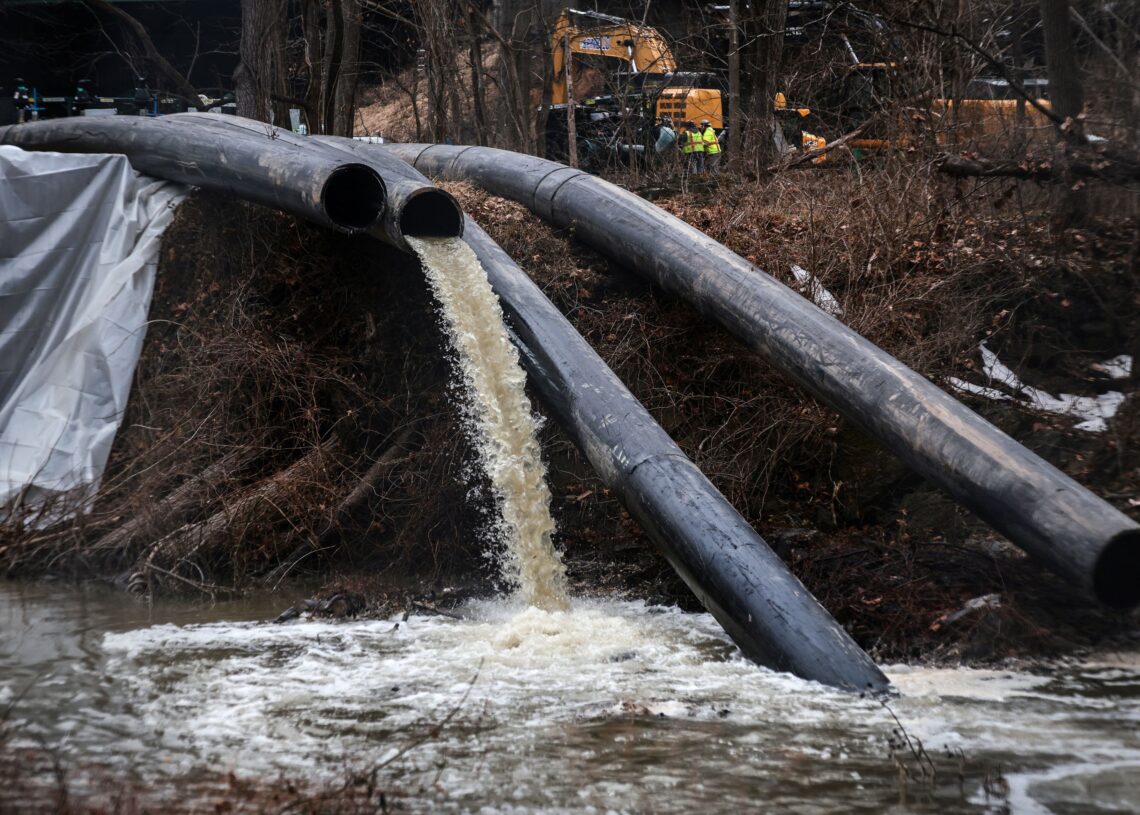
President Donald Trump approved an emergency declaration for D.C. on Saturday, permitting federal agencies to provide disaster assistance to address a massive sewage spill in the Potomac River.
The spill began in mid-January, when part of a major D.C. Water sewage pipeline called the Potomac Interceptor collapsed, flooding the Potomac River with about 234 million gallons of wastewater. The sewer line carries about 60 million gallons of wastewater daily from the Virginia and Maryland suburbs to D.C. for treatment. The cause of the spill remains under investigation.
The Environmental Protection Agency will be leading the federal response to the spill, according to a news release from the agency. The EPA is coordinating with D.C. Water to ensure that measures are taken “to protect public health and prevent additional overflows until the pipe is repaired and the Potomac Interceptor is fully functional again.” Repairs are slated to be completed by mid-March, before events in the region celebrating the 250th anniversary of the United States are set to begin, according to the agency.
The Federal Emergency Management Agency will also be “deploying a team to support incident management” and “working directly with local officials and federal partners to coordinate federal resources,” according to a social media post from Homeland Security Secretary Kristi L. Noem. The assistance will be directed to D.C. and the area where D.C. has responsibilities in Maryland and Virginia, according to a FEMAnews release.
D.C. Mayor Muriel E. Bowser (D) declared a public emergency on Wednesday and requested federal assistance with the cleanup. She also requested a presidential disaster declaration and asked the federal government to reimburse the D.C. government and D.C. Water for costs associated with the spill and recovery effort. On Friday, D.C. Water CEO David L. Gadis estimated the repair and remediation would cost $20 million.
Trump, who previously criticized Bowser and other Democratic elected officials in the region over mishandling the spill, on Thursday signaledthe federal government would help with the recovery.
Bowser had faced questions over the timing of her emergency declaration, coming a month after the spill began. She said she took the actions, in part, after recent signals from the Trump administration that federal officials may support the request, and maintained that the response to the spill had been urgent from the start.
In his Truth Social poston Thursday indicating that he would be responding to Bowser’s request for aid, Trump continued to rail against Democratic Govs. Wes Moore (Maryland) and Abigail Spanberger (Virginia). “Governors of Virginia and Maryland must get moving, quickly,” he wrote. “If they can’t do the job, all they have to do is call, be polite and respectful, and the Federal Government will handle it, and bill them for services rendered, at a later date.”
Authorities have advised against boating, fishing and touching the Potomac River since the spill, but D.C. officials said earlier this week that they hope to lift the guidance on March 2, subject to change based on water quality, as testing has shown the level of E. coli in the D.C. portion of the river consistently hovering under safe recreational limits.
There has not been sewage overflow into the river since Super Bowl Sunday.
Officials with D.C. Water, the public utility responsible for water and sewage in the region, have said drinking water remains safe to drink. But officials have issued warnings for people and pets to stay out of the water near the spill site and downstream in the District.
Jenny Gathright, Meagan Flynn, Dana Hedgpeth and Erin Cox contributed to this report.
The post Trump approves D.C. emergency declaration in response to Potomac sewage spill appeared first on Washington Post.