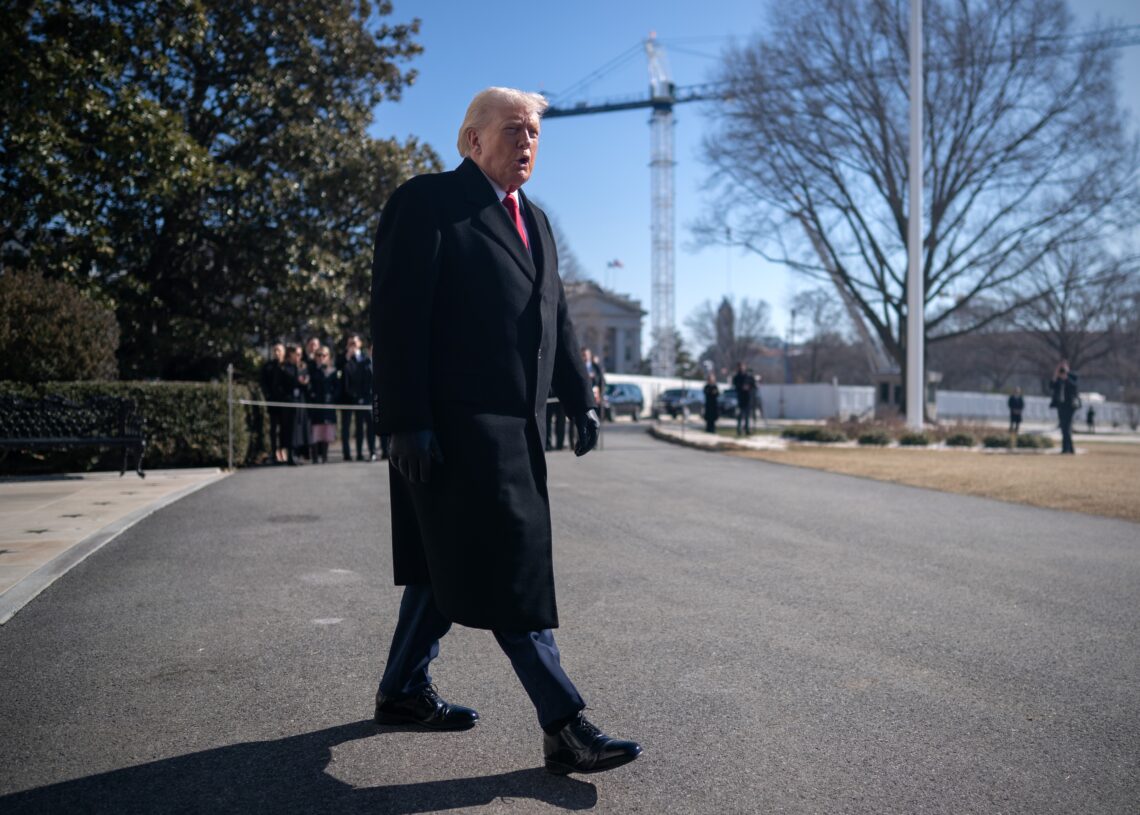
As President Donald Trump prepares to address the nation Tuesday evening, Americans remain generally sour about his performance, with majorities disapproving of his handling of priority initiatives while saying he has overreached the authority of his office, according to a Washington Post-ABC News-Ipsos poll.
The president’s approval rating stands at 39 percent positive and 60 percent negative, including 47 percent who say they strongly disapprove. The last time Trump’s disapproval touched 60 percent was shortly after the Jan. 6, 2021, attack on the U.S. Capitol. Among registered voters, Trump’s approval is 41 percent and his disapproval is 58 percent.
Dissatisfaction with Trump applies to specific issues, as well, with significant majorities saying they disapprove of how he is handling the economy, tariffs, inflation and relations with other countries. His worst rating is on inflation — 32 percent approve of how he has dealt with the issue. On the question of his handling of the economy overall, 41 percent approve, but while he still gets low ratings on this, the gap between negative and positive assessments has narrowed from 25 points negative in October to negative 16 this month.
For Democrats, Trump’s relatively low standing provides opportunities for the upcoming midterm elections, but the party out of power has made little headway in persuading Americans that they have better ideas or policies to offer and are seen as no more in touch with the concerns of the average person.
Asked whether they trust Trump or Democrats in Congress to handle major issues, 33 percent cite the president, 31 percent say Democrats, 4 percent say both equally and a crucial 31 percent say neither. In April, Trump led by 37 percent-30 percent on this question.
Trump will deliver the State of the Union address to a joint session of Congress after a disruptive first year that has produced some successes but more controversies.
Though his approval rating has sagged from the early months of 2025, it is not statistically changed from 41 percent in October. That highlights the degree to which opinions about Trump remain firm and largely fixed among both his supporters and the far larger group of detractors. In the new poll, 85 percent of Republicans approve of Trump’s job performance while 94 percent of Democrats and 69 percent of independents disapprove. Those numbers are almost identical to the partisan breakdown in a Post-ABC-Ipsos poll in October.
Trump has issued more executive orders by far in the first year of his second term than any recent president, and those efforts do not sit well with most Americans. Nearly 2 in 3 (65 percent) say he has gone beyond his authority in exercising the powers he claims, rising from 57 percent early in his second term.
Most Americans (56 percent) say he is not committed to protecting Americans’ rights and freedoms. More than 6 in 10 (62 percent) say he is using the presidency to enrich himself, and 56 percent say his administration has not been transparent in releasing government files from the investigation of Jeffrey Epstein.
Other aspects of his presidency also draw negative reactions. After earlier threats to take over Greenland, from which he has backed away, and only six weeks after the capture of Venezuelan President Nicolás Maduro, a majority (54 percent) say they oppose his use of the military to force changes in other countries, while 20 percent support him, with 26 percent expressing no opinion. Those findings provide a snapshot of public opinion as the president weighs possible military action against Iran.
Health and Human Services Secretary Robert F. Kennedy Jr. has helped engineer new recommendations against the use of many vaccines for children, but 53 percent of Americans oppose recommending fewer childhood vaccines while 21 percent support this and the remainder offer no opinion.
Two issues were critical to Trump’s victory over Vice President Kamala Harris in 2024. One was immigration, and on this issue opinions are mixed. By 50 percent to 48 percent, Americans say they support Trump’s call to deport the estimated 14 million undocumented immigrants in the United States. But almost 6 in 10 (58 percent) say he is going too far in trying to deport undocumented immigrants, up 10 percentage points over the past 10 months. That finding is consistent with other polls that have found majorities supporting some of Trump’s goals, but opposing his methods.
The immigration issue has begun to turn against Trump after what happened in Minnesota last month. About 6 in 10 say they oppose the tactics U.S. Immigration and Customs Enforcement has used, and a majority say they oppose expanded enforcement operations to detain and deport undocumented immigrants.
This comes after growing opposition to ICE and the Border Patrol operations in several cities, including Minneapolis, where the killings of two American citizens sparked massive demonstrations. This has forced Trump to soften his tone and start the process of withdrawing ICE from Minnesota.
The other issue that brought Trump back to the Oval Office was the economy — the perception that President Joe Biden had allowed inflation to spiral out of control and that Harris did not have a plan to deal with it. Trump promised he would immediately bring down prices of key goods.
While there has been some progress, the war on inflation is not over, and the general issue of affordability looms as central to the midterm elections. Government data released Friday showed economic growth slowed sharply at the end of 2025, weakened by tariffs and the government shutdown last fall. Trump has begun to travel to 2026 battlegrounds, as he did on Thursday when he visited Georgia, with a message that things are getting better and will continue to do so as the November elections near.
By 48 percent to 29 percent, Americans say the economy has gotten worse, not better since Trump was inaugurated a year ago. Those numbers have trended in a more positive direction for Trump since the fall and administration officials are counting on additional gains over the coming months.
Asked whether they are personally better or worse off financially since Trump returned to the presidency, 22 percent say better, 33 percent say worse and 44 percent say there’s been no change.
Trump’s tariff policies have never been popular with the public, and despite all he has done and said about them, public opinion has not budged over the past year. Today, 34 percent say they approve of his handling of tariffs, while 64 percent disapprove, identical to findings last April. On Friday, in a sharp rebuke to the president, the Supreme Court struck down the tariffs, saying Trump had exceeded his authority by unilaterally imposing them.
There have been some cracks in the GOP’s solid support for Trump recently with a record-low 48 percent of Republicans now saying they “approve strongly” of his performance, down from 63 percent one year ago.
Assessments of Trump’s character and fitness show some change over time. Americans remain roughly evenly split on whether Trump is a strong leader, as they have been for several years. The percentage of people who say Trump is not honest and trustworthy — 70 percent in the new poll — is as high as at any time in a Post-ABC poll.
On two personal attributes, negative perceptions have grown. The percentage saying he lacks the mental sharpness to serve effectively has increased steadily over the past three years and now stands at 56 percent. On the question of his physical fitness to serve, Americans are split almost evenly, 48 percent saying yes and 51 percent saying no. At the beginning of 2024, 57 percent said he had the physical health to serve effectively.
For Democrats, the new poll offers a reminder of the challenges they face, not just in the 2026 elections but looking further ahead. For one, they have struggled to persuade Americans that their ideas are superior to Trump’s.
Asked whom they trust to deal with reducing the cost of living, for example, about one-third of Americans say Trump, one-third say Democrats and one-third say neither. On immigration, Trump continues to have a slight advantage, 38 percent to 34 percent for Democrats.
Similarly, when asked who is more connected to the concerns of people, Trump and the Democrats fare equally poorly. By nearly 2-1, Americans say each is out of touch. Trump has shown a slight deterioration on this measure over the past year while Democrats have shown a slight improvement. But the broad findings are a reminder of the distrust that Americans have about their elected officials no matter the party.
Recent special and off-year elections have shown, however, that the Democratic base appears more energized. That could prove to be a potentially critical advantage in a midterm election year when turnout historically dips from the previous presidential campaign. Because of the combination of Trump’s poor ratings and those special election results, Republicans are braced for losses in November that could return Democrats to the majority in the House.
Read detailed results The Post-ABC News-Ipsos poll. The poll was conducted Feb. 12-17 among 2,589 U.S. adults. The sample was drawn through the Ipsos KnowledgePanel, an ongoing panel of U.S. households recruited by mail using random sampling methods. The sample is weighted to match population demographics, 2024 turnout/vote choice and political partisanship. Overall results have a margin of error of plus or minus two percentage points; the error margin among 2,087 registered voters is 2.2 points.
Isabelle Gibson contributed to this report.
The post 60% disapprove of Trump ahead of State of the Union, Post-ABC-Ipsos poll finds appeared first on Washington Post.