Times Insider explains who we are and what we do and delivers behind-the-scenes insights into how our journalism comes together.
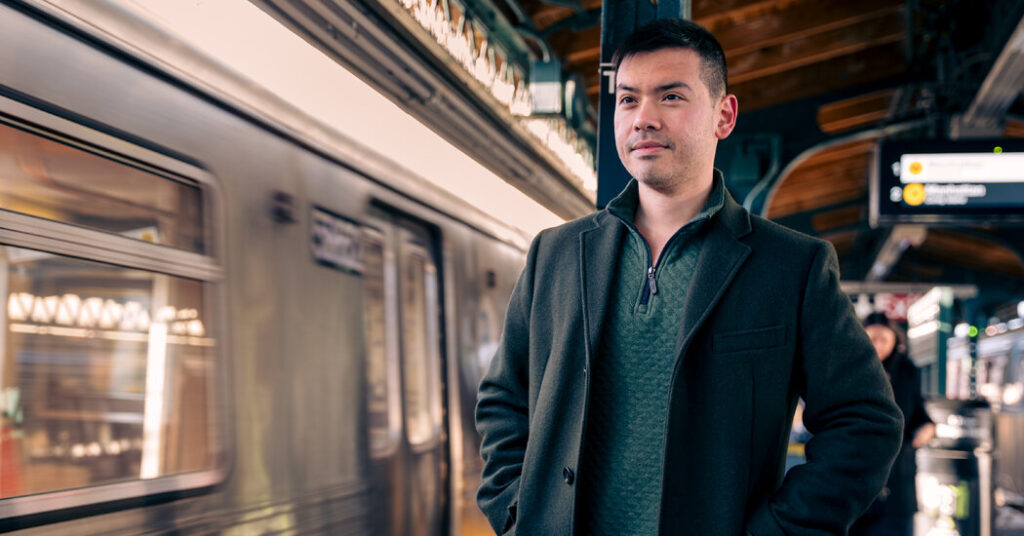
Stefanos Chen has transit in his blood: His father drove a black Lincoln Town Car for most of his life, serving as a chauffeur for Manhattan’s elite. Mr. Chen, who grew up in the Corona neighborhood in Queens, took the Q88 bus to high school. The No. 7 subway line was his gateway to the bright lights of Manhattan, an elevated ride over Queens’s various neighborhoods and cultural enclaves.
“I’ve taken every form of transit in the city at some point,” said Mr. Chen, 39, who covers New York’s mass transit system for The New York Times.
He graduated from Vassar College in Poughkeepsie, N.Y., with a bachelor’s degree in English, and went on to cover housing for five years at The Wall Street Journal. He joined the Real Estate desk at The Times in 2017 and broke the news of million-dollar floods, broken elevators and billionaire infighting at one of the city’s most exclusive supertall condo towers.
In 2023, he moved to the Metro desk to cover the economy, and then, starting last year, the city’s buses, trains and other modes of transportation. He has since written about the subway’s archaic signal system; taken a ride on the Interborough Express, which would be the biggest rail expansion in New York City since the 1930s; and gone inside the room where MetroCards were encoded.
In an interview, Mr. Chen shared lessons he learned from covering real estate for more than a decade and the story he’ll be watching in the coming year. These are edited excerpts from the conversation.
Your first beat at The Times was real estate. How did you begin covering that?
I graduated right around the same time the Great Recession hit in 2008. I landed my first reporting gig covering real estate at AOL in 2010, at a time when there were massive, unprecedented changes happening in housing. And so real estate really has been a lens for how I see journalism, because it’s how I cut my teeth in the business. Any story you put in front of somebody, there’s a potential real estate angle.
And now, coming to the transit beat, I feel the same way. A lot of interesting things happening in the city involve how people get around. For instance, I just did a story about folks who make MetroCard art.
Have you been surprised by how much people care about transit in New York?
I kind of love it. New York only works because it has infrastructure that allows people from much farther away to live in really high-density places and come to great jobs. Whether you’re a teacher or a firefighter or a banker, everyone has a commute story. It’s like, How’s the weather? And then it’s like, Man, the 6 train was awful today.
What does your commute look like now?
When I take the subway, I’m catching a train from the last stop on the N or W line — Ditmars Boulevard in Astoria — to Times Square. It takes about 40 minutes, door to door. Being in an outer borough like Queens and commuting into Manhattan, I think, is the experience of a lot of our readers. Interborough transit is the lifeline that gets us where we need to go.
About once a month, I also take the W train from one end of the line to the other — from Astoria to Whitehall Street in Lower Manhattan — to cover board meetings at the M.T.A. headquarters. It’s good for me because I get to see the full extent of a subway line.
What is one of the most important issues in transit right now?
A big conversation this year will be about whether Mayor Zohran Mamdani can make good on his campaign promise to deliver fast and free buses. The idea that he can make them faster is firmly within his transportation department’s control, because they could change the street design, though that has proven to be difficult for past mayors.
But he will likely have to negotiate with Gov. Kathy Hochul to fund free buses and must get approval from the M.T.A. to execute his plan. It would cost potentially close to a billion dollars every year, which is the expected sum of money that would have been collected in fares. And Governor Hochul’s already said she’s not going to raise taxes this year.
Time for a lightning round!
I’m ready.
Subway or bus?
Being from Queens, I’ve got to rep the buses. I took two buses every morning to get to high school.
Driverless cars, yes or no? Have you ridden in one?
No, I have not, though it’s an area that we’ll be watching closely this year.
There are a couple of cities already that have made pretty widespread use of them. I’ve heard mixed things, but we’ll see. I wonder how that system is going to work in a place where everybody jaywalks. New York is a different city when it comes to robocars.
If you could take one form of mass transit for the rest of your life, what would it be?
If the 7 train could take me everywhere I needed to go, I would always ride the 7. It feels like home. Every stop has a brand-new kind of food and culture. You can’t get that anywhere else.
Pick one: the DeLorean, the Magic School Bus, the Mystery Machine or Aladdin’s magic carpet.
All the cars are disqualified immediately, because I’m a terrible driver. So it would have to be the Magic School Bus.
Sarah Bahr writes about culture and style for The Times.
The post A Roving Reporter on the Future of Transit in New York City appeared first on New York Times.